Posted a news article I found earlier on Facebook and got quite a discussion. The gist of it is the Jordanians have threatened to kill ISIS prisoners if any harm should come to a Jordanian pilot captured alive by ISIS during the air campaign.
I posted that I supported this policy. After all, one of the reasons armies are (supposed to be) kind to enemy prisoners of war is reciprocity--they don't want any bad things happening to their own people who fall into enemy hands. ISIS, given its propensity for killing prisoners en masse (you see this mostly with Syrian Army soldiers), taking and beheading hostages, etc. clearly needs to be taught this lesson.
Some people took issue with my supporting this policy on the grounds of both morality and practicality...
The first to object was Zaid Jilani, who pointed out that the guilt or innocence of anybody tried and convicted by Jordan is questionable given the practice of judicial torture, especially in regards to terror suspects. In case you need a source other than Wikipedia, here's al-Jazeera and here's Human Rights Watch. He also said "civilized people" don't execute prisoners, which is not something I agree with but that's not relevant to the issue at hand. My friend Evan, a college professor, said if anything merited killing ISIS prisoners, it would be that they had committed capital crimes, not that ISIS had killed prisoners/hostages first.
These are some very good arguments. If the Jordanians captured a bunch of teenage conscripts forced to fight by family members held hostage (I don't know if ISIS actually does this, but knowing them I wouldn't be surprised) or people like this teen "volunteer" suicide bomber, that would be victimizing them twice. The same if the captured female suicide bomber is telling the truth about being an unwilling participant in the scheme. During WWII the Allied powers didn't retaliate for Nazi crimes by making indiscriminate massacres among POW camps, although organizations that routinely violated the rules of war could expect little mercy. All too often the argument "don't sink to their level" is basically an exercise in putting the scrupulous at a disadvantage vis-a-vis the unscrupulous (think honorable Ned Stark vs. the crafty Cersei or Littlefinger in Game of Thrones--if Ned had been more willing to be more ruthless or dishonest about his ultimate intentions he could have won even as late as the attempt to arrest Cersei in the throne room), but this is not one of those situations.
On the matter of practicality, Zaid pointed out that ISIS glorifies the deaths of its soldiers in battle, so they wouldn't be unduly upset if some of their prisoners were hanged. Furthermore, martyrs can make useful propaganda tools, so giving them more is not a good idea. And if those hanged were not guilty of major crimes, the PR problem is multiplied on top of the morality problem. To use a WWII analogy, this isn't like bombing Germany--there are many Germanies and some of them are U.S. allies (i.e. Jordan, Saudi Arabia), so PR, propaganda, etc. is much more important.
(I didn't come up with that analogy, but it's a good one.)
Furthermore, this article depicts an ISIS emir captured by the Kurds praising them for their mercy and claiming to have been deceived by ISIS "caliph" al-Baghdadi, so even a high-ranking (and presumably guilty of capital crimes given ISIS's propensity for killing prisoners, making Yezidi women into sex slaves, etc.) enemy commander could be worth more alive than dead. The captive emir, for example, could be used to make particularly effective anti-ISIS propaganda videos and encourage ISIS soldiers facing the Kurds to surrender rather than fight to the death. Showing mercy to a defeated enemy is not just an ethical issue, but can be a practical one as well.
That said, avoiding making martyrs is not the be-all, end-all. The Allied powers made millions of martyrs for fascism during WWII and yet the occupied Axis countries are not ungovernable hellholes. Furthermore, there are martyrs and there are martyrs. If the Jordanians hanged some teenage conscripts, ISIS and opponents of Jordan's government more generally could give them such hell over it that it might not be worth it. But if the Jordanians have got an ISIS technical specialist (like the chemical weapons guy just killed in an air strike) or commander, the threat of hanging them might deter ISIS from killing its remaining hostages (since these people, unlike foot soldiers, aren't a dime a dozen) and their deaths would damage ISIS's cause so much that the "martyr factor" wouldn't compensate.
Think the bombing of the Axis countries during WWII--whatever hay Goebbels (or his Italian or Japanese equivalent) might make it of, their physical ability to make war was damaged. Severing the spinal cord of a mad ax murderer might make him more angry or psychotic than usual, but if he's paralyzed he can't do anything. And as far as the "repentant ISIS fighters make good propaganda" angle is concerned, someone who is remorseful and willing to denounce his former comrades is useful--an unrepentant fanatical twit is not.
So however much hanging ISIS prisoners might appeal to one's instinct, this course of action should be trod very carefully. It would have been better if the Daily Mail article had included more detail about who these "ISIS commanders" the Jordanians have got are, so whether hanging them is moral and/or worth the trouble can be examined. However, it is not a course of action that should be closed off completely either. However vile and racist the Confederates could be in the Civil War (see the Fort Pillow Massacre or Confederate slave-raiding during the Gettysburg campaign), the threat to kill or enslave Confederate prisoners was enough to deter (most) Confederates from treating black prisoners as slave rebels.
Saturday, January 31, 2015
Thursday, January 22, 2015
Thoughts on a Black James Bond...
One interesting bit of material from the Sony hack was that Sony executives had thought about casting a black actor--particularly Idris Elba--as the new James Bond. This, as anything involving race and entertainment generally does, produced a massive controversy.
The problem with casting someone with an obviously different back-story (you know, since he's a different race) is that Bond is a specific individual, not a code name. He was briefly married in On Her Majesty's Secret Service and mourns his wife's death for multiple films, played by different actors all the while. Skyfall
 goes so far as to show the Bond ancestral home (complete with a priest-hole, indicating the family was Catholic) as well as graves of his parents, dead on the same day in the climbing accident Trevelyan alludes to in Goldeneye.
 Unless you can work in a Caribbean or African mother in there somewhere--and Bond's mother is supposed to be Swiss--having a black actor play Bond within the existing continuity does not work. Since I'm not a Bond canon expert by any means, take this fellow's word on it, not mine.
That said, there are two ways that this can work:
1. A full-blown reboot. Start over from the get-go. You can change everybody's race, gender, etc. It's a total blank slate and allows for the "modernization" of classic Bond stories unencumbered by previous canon. SMERSH, for example, could be the FSB of Putin's Russia rather than the Soviet Union's counterintelligence, while SPECTRE could be some kind of organized-crime or terrorist organization. You could also bring in the villains of the modern day like al-Qaeda, ISIS, North Korea, etc.
(Personally I'd prefer an Indian James Bond to highlight Britain's historical links to India, but there are actually more black Britons than Indian Britons. If you want to play the odds, a black Bond is more likely. In either case, as a nod to the original, he could have a Scottish ancestor as the source of his name.)
2. Introduce Idris Elba (or another black actor) as a successor to the Daniel Craig Bond. One problem with Bond films is that nobody seriously expects Bond to come to any significant harm, let alone die. Have Bond and Elba's character go on a mission together and have Bond mortally wounded. The dying Bond does a Take Up My Sword speech to Elba's character, who then for some reason or another has to be pretend to be the actual James Bond. Given how probably not all that many people know what James Bond actually looks like, this is something that might actually work for a time. At the end of the film, Elba's character for whatever reason decides to take up Bond's mantle.
You could call the movie 007 since unlike James Bond, 007 is a code name. Subsequent movies with the "black Bond" could be called 007 and then a subtitle to show that the series is now centered on the new character.
Another idea I had would be to introduce the "black Bond" as another 00 agent. There have been previous 00 agents other than Bond in the franchise, but if I recall correctly they've all been killed, turned traitor, or both. He could be a foil to Bond--faithfully married or even homosexual as opposed to a chronic womanizer, young and inexperienced as opposed to the old veteran Bond, subtle and risk-averse instead of flashy and destructive, etc. He and Bond can have an adventure together and then he can get his own spin-off series.
I thought perhaps he could be introduced in the upcoming SPECTRE film and then his own movie could be advertised as, "He fought alongside James Bond and now has his own adventure" or something to that effect.
The problem with casting someone with an obviously different back-story (you know, since he's a different race) is that Bond is a specific individual, not a code name. He was briefly married in On Her Majesty's Secret Service
and mourns his wife's death for multiple films, played by different actors all the while. Skyfallgoes so far as to show the Bond ancestral home (complete with a priest-hole, indicating the family was Catholic) as well as graves of his parents, dead on the same day in the climbing accident Trevelyan alludes to in Goldeneye.Unless you can work in a Caribbean or African mother in there somewhere--and Bond's mother is supposed to be Swiss--having a black actor play Bond within the existing continuity does not work. Since I'm not a Bond canon expert by any means, take this fellow's word on it, not mine.That said, there are two ways that this can work:
1. A full-blown reboot. Start over from the get-go. You can change everybody's race, gender, etc. It's a total blank slate and allows for the "modernization" of classic Bond stories unencumbered by previous canon. SMERSH, for example, could be the FSB of Putin's Russia rather than the Soviet Union's counterintelligence, while SPECTRE could be some kind of organized-crime or terrorist organization. You could also bring in the villains of the modern day like al-Qaeda, ISIS, North Korea, etc.
(Personally I'd prefer an Indian James Bond to highlight Britain's historical links to India, but there are actually more black Britons than Indian Britons. If you want to play the odds, a black Bond is more likely. In either case, as a nod to the original, he could have a Scottish ancestor as the source of his name.)
2. Introduce Idris Elba (or another black actor) as a successor to the Daniel Craig Bond. One problem with Bond films is that nobody seriously expects Bond to come to any significant harm, let alone die. Have Bond and Elba's character go on a mission together and have Bond mortally wounded. The dying Bond does a Take Up My Sword speech to Elba's character, who then for some reason or another has to be pretend to be the actual James Bond. Given how probably not all that many people know what James Bond actually looks like, this is something that might actually work for a time. At the end of the film, Elba's character for whatever reason decides to take up Bond's mantle.
You could call the movie 007 since unlike James Bond, 007 is a code name. Subsequent movies with the "black Bond" could be called 007 and then a subtitle to show that the series is now centered on the new character.
Another idea I had would be to introduce the "black Bond" as another 00 agent. There have been previous 00 agents other than Bond in the franchise, but if I recall correctly they've all been killed, turned traitor, or both. He could be a foil to Bond--faithfully married or even homosexual as opposed to a chronic womanizer, young and inexperienced as opposed to the old veteran Bond, subtle and risk-averse instead of flashy and destructive, etc. He and Bond can have an adventure together and then he can get his own spin-off series.
I thought perhaps he could be introduced in the upcoming SPECTRE film and then his own movie could be advertised as, "He fought alongside James Bond and now has his own adventure" or something to that effect.
Kickstarting an Audio "I am the Wendigo"?
The other day, my friend Nick suggested I use a crowd-funding mechanism like Kickstarter or Indiegogo to fund audio versions of some of my short stories. It would be (relatively) low cost and provide an additional source of funds and exposure. He also suggested I fit the stories into a singular universe, much like how the X-Files managed to fit mutants that ate people's livers, a living garbage avatar enforcing HOA rules, werewolves, a humanoid fluke creature, a shape-shifter who abused his powers for sex, and various other critters into an overarching plot involving a coming alien invasion.
This might not work for all of them, but since many of them are scattered throughout time (Nicor takes place during the Viking Age, while Melon Heads
 takes place probably around 2003-4), it's surprisingly doable. And there wouldn't even really need to be an overarching plot like the X-Files alien colonization thing--it's just that there's a lot more weird stuff going on the world than we're aware of. Stories that are part of a larger plot of their own like Illegal Alien
 would need to be left out, but it's not like I'm lacking for material.
My first thought was to do "Nicor," because it's one of my more thoughtful stories and because it has already been professionally published. However, then I did some research about recording audio fiction and came across ACX, which is basically the audio version of Amazon KDP that resulted from Amazon acquiring Audible. I created an account and did some poking around on the main page. ACX will get people in touch with voice-actors, after which one can negotiate a fee-for-service arrangement or royalty split. For the latter, having the sales to attract voice-actors is especially important.
That forced a revision of the plan, as "Nicor" has been a poor seller (probably due to still being available on the Heroic Fantasy Quarterly website and being part of Flashing Steel, Flashing Fire collection). Furthermore, creating an audio version would require either a large cast to play multiple roles or a smaller number of people doing many different voices.

However, I am the Wendigo is my single best seller and requires only one voice actor, to play the wendigo itself. Hell, I could narrate it myself rather than hiring a professional voice actor. I could set a "stretch goal" to include a longer project like "Melon Heads" or The Beast of the Bosporus.
Possible incentives to give to people include a PDF of FSFF, print copies of FSFF, signed and personalized copies of FSFF, prints of the cover art, signed prints of the cover art, getting listed as a producer in the credits, etc.
So, my loyal readers, do you think crowdfunding an audio production of "I am the Wendigo" is a good idea? If it is, you'll probably see me digitally panhandling pretty soon...
managed to fit mutants that ate people's livers, a living garbage avatar enforcing HOA rules, werewolves, a humanoid fluke creature, a shape-shifter who abused his powers for sex, and various other critters into an overarching plot involving a coming alien invasion.This might not work for all of them, but since many of them are scattered throughout time (Nicor
takes place during the Viking Age, while Melon Headstakes place probably around 2003-4), it's surprisingly doable. And there wouldn't even really need to be an overarching plot like the X-Files alien colonization thing--it's just that there's a lot more weird stuff going on the world than we're aware of. Stories that are part of a larger plot of their own like Illegal Alien would need to be left out, but it's not like I'm lacking for material.My first thought was to do "Nicor," because it's one of my more thoughtful stories and because it has already been professionally published. However, then I did some research about recording audio fiction and came across ACX, which is basically the audio version of Amazon KDP that resulted from Amazon acquiring Audible. I created an account and did some poking around on the main page. ACX will get people in touch with voice-actors, after which one can negotiate a fee-for-service arrangement or royalty split. For the latter, having the sales to attract voice-actors is especially important.
That forced a revision of the plan, as "Nicor" has been a poor seller (probably due to still being available on the Heroic Fantasy Quarterly website and being part of Flashing Steel, Flashing Fire
collection). Furthermore, creating an audio version would require either a large cast to play multiple roles or a smaller number of people doing many different voices.However, I am the Wendigo
is my single best seller and requires only one voice actor, to play the wendigo itself. Hell, I could narrate it myself rather than hiring a professional voice actor. I could set a "stretch goal" to include a longer project like "Melon Heads" or The Beast of the Bosporus.Possible incentives to give to people include a PDF of FSFF, print copies of FSFF, signed and personalized copies of FSFF, prints of the cover art, signed prints of the cover art, getting listed as a producer in the credits, etc.
So, my loyal readers, do you think crowdfunding an audio production of "I am the Wendigo" is a good idea? If it is, you'll probably see me digitally panhandling pretty soon...
Tuesday, January 13, 2015
If You Like What You're Getting, Buy Amazon Products Through Me
The World According to Quinn has been active since early 2010. So far I have blogged on many topics including science, politics, books, movies, and my personal writing ambitions. I have gotten more than 150,000 hits and hosted guest blog posts by interesting people like James R. Tuck, Delilah S. Dawson, Christopher Nuttall, and Sean C.W. Korsgaard. Thank you all for your patronage over the years.
However, so far I haven't made any money on the blog. On paper I've made some money via Google AdSense, but I won't get paid until I hit $100 and at the current rate, it will be years before that happens. I'm not asking you to go clicking on ads if you're not interested in at least finding out more about the product that appears--that's called click fraud and that's a crime.
However, I am suggesting you take a look at my Amazon links. If you see any links to books, movies, etc. on my blog and there's an odd space after the end of each link, those links will take you to the product's Amazon page that has my Amazon Associates' ID in the URL. If you buy the product, I'll get a percentage. Not only that--and this is the important part--if you go from that page to other Amazon products and buy those, I'll still get paid a commission. Apparently I've sold three Finish Powerball Tabs Dishwasher Detergent Tablets, Fresh Scent, 60 Count and one third party copy of Adrift on the Sea of Rains
 despite never actually linking to either them in addition to the one copy of Lines of Departure
 that I definitely did. I won't actually get paid for those until I clear a $10 threshold, but clearing that is much easier than clearing $100 one.
Thanks to this awesome YouTube video, I've learned how to install Amazon-generated widgets on Blogger. I've installed a link to my short story collection Flashing Steel Flashing Fire as well as a carousel of products you can see on the upper right. I'll regularly swap out that one with carousels of other products, depending on what's hot right now and what I'm reading or watching. Since I've gotten plenty of clicks and some sales over the years due to links-in-text and a new Chrome gadget that makes creating these links easier, those aren't not going anywhere.
and one third party copy of Adrift on the Sea of Rains despite never actually linking to either them in addition to the one copy of Lines of Departure that I definitely did. I won't actually get paid for those until I clear a $10 threshold, but clearing that is much easier than clearing $100 one.Thanks to this awesome YouTube video, I've learned how to install Amazon-generated widgets on Blogger. I've installed a link to my short story collection Flashing Steel Flashing Fire
as well as a carousel of products you can see on the upper right. I'll regularly swap out that one with carousels of other products, depending on what's hot right now and what I'm reading or watching. Since I've gotten plenty of clicks and some sales over the years due to links-in-text and a new Chrome gadget that makes creating these links easier, those aren't not going anywhere.
Thank you for your help and readership over the years.
Friday, January 9, 2015
December 2014 Writing Contest: The Results
The revival of my earlier writing bets with a couple friends is now in its second month, so it's time to update you on how the first month went.
In the first month, I wrote 3,838 words of fiction. This doesn't compare well with a previous December in which I wrote just under 12,000 words, but I can plead extenuating circumstances. I was editing a novel for a client, which will be available on Amazon sometime soon. Between that and the end of an editorial internship I had with a magazine company, I had significantly less writing time than in 2013, but I made more money. :)
Here is what I did accomplish:
*Although I only finished bulking up The Thing in the Woods in preparation for the Amazon Breakthrough Novel Award this morning, I got much of the work done over December. One of the better critiques I'd received from my writing group is that a character introduced at the end of the novel in the first draft should have been introduced earlier. The technical term for this is a Chekhov's Gun--if you see a gun in the first act, it had better be fired in the third, or don't include it. In this case, it was the reverse. I plugged the scene introducing him (part of which I wrote in November and part in December) around two-thirds into the book and had his earlier appearance play a role in driving events toward their climax. He's going to play a much bigger role in the sequel, The Atlanta Incursion, so this will help set him up for that.
*I finished and then after writing-group critique heavily revised a chapter in my new novel project. I'm keeping this one more quiet until it's finished so I won't go into a lot of detail but now I've got four complete chapters. I've plotted out a fair bit more and this project plays to my strengths (imaginative situations, world-building) rather than my weaknesses (characterization), so I have high hopes for it.
*Little People, Big Guns got the short end of the stick, I'm afraid. Just under 200 words written. This is something I thought I'd be able to finish quickly. I start class again Monday, but maybe I'll be able to do more this month.
*Added a link to the sequel Needs Must to the "back matter" of Übermensch,
 my supervillain-protagonist short story. For independently-published authors, "back matter" is something quite useful to have. That's your chance to link people to related projects, encourage them to leave reviews, etc. Hopefully this will lead to more sales for "Needs Must," especially during periods where I give "Ubermensch" away for free.
*I finished and then after writing-group critique heavily revised a chapter in my new novel project. I'm keeping this one more quiet until it's finished so I won't go into a lot of detail but now I've got four complete chapters. I've plotted out a fair bit more and this project plays to my strengths (imaginative situations, world-building) rather than my weaknesses (characterization), so I have high hopes for it.
*Little People, Big Guns got the short end of the stick, I'm afraid. Just under 200 words written. This is something I thought I'd be able to finish quickly. I start class again Monday, but maybe I'll be able to do more this month.
*Added a link to the sequel Needs Must
to the "back matter" of Übermensch, my supervillain-protagonist short story. For independently-published authors, "back matter" is something quite useful to have. That's your chance to link people to related projects, encourage them to leave reviews, etc. Hopefully this will lead to more sales for "Needs Must," especially during periods where I give "Ubermensch" away for free.Tuesday, January 6, 2015
Another Song of Ice and Fire Alternate History: The King Nobody Wanted
The denizens of the alternate-history forum I have been a member of since high school include a fair number of fans of A Song of Ice and Fire in their number. And a world with as rich a history as Martin's has a lot of possible roads not taken, so it's no surprise that a lot of ASOIAF alternate timelines have been written and many of them have escaped from the members-only Alien Space Bat forum to places like fanfiction.net, which anybody can read.
Here's the newest one, "The King Nobody Wanted." It starts out with Robert dying of his wounds on the Trident soon after he kills Crown Prince Rhaegar Targaryen. Now the cause of House Baratheon and the rebellion against the mad King Aerys are in the hands of Robert's unappreciated little brother Stannis, currently trapped in Storm's End.
Interesting tidbits in the story include:
*Robert's Rebellion lasts longer due to the machinations of, among others, the Queen of Thorns. Randyll Tarly shows what he can do when he doesn't have the credit-stealing incompetent Mace Tyrell to deal with. It's still going on as of the last update.
*Lyanna Stark survives the fever that killed her in the "bed of blood" in canon and so Jon Snow has a mother. A mother who named him Rhaegar after his father...
*Point-of-view chapters from the perspective of Jon Arryn and Balon Greyjoy, as well as lesser-known characters like Garth Tyrell and Tytos Clegane (Gregor and Sandor's father--since this was written before A World of Ice and Fire, I'm not sure if that's his canon name) along with favorites like Ned Stark. We even get a sympathetic POV from the young Janos Slynt, who hasn't turned into the vile scumbag he was in canon.
*This hasn't been posted on fanfiction.net as of today, but Cersei Lannister's wedding night is a heck of a lot more pleasant for everybody involved. Cersei is a nasty piece of work, but given how much of a lout Robert is, I don't blame her for hating him.
*A surprisingly endearing portrait of the young Viserys Targaryen, before years in exile and poverty warp his already fragile (he is a Targaryen, after all) psyche.
So sit back and enjoy another "what might have been" in one of the bloodiest deconstructions of epic fantasy ever written...
Here's the newest one, "The King Nobody Wanted." It starts out with Robert dying of his wounds on the Trident soon after he kills Crown Prince Rhaegar Targaryen. Now the cause of House Baratheon and the rebellion against the mad King Aerys are in the hands of Robert's unappreciated little brother Stannis, currently trapped in Storm's End.
Interesting tidbits in the story include:
*Robert's Rebellion lasts longer due to the machinations of, among others, the Queen of Thorns. Randyll Tarly shows what he can do when he doesn't have the credit-stealing incompetent Mace Tyrell to deal with. It's still going on as of the last update.
*Lyanna Stark survives the fever that killed her in the "bed of blood" in canon and so Jon Snow has a mother. A mother who named him Rhaegar after his father...
*Point-of-view chapters from the perspective of Jon Arryn and Balon Greyjoy, as well as lesser-known characters like Garth Tyrell and Tytos Clegane (Gregor and Sandor's father--since this was written before A World of Ice and Fire, I'm not sure if that's his canon name) along with favorites like Ned Stark. We even get a sympathetic POV from the young Janos Slynt, who hasn't turned into the vile scumbag he was in canon.
*This hasn't been posted on fanfiction.net as of today, but Cersei Lannister's wedding night is a heck of a lot more pleasant for everybody involved. Cersei is a nasty piece of work, but given how much of a lout Robert is, I don't blame her for hating him.
*A surprisingly endearing portrait of the young Viserys Targaryen, before years in exile and poverty warp his already fragile (he is a Targaryen, after all) psyche.
So sit back and enjoy another "what might have been" in one of the bloodiest deconstructions of epic fantasy ever written...
Thursday, January 1, 2015
Review of My 2014 Kindle Sales
Looking back on my Kindle short-story project, here are the lessons I've learned in 2014. Hearken to my words, aspiring e-book authors, and let's see what you can gain my from my experiences...
*For starters, short-story collections sell better than individual short stories. I've sold nearly 30 copies of my collection Flashing Steel, Flashing Fire, which debuted in June. In contrast, my most successful short story has been I am the Wendigo, which had 14 sales or borrows this past year. My supervillain-protagonist tale Übermensch had 12 sales or borrows, while The Beast of the Bosporushad 11. This is something "the rock star of the small press" William Meikle has experienced as well--he's consolidated his short stories into multiple collections like Flower of Scotland,
 which I own, rather than selling them individually.
*Needs Must, the sequel to "Ubermensch," wasn't a strong seller (six buys or borrows), but it exceeded Illegal Alien and equaled Melon Heads. I'd posted before about how I worried that my Patel stories weren't selling well, so this is a pleasant surprise. I've got a partial for a third Andrew Patel story written, so maybe it'll see the light of day.
*If your product is cheap enough, you'll actually get more royalties per borrow than per buy. My royalty for a borrowed short story is nearly six times per that of a purchased short story. However, if your royalties are relatively high (say 70% of a $10 book, like FSFF), then a borrow rather than a buy is a significant step down. This might explain why so many authors more successful than I have been complaining about Kindle Unlimited I didn't put FSFF in KU because Nicor, one of the stories in the collection, is available elsewhere online. Unless the borrow rate goes up significantly (which Chuck Wendig has suggested in his recent blog post), it's going to stay where it is.
*I have made zero sales with "Nicor," possibly due to it being available online elsewhere for free. I was gambling on the cover art and the portability of a downloaded e-book vs. a website (you'll be able to read it whether you have an Internet connection or not) as something one couldn't get just by swinging by a website, but it looks like that gamble didn't pay off. Still, I'm not taking "Nicor" down anytime soon. Things might change.
*If you really want to make money, do what my friend Jeff Baker suggested and generate sales through volume. Most of my income lately has been coming from setting a story or two free for a couple days, which encourages the occasional buy or borrow. This risks becoming a source of diminishing returns if I don't keep supplying new material. However, posting FSFF on Amazon spiked my revenues for months. "Nicor" fizzled, but there are extenuating circumstances. I've got a kind of bizarro story I'm working on now called "Little People, Big Guns" that might be my first independently-published novella (I don't anticipate it being very long), since it's more goofy and comedic rather than the thoroughly-twisted stuff a lot of the bizarro markets seem to want.
(That said, maybe I should consider Eraserhead Press first--their novels Shatnerquest and Shatnerquake
 seem goofy rather than grotesque stuff like The Bighead.
 "Little People" might be too short for their purposes, but I haven't written too much of it yet.)
*For starters, short-story collections sell better than individual short stories. I've sold nearly 30 copies of my collection Flashing Steel, Flashing Fire,
which debuted in June. In contrast, my most successful short story has been I am the Wendigo, which had 14 sales or borrows this past year. My supervillain-protagonist tale Übermensch had 12 sales or borrows, while The Beast of the Bosporushad 11. This is something "the rock star of the small press" William Meikle has experienced as well--he's consolidated his short stories into multiple collections like Flower of Scotland, which I own, rather than selling them individually.*Needs Must,
the sequel to "Ubermensch," wasn't a strong seller (six buys or borrows), but it exceeded Illegal Alien and equaled Melon Heads. I'd posted before about how I worried that my Patel stories weren't selling well, so this is a pleasant surprise. I've got a partial for a third Andrew Patel story written, so maybe it'll see the light of day.*If your product is cheap enough, you'll actually get more royalties per borrow than per buy. My royalty for a borrowed short story is nearly six times per that of a purchased short story. However, if your royalties are relatively high (say 70% of a $10 book, like FSFF), then a borrow rather than a buy is a significant step down. This might explain why so many authors more successful than I have been complaining about Kindle Unlimited I didn't put FSFF in KU because Nicor,
one of the stories in the collection, is available elsewhere online. Unless the borrow rate goes up significantly (which Chuck Wendig has suggested in his recent blog post), it's going to stay where it is.*I have made zero sales with "Nicor," possibly due to it being available online elsewhere for free. I was gambling on the cover art and the portability of a downloaded e-book vs. a website (you'll be able to read it whether you have an Internet connection or not) as something one couldn't get just by swinging by a website, but it looks like that gamble didn't pay off. Still, I'm not taking "Nicor" down anytime soon. Things might change.
*If you really want to make money, do what my friend Jeff Baker suggested and generate sales through volume. Most of my income lately has been coming from setting a story or two free for a couple days, which encourages the occasional buy or borrow. This risks becoming a source of diminishing returns if I don't keep supplying new material. However, posting FSFF on Amazon spiked my revenues for months. "Nicor" fizzled, but there are extenuating circumstances. I've got a kind of bizarro story I'm working on now called "Little People, Big Guns" that might be my first independently-published novella (I don't anticipate it being very long), since it's more goofy and comedic rather than the thoroughly-twisted stuff a lot of the bizarro markets seem to want.
(That said, maybe I should consider Eraserhead Press first--their novels Shatnerquest
and Shatnerquake seem goofy rather than grotesque stuff like The Bighead. "Little People" might be too short for their purposes, but I haven't written too much of it yet.)
Tuesday, December 30, 2014
Book Review: Crooked Little Vein (2007)
This month I decided to step out of the sort of fiction I usually read and checked out Warren Ellis's 2007 novel Crooked Little Vein: A Novel. It was a pretty quick read, so here's a book review for you:

The Plot
Down-on-his luck private detective Michael McGill is hired by the rather conservative White House Chief of Staff to find a supposed backup copy of the U.S. Constitution that the man is convinced will restore the United States to a much more moral, pristine state. Between coercion from Secret Service and the prospect of an unlimited expense account, Michael sets off on an adventure through the sleazy underbelly of the United States.
The Good
*The book is quite amusing. I particularly enjoyed it when Michael and his love interest Trix visit Texas and a ranch belonging to a powerful conservative political family who are not the Bushes (look at my eye it's winking see). There's political satire, there's over-the-top sexual or vulgar humor, and there's this delightfully insane combination of both.
*In general, the voice Ellis uses for Michael is really smart-alecky and really funny. He's a fun character to follow on his epic journey through some of the weirdest places in the United States imaginable.
*The book isn't very long and moves along nicely, so it's a quick, fun read.
The Bad
*I found the extremely lowbrow Refuge in Audacity type humor to be pretty funny, but not everybody will.
*Its shortness can work against it. It's not a slog, but there could be more room for further insane adventures.
The Verdict
It's a quick, amusing read that I recommend getting from the library because reading it once is fine. 8.5 out of 10.
It was a pretty quick read, so here's a book review for you:The Plot
Down-on-his luck private detective Michael McGill is hired by the rather conservative White House Chief of Staff to find a supposed backup copy of the U.S. Constitution that the man is convinced will restore the United States to a much more moral, pristine state. Between coercion from Secret Service and the prospect of an unlimited expense account, Michael sets off on an adventure through the sleazy underbelly of the United States.
The Good
*The book is quite amusing. I particularly enjoyed it when Michael and his love interest Trix visit Texas and a ranch belonging to a powerful conservative political family who are not the Bushes (look at my eye it's winking see). There's political satire, there's over-the-top sexual or vulgar humor, and there's this delightfully insane combination of both.
*In general, the voice Ellis uses for Michael is really smart-alecky and really funny. He's a fun character to follow on his epic journey through some of the weirdest places in the United States imaginable.
*The book isn't very long and moves along nicely, so it's a quick, fun read.
The Bad
*I found the extremely lowbrow Refuge in Audacity type humor to be pretty funny, but not everybody will.
*Its shortness can work against it. It's not a slog, but there could be more room for further insane adventures.
The Verdict
It's a quick, amusing read that I recommend getting from the library because reading it once is fine. 8.5 out of 10.
Monday, December 29, 2014
Book Review: The Flock (2006)
A few months ago I came across James Robert Smith's novel 2006 novel The Flock and the rather strange story about just how the movie rights got optioned. Sufficient to say, this seems to be the one time that arguing on the Internet has actually produced financial benefits.

The Plot
In Florida, in the last major region of long-leaf pine savanna in the United States, a former Air Force training ground holds an unusual secret--a surviving population of Titanis walleri (imagine the most jacked-up ostriches that ever lived, with two-foot razor beaks that in their time hunted horses) that have escaped the scrutiny of men. The birds have escaped detection by becoming nocturnal, avoiding hunting humans, and dwelling in an area that humans have long been excluded from--but now the 400,000-odd acres that once made up a bombing range are being disputed by the Disney-esque Berg Brothers, a cantankerous militiaman, and a wealthy environmentalist who knows more than he lets on.
Into this mess stumbles a young investigator from the Fish and Wildlife Department looking into some mysterious attacks on animals near the Berg Brothers' model community that bears a strong resemblance to Celebration, Florida. The game is afoot, and somebody's going to end up lunch...
The Good
*I buy a fair number of fiction books to read while I'm on the elliptical at the gym, since although the elliptical burns a vast number of calories in a relatively short amount of time, it's extremely tedious. I finished the book in two 1.5-hour sessions that went by in a breeze. The book is fast-moving and never, ever boring. Its excellent entertainment value alone makes it worth buying, but there's more...
*I have never heard of a horror novel or film featuring terror-birds before, so points for a creative concept. And Smith's characterization is so good that he makes the two terror-birds who have point-of-view chapters--the rogue male Scarlet who wants to establish a flock of his own and Walks-Behind, whose job is to destroy evidence of the flock's presence, interesting characters in their own right. And with two mutually-contradictory goals in mind, this is going to get nasty.
*And although it'd be very easy to make this just some "rampaging monsters" novel, the primary baddies in the story are actually humans. This is something I can agree with on a philosophical level--a predatory animal is acting according to its nature and although they might need to be killed to protect humans, pets, or livestock, it's not like they're evil per se. Humans, however, can sin, and there's plenty of choose from in this one--murder in the name of greed, racism, etc. No wonder Smith invented an entire fictional entertainment conglomerate instead of setting it at Celebration.
*One of the human factions has a mole within one of the others, but Smith lets the reader think it's someone else, then someone else, etc. until they're finally revealed. Very well-done, and surprising.
*There are some amusing bits, like comparing two terror-birds dueling to the world's biggest cock-fight and an ending joke based on an ability the birds display in the climax of the novel.
The Bad
No book is perfect, so here're my critiques:
*The prologue strongly implies that the Scarlet was a chick in 1946 when a group of soldiers stumble on something they shouldn't. That would make Scarlet at least 60 years old if the book takes place in 2006-ish, with Walks-Behind and his parents even older than that. I'm not aware of any wild animal that naturally lives that long other than the Galapagos tortoise and maybe some whales. Scarlet also comes off a bit like a human adolescent wanting to break away from his family and establish his own. Were it me writing this, I would have set the prologue in the 1980s or 1990s so Scarlet (and by extension, his elders in the flock) are much younger.
*In the climax of the novel, the terror-birds display some interesting abilities on top of their near-human-level intelligence and their extreme physical prowess. Not going to go into detail for reasons of spoilers. Although their being able to do one of these things does make sense in the context of earlier events in the story, giving them these abilities on top of everything else is taking things too far. Even if it does provide for a funny bit of humor at the end.
*In a scene where some hired goons try to shake down a character and are foiled, the characters don't immediately call the police. That could have unraveled the villains' plans right there--or forced them to act prematurely. The latter course is something Smith could have adopted without changing the plot much if at all.
*The flock has adopted its lifestyle because they know they cannot stand before humans with guns, but one would think if European colonists or Native Americans killed most of them off, there'd have been some record of their existence. If I took down one of those critters, I'd have it stuffed and mounted and displayed with pride. This is a pretty minor thing that could be explained away by invoking them as some kind of local legend that the characters write off...until they can't anymore.
The Verdict
A wonderful book. 9.0 out of 10.0. I'm looking forward to the sequel The Clan that's apparently in limbo, as well as the movie that seems to be in similar straits. Maybe if some of y'all bought the book and reviewed it on Amazon?
and the rather strange story about just how the movie rights got optioned. Sufficient to say, this seems to be the one time that arguing on the Internet has actually produced financial benefits.The Plot
In Florida, in the last major region of long-leaf pine savanna in the United States, a former Air Force training ground holds an unusual secret--a surviving population of Titanis walleri (imagine the most jacked-up ostriches that ever lived, with two-foot razor beaks that in their time hunted horses) that have escaped the scrutiny of men. The birds have escaped detection by becoming nocturnal, avoiding hunting humans, and dwelling in an area that humans have long been excluded from--but now the 400,000-odd acres that once made up a bombing range are being disputed by the Disney-esque Berg Brothers, a cantankerous militiaman, and a wealthy environmentalist who knows more than he lets on.
Into this mess stumbles a young investigator from the Fish and Wildlife Department looking into some mysterious attacks on animals near the Berg Brothers' model community that bears a strong resemblance to Celebration, Florida. The game is afoot, and somebody's going to end up lunch...
The Good
*I buy a fair number of fiction books to read while I'm on the elliptical at the gym, since although the elliptical burns a vast number of calories in a relatively short amount of time, it's extremely tedious. I finished the book in two 1.5-hour sessions that went by in a breeze. The book is fast-moving and never, ever boring. Its excellent entertainment value alone makes it worth buying, but there's more...
*I have never heard of a horror novel or film featuring terror-birds before, so points for a creative concept. And Smith's characterization is so good that he makes the two terror-birds who have point-of-view chapters--the rogue male Scarlet who wants to establish a flock of his own and Walks-Behind, whose job is to destroy evidence of the flock's presence, interesting characters in their own right. And with two mutually-contradictory goals in mind, this is going to get nasty.
*And although it'd be very easy to make this just some "rampaging monsters" novel, the primary baddies in the story are actually humans. This is something I can agree with on a philosophical level--a predatory animal is acting according to its nature and although they might need to be killed to protect humans, pets, or livestock, it's not like they're evil per se. Humans, however, can sin, and there's plenty of choose from in this one--murder in the name of greed, racism, etc. No wonder Smith invented an entire fictional entertainment conglomerate instead of setting it at Celebration.
*One of the human factions has a mole within one of the others, but Smith lets the reader think it's someone else, then someone else, etc. until they're finally revealed. Very well-done, and surprising.
*There are some amusing bits, like comparing two terror-birds dueling to the world's biggest cock-fight and an ending joke based on an ability the birds display in the climax of the novel.
The Bad
No book is perfect, so here're my critiques:
*The prologue strongly implies that the Scarlet was a chick in 1946 when a group of soldiers stumble on something they shouldn't. That would make Scarlet at least 60 years old if the book takes place in 2006-ish, with Walks-Behind and his parents even older than that. I'm not aware of any wild animal that naturally lives that long other than the Galapagos tortoise and maybe some whales. Scarlet also comes off a bit like a human adolescent wanting to break away from his family and establish his own. Were it me writing this, I would have set the prologue in the 1980s or 1990s so Scarlet (and by extension, his elders in the flock) are much younger.
*In the climax of the novel, the terror-birds display some interesting abilities on top of their near-human-level intelligence and their extreme physical prowess. Not going to go into detail for reasons of spoilers. Although their being able to do one of these things does make sense in the context of earlier events in the story, giving them these abilities on top of everything else is taking things too far. Even if it does provide for a funny bit of humor at the end.
*In a scene where some hired goons try to shake down a character and are foiled, the characters don't immediately call the police. That could have unraveled the villains' plans right there--or forced them to act prematurely. The latter course is something Smith could have adopted without changing the plot much if at all.
*The flock has adopted its lifestyle because they know they cannot stand before humans with guns, but one would think if European colonists or Native Americans killed most of them off, there'd have been some record of their existence. If I took down one of those critters, I'd have it stuffed and mounted and displayed with pride. This is a pretty minor thing that could be explained away by invoking them as some kind of local legend that the characters write off...until they can't anymore.
The Verdict
A wonderful book. 9.0 out of 10.0. I'm looking forward to the sequel The Clan that's apparently in limbo, as well as the movie that seems to be in similar straits. Maybe if some of y'all bought the book and reviewed it on Amazon?
Friday, December 26, 2014
On Sony, THE INTERVIEW, and Free Speech
I got into an interesting Facebook discussion with my friend Zaid Jilani after I posted this article about how both Republicans and Democrats are standing together against attempts by North Korea (or groups putting on a very good show of acting on behalf of the regime) to stop The Interview as a piece of uplifting news.
To make a long story short, Zaid said that this wasn't a free-speech issue, but Sony covering up for the incompetence of its IT department (Sony has been hacked before, on top of this recent bit of idiocy) by using the hack as part of a publicity campaign for The Interview, a movie that it feared would not do well. He did not see why he ought to give money to a company that repeatedly puts its customers at risk by failing to secure its electronics. To make a long story short, he said that Sony has been playing everybody rushing to its defense in the name of "free speech."
To be fair, he's raised some good points. If he doesn't want to see The Interview because that would be rewarding incompetence, so be it. And I could easily imagine any executive with any degree of intelligence following the dictum of never letting a good crisis go to waste. No less an authority than Forbes magazine agrees.
However, I disagree that it's not a free-speech issue:
*Most of the major American movie chains refused to screen the movie out of fear of extralegal violence, be it a threat of 9/11-esque violence (which might inspired some homegrown moron to attack a theater--I doubt there are North Korean commandos running around) or the more probable danger of hacking. The Sony hack crippled its electronic infrastructure--hacking isn't just a matter of embarrassment (racist Sony e-mails, nude pictures) but a real threat to one's business.
*For a time it seemed like Sony was going to bury the movie completely--they initially said there were "no plans" to release it on Video On Demand or DVD. Had that happened, the North Koreans would have straight-up silenced a critic well outside of their territory. It'd be like agents of the Nazi regime coming into the U.S. and waging a terror campaign to get United Artists to shelve The Great Dictator.
*An adaptation of the graphic novel Pyongyang: A Journey in North Korea that might feature Steve Carrell had the plug pulled on it in the middle of development.
*When a Texas theater chain decided to air Team America World Police in place of The Interview to show it would not be intimidated by North Korean threats, Paramount Pictures prevented them from screening the movie.
*The Associated Press theorized that the attack on Sony would deter Hollywood from making films featuring overseas villains.
These electronic attacks and threats of physical violence have unleashed a massive "chilling effect." People are being intimidated from speaking their minds, producing art, etc. by either a foreign regime, a private entity (a hacker gang trying to sound scarier than it really is), or a combination of the two (a hacker gang working for North Korea). Chuck Wendig explains it very well.
Zaid repeatedly referred to The Interview as a crappy movie. That's purely a subjective matter--I've loved movies like Skyline that had horrible RottenTomatoes ratings and disliked movies like Get Him to the Greek
 that had much better ratings. RT currently gives The Interview a 48% and a kind of middling critical consensus. I could easily imagine the movie being crap--I didn't really enjoy Wedding Crashers
 and I disliked Get Him To The Greek so much I turned off the movie 15 minutes in and returned it.
However, just because a movie is crap doesn't mean it isn't worth defending. I read parts of The Satanic Verses and didn't really understand or enjoy it, but that doesn't mean Salman Rushdie should have been left to the tender mercies of the Ayatollah Khomeini and goons inspired by him.
Furthermore, free speech is something that should be extended as broadly as possible to the most unpopular people to make sure everybody is protected.
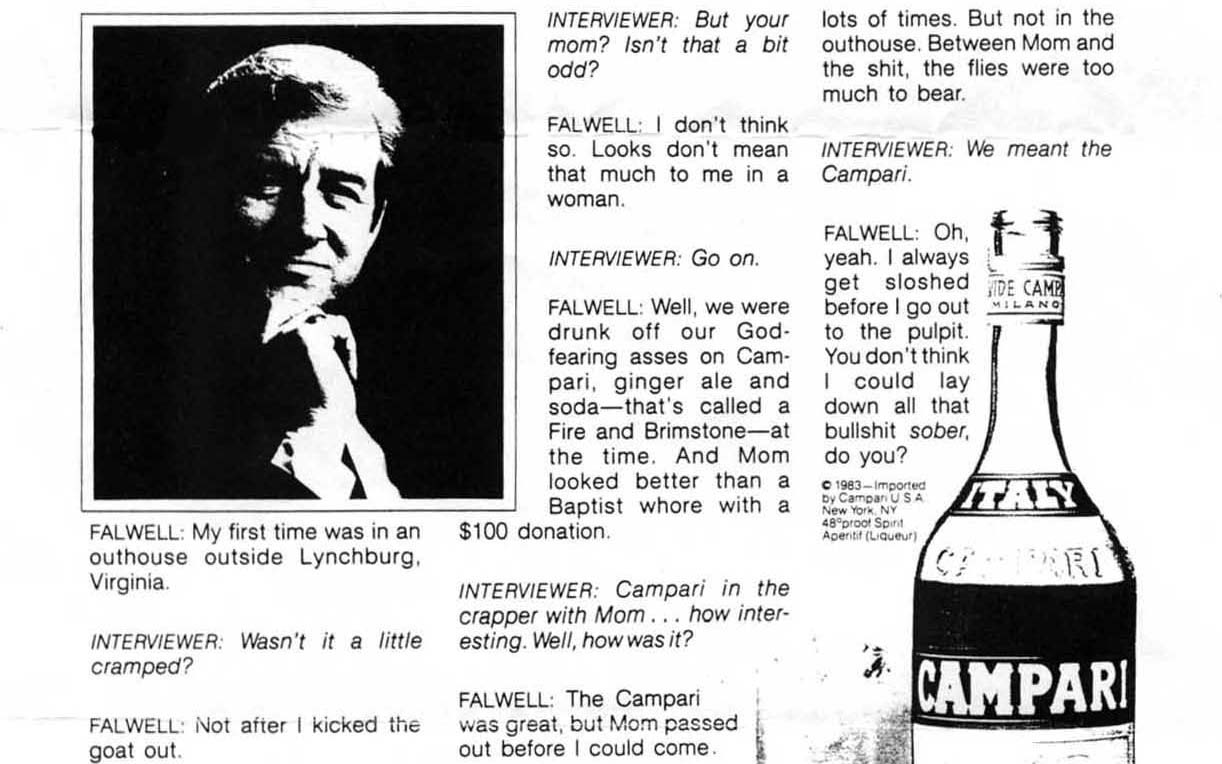
For example, Hustler magazine is incredibly tasteless, vile, and sexist. It ran an ad depicting Jerry Falwell confessing to incest with his mother, it mocks female politicians by depicting them in sexual situations, one magazine cover featured a woman in a meat grinder, and apparently it had some kind of spread depicting a pornographic version of a concentration camp. Even if you don't have a moral objection to pornography, Hustler is garbage.
However, so long as Hustler's right to free speech, however vile, is protected, more prosaic incidents of artistic nudity (and I mean legitimate art) are in significantly less danger from Moral Guardians on the right (artistic nudity is sinful and immodest, and according to the Calvinists undermines the gospel) or on the left (artistic nudity is exploitation of women). And if history is anything to go by, these groups will impose censorship if they could. This applies to both social conservatives and social liberals.
The same goes for "hate speech." As long as the speech of definitely hateful people like the Ku Klux Klan, neo-Nazis, etc. is protected, you won't have the kind of censorship of far more innocent things that "hate speech" laws in France, India, Poland, Britain, etc. have led to.
To quote A Man for All Seasons, I'd give the Devil the benefit of the law for my own safety's sake.
So I will be seeing The Interview as a matter of principle. If the movie sucks, so be it. If I'm giving money to a company that's too inept to protect its employees and customers, so be it. This is about taking a stand against appeasement and threats of violence, in defense of artistic freedom against crude coercion.
To make a long story short, Zaid said that this wasn't a free-speech issue, but Sony covering up for the incompetence of its IT department (Sony has been hacked before, on top of this recent bit of idiocy) by using the hack as part of a publicity campaign for The Interview, a movie that it feared would not do well. He did not see why he ought to give money to a company that repeatedly puts its customers at risk by failing to secure its electronics. To make a long story short, he said that Sony has been playing everybody rushing to its defense in the name of "free speech."
To be fair, he's raised some good points. If he doesn't want to see The Interview because that would be rewarding incompetence, so be it. And I could easily imagine any executive with any degree of intelligence following the dictum of never letting a good crisis go to waste. No less an authority than Forbes magazine agrees.
However, I disagree that it's not a free-speech issue:
*Most of the major American movie chains refused to screen the movie out of fear of extralegal violence, be it a threat of 9/11-esque violence (which might inspired some homegrown moron to attack a theater--I doubt there are North Korean commandos running around) or the more probable danger of hacking. The Sony hack crippled its electronic infrastructure--hacking isn't just a matter of embarrassment (racist Sony e-mails, nude pictures) but a real threat to one's business.
*For a time it seemed like Sony was going to bury the movie completely--they initially said there were "no plans" to release it on Video On Demand or DVD. Had that happened, the North Koreans would have straight-up silenced a critic well outside of their territory. It'd be like agents of the Nazi regime coming into the U.S. and waging a terror campaign to get United Artists to shelve The Great Dictator.
*An adaptation of the graphic novel Pyongyang: A Journey in North Korea
that might feature Steve Carrell had the plug pulled on it in the middle of development.*When a Texas theater chain decided to air Team America World Police
in place of The Interview to show it would not be intimidated by North Korean threats, Paramount Pictures prevented them from screening the movie.*The Associated Press theorized that the attack on Sony would deter Hollywood from making films featuring overseas villains.
These electronic attacks and threats of physical violence have unleashed a massive "chilling effect." People are being intimidated from speaking their minds, producing art, etc. by either a foreign regime, a private entity (a hacker gang trying to sound scarier than it really is), or a combination of the two (a hacker gang working for North Korea). Chuck Wendig explains it very well.
Zaid repeatedly referred to The Interview as a crappy movie. That's purely a subjective matter--I've loved movies like Skyline
that had horrible RottenTomatoes ratings and disliked movies like Get Him to the Greek that had much better ratings. RT currently gives The Interview a 48% and a kind of middling critical consensus. I could easily imagine the movie being crap--I didn't really enjoy Wedding Crashers and I disliked Get Him To The Greek so much I turned off the movie 15 minutes in and returned it.However, just because a movie is crap doesn't mean it isn't worth defending. I read parts of The Satanic Verses
and didn't really understand or enjoy it, but that doesn't mean Salman Rushdie should have been left to the tender mercies of the Ayatollah Khomeini and goons inspired by him.Furthermore, free speech is something that should be extended as broadly as possible to the most unpopular people to make sure everybody is protected.
For example, Hustler magazine is incredibly tasteless, vile, and sexist. It ran an ad depicting Jerry Falwell confessing to incest with his mother, it mocks female politicians by depicting them in sexual situations, one magazine cover featured a woman in a meat grinder, and apparently it had some kind of spread depicting a pornographic version of a concentration camp. Even if you don't have a moral objection to pornography, Hustler is garbage.
However, so long as Hustler's right to free speech, however vile, is protected, more prosaic incidents of artistic nudity (and I mean legitimate art) are in significantly less danger from Moral Guardians on the right (artistic nudity is sinful and immodest, and according to the Calvinists undermines the gospel) or on the left (artistic nudity is exploitation of women). And if history is anything to go by, these groups will impose censorship if they could. This applies to both social conservatives and social liberals.
The same goes for "hate speech." As long as the speech of definitely hateful people like the Ku Klux Klan, neo-Nazis, etc. is protected, you won't have the kind of censorship of far more innocent things that "hate speech" laws in France, India, Poland, Britain, etc. have led to.
To quote A Man for All Seasons,
I'd give the Devil the benefit of the law for my own safety's sake.So I will be seeing The Interview as a matter of principle. If the movie sucks, so be it. If I'm giving money to a company that's too inept to protect its employees and customers, so be it. This is about taking a stand against appeasement and threats of violence, in defense of artistic freedom against crude coercion.
Subscribe to:
Posts (Atom)