Showing posts with label Sony Pictures. Show all posts

Thursday, January 22, 2015

Thoughts on a Black James Bond...

One interesting bit of material from the Sony hack was that Sony executives had thought about casting a black actor--particularly Idris Elba--as the new James Bond. This, as anything involving race and entertainment generally does, produced a massive controversy.

The problem with casting someone with an obviously different back-story (you know, since he's a different race) is that Bond is a specific individual, not a code name. He was briefly married in On Her Majesty's Secret Serviceand mourns his wife's death for multiple films, played by different actors all the while. Skyfallgoes so far as to show the Bond ancestral home (complete with a priest-hole, indicating the family was Catholic) as well as graves of his parents, dead on the same day in the climbing accident Trevelyan alludes to in Goldeneye.Unless you can work in a Caribbean or African mother in there somewhere--and Bond's mother is supposed to be Swiss--having a black actor play Bond within the existing continuity does not work. Since I'm not a Bond canon expert by any means, take this fellow's word on it, not mine.

That said, there are two ways that this can work:

1. A full-blown reboot. Start over from the get-go. You can change everybody's race, gender, etc. It's a total blank slate and allows for the "modernization" of classic Bond stories unencumbered by previous canon. SMERSH, for example, could be the FSB of Putin's Russia rather than the Soviet Union's counterintelligence, while SPECTRE could be some kind of organized-crime or terrorist organization. You could also bring in the villains of the modern day like al-Qaeda, ISIS, North Korea, etc.

(Personally I'd prefer an Indian James Bond to highlight Britain's historical links to India, but there are actually more black Britons than Indian Britons. If you want to play the odds, a black Bond is more likely. In either case, as a nod to the original, he could have a Scottish ancestor as the source of his name.)

2. Introduce Idris Elba (or another black actor) as a successor to the Daniel Craig Bond. One problem with Bond films is that nobody seriously expects Bond to come to any significant harm, let alone die. Have Bond and Elba's character go on a mission together and have Bond mortally wounded. The dying Bond does a Take Up My Sword speech to Elba's character, who then for some reason or another has to be pretend to be the actual James Bond. Given how probably not all that many people know what James Bond actually looks like, this is something that might actually work for a time. At the end of the film, Elba's character for whatever reason decides to take up Bond's mantle.

You could call the movie 007 since unlike James Bond, 007 is a code name. Subsequent movies with the "black Bond" could be called 007 and then a subtitle to show that the series is now centered on the new character.

Another idea I had would be to introduce the "black Bond" as another 00 agent. There have been previous 00 agents other than Bond in the franchise, but if I recall correctly they've all been killed, turned traitor, or both. He could be a foil to Bond--faithfully married or even homosexual as opposed to a chronic womanizer, young and inexperienced as opposed to the old veteran Bond, subtle and risk-averse instead of flashy and destructive, etc. He and Bond can have an adventure together and then he can get his own spin-off series.

I thought perhaps he could be introduced in the upcoming SPECTRE film and then his own movie could be advertised as, "He fought alongside James Bond and now has his own adventure" or something to that effect.

Friday, December 26, 2014

On Sony, THE INTERVIEW, and Free Speech

I got into an interesting Facebook discussion with my friend Zaid Jilani after I posted this article about how both Republicans and Democrats are standing together against attempts by North Korea (or groups putting on a very good show of acting on behalf of the regime) to stop The Interview as a piece of uplifting news.

To make a long story short, Zaid said that this wasn't a free-speech issue, but Sony covering up for the incompetence of its IT department (Sony has been hacked before, on top of this recent bit of idiocy) by using the hack as part of a publicity campaign for The Interview, a movie that it feared would not do well. He did not see why he ought to give money to a company that repeatedly puts its customers at risk by failing to secure its electronics. To make a long story short, he said that Sony has been playing everybody rushing to its defense in the name of "free speech."

To be fair, he's raised some good points. If he doesn't want to see The Interview because that would be rewarding incompetence, so be it. And I could easily imagine any executive with any degree of intelligence following the dictum of never letting a good crisis go to waste. No less an authority than Forbes magazine agrees.

However, I disagree that it's not a free-speech issue:

*Most of the major American movie chains refused to screen the movie out of fear of extralegal violence, be it a threat of 9/11-esque violence (which might inspired some homegrown moron to attack a theater--I doubt there are North Korean commandos running around) or the more probable danger of hacking. The Sony hack crippled its electronic infrastructure--hacking isn't just a matter of embarrassment (racist Sony e-mails, nude pictures) but a real threat to one's business.

*For a time it seemed like Sony was going to bury the movie completely--they initially said there were "no plans" to release it on Video On Demand or DVD. Had that happened, the North Koreans would have straight-up silenced a critic well outside of their territory. It'd be like agents of the Nazi regime coming into the U.S. and waging a terror campaign to get United Artists to shelve The Great Dictator.

*An adaptation of the graphic novel Pyongyang: A Journey in North Korea that might feature Steve Carrell had the plug pulled on it in the middle of development.

*When a Texas theater chain decided to air Team America World Police in place of The Interview to show it would not be intimidated by North Korean threats, Paramount Pictures prevented them from screening the movie.

*The Associated Press theorized that the attack on Sony would deter Hollywood from making films featuring overseas villains.

These electronic attacks and threats of physical violence have unleashed a massive "chilling effect." People are being intimidated from speaking their minds, producing art, etc. by either a foreign regime, a private entity (a hacker gang trying to sound scarier than it really is), or a combination of the two (a hacker gang working for North Korea). Chuck Wendig explains it very well.

Zaid repeatedly referred to The Interview as a crappy movie. That's purely a subjective matter--I've loved movies like Skyline that had horrible RottenTomatoes ratings and disliked movies like Get Him to the Greek that had much better ratings. RT currently gives The Interview a 48% and a kind of middling critical consensus. I could easily imagine the movie being crap--I didn't really enjoy Wedding Crashers and I disliked Get Him To The Greek so much I turned off the movie 15 minutes in and returned it.

However, just because a movie is crap doesn't mean it isn't worth defending. I read parts of The Satanic Verses and didn't really understand or enjoy it, but that doesn't mean Salman Rushdie should have been left to the tender mercies of the Ayatollah Khomeini and goons inspired by him.

Furthermore, free speech is something that should be extended as broadly as possible to the most unpopular people to make sure everybody is protected.

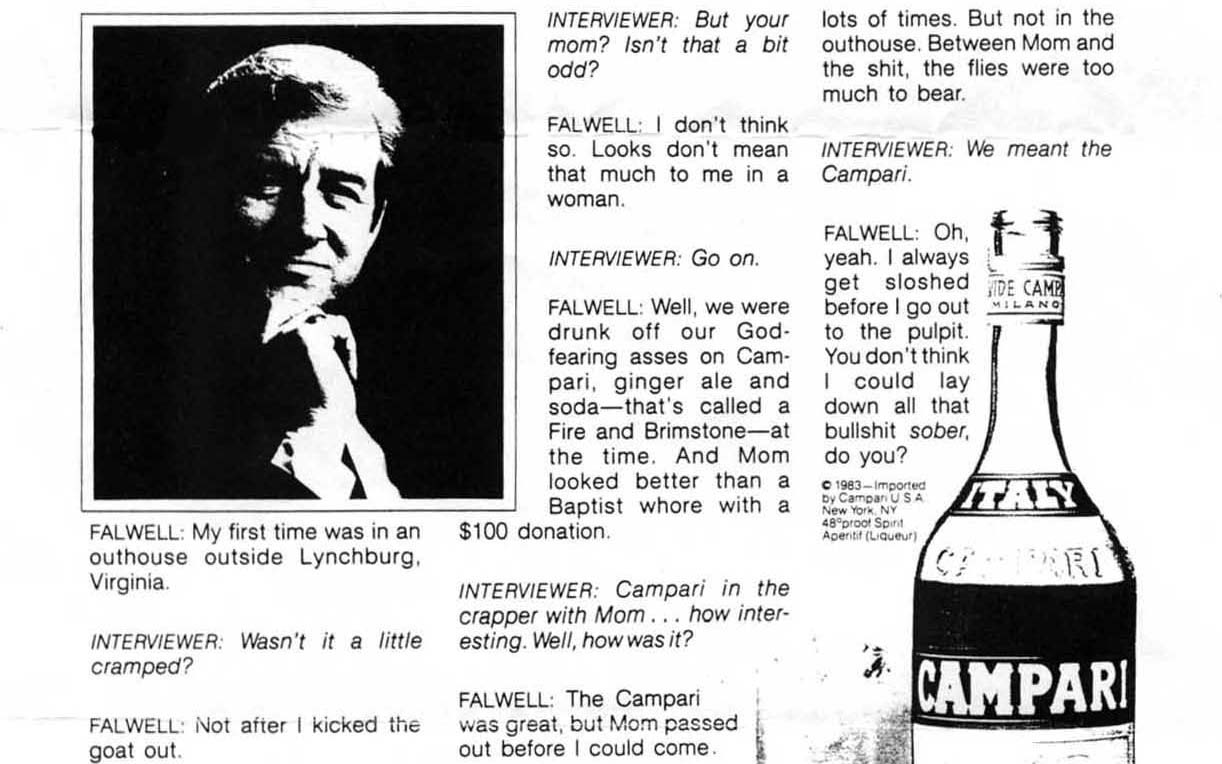
For example, Hustler magazine is incredibly tasteless, vile, and sexist. It ran an ad depicting Jerry Falwell confessing to incest with his mother, it mocks female politicians by depicting them in sexual situations, one magazine cover featured a woman in a meat grinder, and apparently it had some kind of spread depicting a pornographic version of a concentration camp. Even if you don't have a moral objection to pornography, Hustler is garbage.

However, so long as Hustler's right to free speech, however vile, is protected, more prosaic incidents of artistic nudity (and I mean legitimate art) are in significantly less danger from Moral Guardians on the right (artistic nudity is sinful and immodest, and according to the Calvinists undermines the gospel) or on the left (artistic nudity is exploitation of women). And if history is anything to go by, these groups will impose censorship if they could. This applies to both social conservatives and social liberals.

The same goes for "hate speech." As long as the speech of definitely hateful people like the Ku Klux Klan, neo-Nazis, etc. is protected, you won't have the kind of censorship of far more innocent things that "hate speech" laws in France, India, Poland, Britain, etc. have led to.

To quote A Man for All Seasons, I'd give the Devil the benefit of the law for my own safety's sake.

So I will be seeing The Interview as a matter of principle. If the movie sucks, so be it. If I'm giving money to a company that's too inept to protect its employees and customers, so be it. This is about taking a stand against appeasement and threats of violence, in defense of artistic freedom against crude coercion.

Friday, December 19, 2014

A Second Post About "The Interview"

Now it seems that the film The Interview will not be released at all, not even on Video on Demand, at least in the near future. Sony first abandoned plans to release the film after most theater chains in the United States refused to show it after the hackers (likely backed by North Korea) threatened 9/11-esque terror attacks. It seems more realistic that the greater danger would be hacking of customer credit card data and the like rather than physical violence (thus saith Homeland Security), but given how a judge has ruled a lawsuit against the theater in Aurora, Colorado over the shooting in the movie theater can go forward, that theaters might be concerned is understandable.

(The only solution I could think of would be for the government to agree to assume liability for this particular situation on the grounds of defending the citizens' freedoms against all enemies, foreign and domestic. That could potentially be very expensive and theater owners might not want the theaters full of cops--or if a municipality doesn't have enough police, the National Guard--as an alternative to simply not screening the movie. And they're a private business--if they don't want to go to all the trouble, that's their call.)

However, many movie theaters like the Plaza Theater in Atlanta were still willing to show the movie. I was actually planning on seeing it there as part of a "To Hell With Kim Jong-Un" outing. I am aware there is a risk (however minimal) of violence or (more probable) that my financial data might be compromised in a reprisal hack. Thing is, life has risks.

We are free because people in this country resisted bullies like the British Crown, the Klan, etc. not by cowering and hoping against hope the arrogant and the strong would show mercy. I intended to see the movie to show that I (and presumably the others who would see it with me) were not going to be intimidated by the Internet hired guns of some chunky despot in some unreconstructed Stalinist hellhole. And to all those people moralizing in the comments sections about how showing the movie isn't worth innocent lives, that if there was an incident the same people who condemned Sony for pulling the movie would condemn Sony for releasing the movie, etc., I would remind you that Allied bombing killed vast numbers of civilians living under German occupation in WWII and these same populations thought it was worth it to be liberated. Sometimes freedom has a price.

Then, when I was in the early stages of organizing my outing, Sony pulled the movie completely. One of my friends theorized that the hackers still had unreleased employee personal data that they could have released if further antagonized and Sony knuckled under to their threats to protect employees, which this article here supports. However, this article here depicts Sony warning past and present employees that their data is already out there. If that is the case, this was cowardice on Sony's part, since the hackers would have (foolishly) expended their leverage.

And Paramount is even worse. Some theaters decided to show Team America World Police instead to show they would not be intimidated by Fat Boy and his minions, but Paramount prevented them from screening the film. Paramount has not been hacked and now that the North Koreans' goons' tactics are known, precautions can be taken. And since it seemed the theater owners were making the decision to show the movie on their own, they're the ones assuming liability. This is an even more pathetic case of cowardice on the part of Paramount, which can't even plead coercion the way Sony can.

I've seen some people online suggesting that The Interview would be released later once the hubbub dies down, either theatrically or, to avoid security problems, by video-on-demand. It would be a good idea to give Sony a few months to a year to do the right thing, once the initial threat has passed. However, between Sony's "no plans" statement and this new threat by hackers, that might not be happening. If Sony tried to kill the movie permanently, this would be one of those rare occasions that I would support pirating it and spreading it so far over the Internet that all the threats and bloviations of Sony, Fat Boy, etc. would not be able to stop it. It would foil the North Korean regime's desire that people not see this movie and show Sony that bowing to the demands of hackers can cost them as well.

(And to anyone who says that'd be victimizing Sony twice, this would allow them to get their product out there and have an excuse to the people holding them hostage that they had nothing to do with it. Once the cat's out of the bag, the hackers might back off and Sony can release it legitimately.)

Judd Apatow has said Sony's actions guarantee the film will be seen illegally. Glad to see he agrees with me.

Wednesday, December 17, 2014

"The Interview," Or Sony Gives Into Terror

I logged onto Facebook this morning and found a rather unpleasant article courtesy of my fellow blogger The Corner Critic. Apparently the Georgia-based movie theater chain Carmike Cinemas has canceled screenings of the upcoming film The Interview due to liability concerns after Internet death threats were made, something done with the blessing of Sony Pictures. The film's premiere in New York was canceled due to threats of a "9/11-style attack." And Sony has already caved to North Korea's whining once already by editing real-life North Korean military medals out of the film.

I can understand prudence, especially if there are lives and/or a great deal of money on the line. However, the chances of anything actually happening are extremely remote. Although North Korea has engaged in state sponsorship of terror before (so there is precedent for violent behavior abroad), incidents like the Rangoon Bombing and the bombing of Korean Air Flight 858 were in the 1980s and in Asia to boot. North Korea is a heck of a lot poorer now without Soviet subsidies and with its economy having tanked to the point of famine. And by making threats, whoever is behind the hacks (probably agents of the regime) has openly telegraphed its intentions. Whatever assets, personnel, etc. they've got here (apparently they don't have diplomatic relations with the U.S.) would be under more serious scrutiny. Even if they seriously attempted anything, it would get nixed really quickly.

Hacking and making Internet threats are an extremely cheap way to sow terror. All you really need are a couple guys with computer skills (and diplomatic immunity if they get caught) to do things like hack Sony's computers or send online death threats. Actually putting together a terrorist attack is a much more difficult proposition. The first link cites the Department of Homeland Security saying there is no evidence an actual attack is in the works. This report from the Atlanta-based pop-culture news site Fanbolt confirms it.

Furthermore, it seems rather questionable that movie theaters would be liable in the unlikely event there were some kind of terrorist attack. This article here indicates workplaces can be sued for negligence, but if theaters can get Sony Pictures to provide extra security, hire security guards themselves, or get the local government to provide extra police (spin it as defending Americans' right to see whatever movies they like being under threat from foreign goons), that would indicate they took the threat seriously and would limit their liability.

I do like what this group of human-rights activists are planning on doing--sending copies of The Interview into North Korea via balloon. I wonder if they've already done the same with Team America World Police, since that one mocks Kim Jong-Il mercilessly. The article states that North Korea would be much more upset at The Interview than a film like Titanic because it openly undermines the cult of the Kims. If non-political Western movies weaken the brainwashing as much as the story in the article indicates, movies openly bashing the Kim Dynasty would be even more effective.