Showing posts with label film. Show all posts

Friday, December 16, 2022

A 1750s SCOTTISH Karate Kid?

I just watched the original Karate Kid film for Myopia Movies and coincidentally found this Tumblr post that Canadian author Bruno Lombardi, whom I know from the alternate history forum, posted on Facebook.


I thought that would actually be pretty fun to watch and joined in the brainstorming. For the Scottish scenario, I suggested the equivalent to the Japanese Internment would be German bombing of Scottish cities and evacuation of Scots to Canada, with "Mr. MacMiyagi" as the sole survivor of a U-Boat attack on the ship evacuating his clan. Bruno's friend, fellow writer Jonathan Edelstein, suggested instead it could actually take place in the early modern period, with "Mr. MacMiyagi's" personal tragedy being the Highland Clearances.

So here's the scenario we hashed out:

*Daniel is from the yeoman class, while Ali is gentry. There's a clear class difference, but they're both landowners. Mr. and Mrs. Mills aren't going to be exactly impressed, but the class difference isn't such a problem for them that they're going to have Daniel kidnapped and shipped to the Colonies as an indentured servant or quietly murdered. Perhaps Daniel's father was killed in one of Britain's wars during this period rather than dying of cancer and so the Mills, however skeptical they are of this poor(er) man, at least have that respect for Daniel. If he's an officer rather than "the scum of the earth" who formed the enlisted ranks in this period, even better. Edelstein suggested the LaRussos might own enough land to be able to vote, albeit at the lowest possible level (a "forty shilling freehold").

*Our elderly friend "Mr. MacMiyagi" is a Scot who fought for the British government against the 1745 Jacobite insurrection, but was driven off his land during the clearances. During the disaster his wife died in childbirth and his son died with her and with his home gone, he drifted southward and became a groundskeeper or gardener on the Mills' family estate. Traumatized by his various mishaps, he keeps to himself and engages in stereotypically Scottish hobbies like shinty (the Scottish equivalent of Irish hurling) or (if he's literate), writing Scottish poetry?

*The equivalent of Johnny and his Cobra Kai gang are "young gents" who dislike someone they view as little better than a peasant wooing a girl of their class, with Johnny in particular being a spurned suitor of Ali. Given how much more power parents' had over their children's, particularly daughters', romantic choices in this period, perhaps Mr. Mills is somewhat less oblivious than his movie equivalent and recognizes Johnny for the incipient wife-beater he is, or perhaps he also looks down on Johnny on class grounds. After all, Cobra Kai gets more into Johnny's backstory and "the money" he comes from his from his stepfather who barely tolerates him, not his birth family. Perhaps his mother is an actress or from a similarly low-class background who "married up" and the illegitimate Johnny was part of the package? Not only is Johnny a hormonal and jealous a-hole, but he's also classist and nasty toward Daniel because he's overcompensating for his own impoverished background.

*Bobby, one of the Cobra Kais in the original film who tries to restrain Johnny from his grotesque behavior toward Daniel, is an early Wesleyan. In the Cobra Kai series, we later see that he's become a preacher, so he sticks with it.

*"MacKreese" is another veteran of Culloden, only he fought for the Jacobites. He has a beef with "MacMiyagi" for that reason, plus the fact his side lost. He runs his quarterstaff club (I doubt they'd have martial-arts dojos in England at this time) like a particularly abusive military unit, spinning it to his charges' parents that he's teaching them discipline so they don't end up dissolute libertines. Thing is, instead they're a bunch of angry young men abusing peasants (think Chozen from the second film cheating people at the grocery store) or peers they dislike (i.e. Daniel).

So we have something roughly similar to the canonical film in which Johnny and his gang bully Daniel for courting Ali, but an attempt to jump him and murder him is interrupted by "Mr. MacMiyagi" totally wrecking them the way Mr. Miyagi wiped out five Cobra Kai students in seconds in the canonical film. Given the legal hell to pay a poor Scot is going to get for beating up some English gentlemen even in defense of an English yeoman (especially if their parents are important local nobles), perhaps "MacKreese" and "Mr. MacMiyagi" agree to allow Daniel to fight some kind of duel with Johnny rather than getting the law involved? "MacKreese" could spin this as some kind of test for his students (or put on a show of not wanting "Sassenach" laws judging another Scot), but it's really part of some kind of elaborate revenge on "Mr. MacMiyagi" for the Battle of Culloden?

Things start to get a little tricky when we tried to come up with a Scottish equivalent of Mr. Miyagi's traditional Okinawan/Japanese wisdom (be it authentic or something underinformed Americans would *think* was traditional Okinawan/Japanese wisdom). Edelstein said setting it in the 1750s would be too early for Robert Burns, but "MacMiyagi" could tell embellished stories of the founding of various Scottish clans or the great William Wallace and Robert the Bruce. And instead of Daniel's crane kick, there's a finishing move called "the Kelpie."

I personally am rather disinclined to join with woketarians in attacking The Karate Kid (see Ralph Macchio's defense of the original film when it's criticized for being "too white"), but I also recognize the concept of "turnabout is fair play." So if someone actually wanted to make a parody of TKK that riffs on the Magical Asian Mentor and Mighty Whitey tropes, I'd be all for it.
Thursday, December 1, 2022

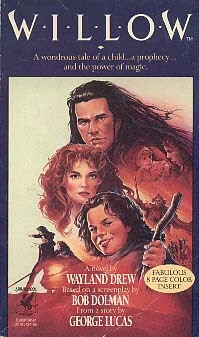
Book Review: WILLOW Novelization (1988)

Since Disney+ is putting out a next-generation sequel to the 1988 fantasy classic Willow, the film podcast Myopia Movies recorded an episode that came out alongside it. I enjoyed the movie, but there were a number of flaws, most notably the lack of explanation and worldbuilding. Given how the movie was intended for children and as-is the host's kindergartner was losing interest toward the end, I figured the novelization would be a big improvement. Fortunately it is available for purchase on Amazon, so I decided to give it a spin.


The Plot

In a faraway land, a prophecy predicts that a child will be born who will overthrow the evil Queen Bavmorda. To that end, Bavmorda, imprisons all late-stage pregnant women and has their child inspected after birth to see if they bear the prophesied mark--and one day the newborn Elora Danan does. A sympathetic midwife smuggles the child out and Bavmorda dispatches her grim General Kael and warlike daughter Sorsha to pursue the child.

But the child falls into the hands of gnomish farmer and family man Willow Ulfgood, who aspires to do magic. Assigned by the gnome village elders to find a human to look after said child, Willow soon encounters the rogue Madmartigan and the transformed sorceress Fin Raziel. Soon they're all allies on a quest to overthrow Bavmorda, with some surprising twists and turns along the way.

(The novelization appears to be based on an earlier draft of the screenplay and includes content cut from the actual film.)

The Good

*The novel beefs up the characterization of Willow himself and emphasizes the danger his quest to protect baby Elora puts him in besides the obvious problem of Bavmorda's murderous soldiers. Basically he's been pursuing his dreams of becoming a wizard to the detriment of working on his farm and owes the bullying village prefect Burglekutt money. Friendly neighbors have had to give him seed for this year's crop and he's apparently one payment away from foreclosure. Although the situation is largely his own fault, if his children had never found the baby he could have easily turned his situation around--he gets a lot of plowing done in a single day.

*Bavmorda, Fin Raziel, and their Fae mentor Charlindea get a lot more back-story and characterization than in the film. In the movie, Bavmorda is basically a live-action version of Snow White's Evil Queen, Fin is a rival she's transformed, and it's not even clear what exactly Charlindea even *is*--on the podcast, I refer to her at one point as the "non-union Mexican equivalent" of Galadriel.

*A monster cut from the film and a monster that appears later in the film have reasons for being there that further build Bavmorda's character. Not only is she a powerful sorceress, but she's also a planner who has fail-safes for her various schemes.

*Burglekutt isn't just an obnoxious small-town moneylender...he's also a prefect in the local government and owns the town's sole seed shop. Willow is not the only person he antagonizes either. If it weren't for his physical cowardice and being completely out of shape physically, he could have been a PG version of small-town gangster Wesley from the Patrick Swayze movie Road House.

*The novel explains some stuff that, in the film alone, don't make a whole lot of sense. For example, the midwife escapes the sinister Nockmaar Castle with the infant Elora by hiding out in some secret passages she knew about (and apparently the guards didn't) until Bavmorda's pursuers are far away before setting off into the wilderness. And once away, she's assisted by people opposed to Bavmorda's regime and even friendly animals. This explains why Elora is a newborn at the beginning of the film but looks significantly older by the time the midwife sets her adrift on the river to save her from the Death Dogs...they've actually been on the run for months. A character who gets captured by the heroes in the film because they insist on being the first one to search a room displays a bit more common sense and sends minions in first.

*The war depicted in the film is also explained in more detail. Bavmorda, having usurped her late husband, rules all the territories he did, and has been making war on the nearby kingdom of Galladoorn. The various rebels, armies, etc. we see in the film are survivors of Galladoorn's army, people within Nockmaar opposed to Bavmorda's rule, etc. The film doesn't really explain the politics of the situation very much or very well.

*There's a scene where we see Nockmaar's army in battle in large numbers (as opposed to Kael and Sorsha's death squad that numbers about fifty people at most) that's pretty cool.

The Bad

*The prose is not very descriptive and doesn't move very quickly until about halfway through the book. There's a lot of telling rather than showing.

*Some of the worldbuilding and back-story is rather silly. Before Bavmorda, apparently all living things in the world lived in harmony and several times characters are assisted by friendly animals. Yes, I know this is a novelization of a children's film and friendly animals are a fairy-tale staple, but still. Although I criticized the movie for oversimplifying matters, the more complex attempts at worldbuilding and back-story raise more questions than they answer. The Willow Blu-Ray has an interview with Ron Howard in which he explains how a whole subplot involving Sorsha's father--the previous king at Tir Asleen and Bavmorda's husband--was ordered cut by the studio and frankly the movie version is better than what's in the novelization. 

(This fan-fic keeps Sorsha's dad dead like the movie at least strongly implies and explains the whole situation better than either the novelization or the film, but beware spoilers.)

Elora's role in the novel is also needlessly complex--some commenter on TVTropes states that she causes Bavmorda's downfall in the film, not by anything she does, but the actions she inspires others to undertake. There's also a lot of Chekov's Guns that aren't fired--worldbuilding that doesn't really tie in with the immediate plot but mostly serves to add pages.

*The way Bavmorda's and Madmartigan's back-stories are explained feature gigantic info-dumps that are basically characters telling stories around the campfire. This is especially the case with Madmartigan. Yes, the back-stories are interesting, but they go on for far too long and are kind of clunky.

*Some stuff from the movie gets left out, like scenes in Nockmaar Castle where Bavmorda interacts with Sorsha and Kael. This would explain the unhealthy family dynamic between Sorsha and her belittling, affection-withholding mother (and why a character's romantic speech, drug-induced though it may be, has such an effect on her) and show the evil kingdom's political dysfunction. Sorsha's first film meeting with the heroes that sets up a lot of stuff that happens later is also left out. Although Willow and Madmartigan benefit from the expanded characterization in the novel, Sorsha (to a point) and especially Kael lose out.

The Verdict

A library read, unless you can get it super-cheap somewhere. Only worth reading once. 6.0 out of 10.

Movie Review: WILLOW (1988)

On the 100th episode of the Blasters and Blades podcast, I briefly discussed the movie Willow with the hosts. I referred to the movie as being "before my time" (it turns out I was actually around four years old, but at that point I was mostly interested in cartoons), much to the slightly-older host's annoyance. At the time I had not seen it, but lo and behold some time later, the film podcast Myopia Movies added it to the Season Nine lineup. So not long after DragonCon 2022, I watched it for the podcast...


Here's the link to the podcast. And now for the review...

The Plot

In a faraway land, a prophecy predicts that a child will be born who will overthrow the evil Queen Bavmorda (Jean Marsha). To that end, Bavmorda, imprisons all late-stage pregnant women and has their child inspected after birth to see if they bear the prophesied mark--and one day the newborn Elora Danan (twins Kate and Ruth Greenfield) does. A sympathetic midwife smuggles the child out and Bavmorda dispatches her grim General Kael (Pat Roach) and warlike daughter Sorsha (Joanne Whalley) to pursue the child.

But the child falls into the hands of the farmer and family man Willow Ulfgood (Warwick Davis), who aspires to do magic. Assigned by the village elders to find a human to look after said child, Willow soon encounters the rogue Madmartigan (Val Kilmer) and the transformed sorceress Fin Raziel (Patricia Hayes). Soon they're all allies on a quest to overthrow Bavmorda, with some surprising twists and turns along the way.

The Good

*For starters, Willow and his kindred are a very specific fantasy race--they're gnomes. This is the first and so far only time I've seen gnomes in an actual film. For the scenes in the gnome village it looks like Lucasfilm hired every dwarf actor in Hollywood--every adult seems to have some form of dwarfism and there are a lot of them who can play musical instruments, fight with weapons, etc. The only ordinary-sized people seem to be the children. This is a good thing on multiple levels--it's more authentic and real-looking and it provides employment for people who often live rather difficult lives. And their characterizations are varied--the gnome village has an obnoxious moneylender who covets Willow's land, there are full-time soldiers (who are actually fairly skilled--on Twitter I called them "the littlest pikemen"), and even a wizard. We even see their form of government--they seem to have a town council and direct democracy on certain major issues. These aren't a bunch of circus performers, but an actual complex society.

*Also, this is a world where there are non-human fantasy races in addition to ordinary people. In a world of only Homo sapiens sapiens who often look different, practice different religions, etc. we're often bigoted enough toward each other. Willow and the other gnomes get repeatedly referred to as "pecks" (a reference to a unit of measurement, approximately 12-14 pounds) even by people who are supposed to be heroic. It's a major sign of a character's moral growth that this person starts referring to them by how they call themselves (Nalwyn) rather than "peck."

*The film also has a good cast. I liked all three of the main trio--Davis, Kilmer, and Whalley.

*The movie is fast-moving and entertaining, albeit a bit on the cheesy side.

The Bad

*Unfortunately, I can kind of tell where the filmmakers are getting a lot of their inspiration from. Willow and his friend Meegosh, after being captured by the brownies, are sent on a quest to protect Elora by some kind of forest sorceress whom I refer to on Twitter as Galadriel's "non-union Mexican equivalent." Apparently the novelization explains more--including her relationship to Fin Raziel and Bavmorda--but I shouldn't have to refer to the novelization, deleted scenes, etc. for a movie to make sense. According to the novelization she was a senior sorceress (and also a forest fairy of some kind) mentoring Raziel and Bavmorda, the latter of whom went bad. In the film it's not even clear if she's human or some kind of elf, fairy, etc. Hence "Galaldriel's non-union Mexican equivalent." Making her human--and perhaps involved in the military resistance against Bavmorda we see elsewhere in the film--would be more original, but again, it's not in the film.

*Per the above, there's a lot of missing material that's included in the novelization, earlier drafts of the script, comic books, etc. that would have helped the movie make a lot more sense. For example, Bavmorda believes that even if she killed baby Elora, she'd be reborn in a new body and the prophecy would kick back in. Hence the elaborate ritual to banish Elora's soul to another dimension and/or destroy it completely so that never happens rather than simply murdering her at first chance. There's also a character's defection that has a lot more back-story in the extended universe, but in the actual movie it seems like they're mostly doing it out of love (or at least lust) for one of the good guys.

(I suggested in the podcast the movie could be a bit longer to fix these issues, but Nic cited the example of his own child getting bored later in the movie to point out this risks losing the attention of the primary audience. The deleted scenes pertaining to the defector character--beware spoilers--don't add many minutes to the film, although the last bit involving a character conscious while imprisoned in a crystal is so ridiculous and cheap-looking. A few bits of dialogue here and there would be fine, but lots and lots of new scenes, not so much. I still think it'd be doable, although we're about 34 years too late. If you want an alternative take that's not overly elaborate, check out this fan-fic here. Spoilers beware.)

The Verdict

Not perfect, but a fun and entertaining fantasy film. Also a means of teaching good values to the target audience (kids) without being preachy and annoying to adults. 8.5 out of 10.

And while you're at it, check out my novella Little People, Big Guns. Although it on the surface it looks rather tacky and exploitative, my intention was to get into the real life issues little people face--people ignoring them because they can't see them, problems functioning in a world designed for people much larger than themselves, health difficulties, bullying by bigger people, and even weird fetishization. Davis actually runs an acting agency that started out representing his coworkers with dwarfism and later included those who were unusually tall.

Saturday, November 12, 2022

THE HOWLING, The Heroes Of Other Stories, and Fan Fiction Ideas

In the 1981 film The Howling, TV news anchor Karen White (Dee Wallace) discovers a rural California community run by her station's psychiatrist has a dark secret. A very hairy dark secret...although the cover pretty obviously gives away the fact it's a werewolf movie, this isn't confirmed until about an hour into the film.

Although the film is kind of dull (I gave it a grade of C on my blog), the characterization is interesting. Several supporting cast members seem like they could potentially be the heroes of their own stories. Anybody who's a fanfic enthusiast (Archive of Our Own has a lot of Howling fanfic stories) is welcome to give these a spin. I posted about this on Twitter earlier this morning; here is my rambling in more coherent form, with some fact-checking.

Spoilers for a 30-odd year old movie below. I'll post the YouTube clip of the relevant scene that reveals a lot about the lesser characters to further block it off.


Dr. George Waggner (Patrick McNee)-The station psychiatrist and basically the cult guru in charge of "The Colony." He tries to get the werewolves to control their animal nature and live peacefully, but he cannot control the violent Quist siblings--serial killer Eddie, homewrecker Marcia, and creepy little brother T.C. Under California law, he's an accessory after the fact to several murders (possibly with rape to boot), since he knows about Eddie's crimes and seems to have done nothing but try to conceal them by luring the only surviving witness to his commune. If the cops (other than the local sheriff who's a werewolf himself) get involved, he's going to be doing some pretty serious time.

(You don't get the misdemeanor accessory charge for covering for a serial killer and Eddie has committed multiple serious crimes. That jail time piles up real quick, and him trying to plead coercion would involve revealing that he's the guru of a colony of werewolves.)

However, his options to deal with the Quists are rather limited. At the climax of the film, Marcia and one of her friends openly assault him when he tells them he won't let them kill Karen and it seemed to me his bad deeds (largely of omission rather than commission) are basically for damage control purposes. If not for him, many if not most of the werewolves in the community would start hunting and killing people before the government comes in and gives them the Waco treatment. He can't exactly go to the police for help--they wouldn't believe him if he said they were all werewolves and if they did believe it (say if he transformed in front of them), he and his would be hunted down and killed as monsters.

You could depict him as this morally gray version of Charles Xavier making harder and harder "lesser of two evils" choices to the point it's a relief when Karen's colleague Chris Halloran shoots him with a silver bullet. Hell, you could make him a full-on tragic hero. If Macbeth (traitor and murderer of families), Othello (domestic violence), and Hamlet (causes several deaths and the foreign invasion of his kingdom through sheer bumbling) can be tragic heroes, well, Waggner's crimes are much less extreme.

Jerry and Donna Warren (James Murtaugh and Margie Impert)-In this scene here, the werewolves detain Karen after Eddie kills her colleague Terri and she realizes just what's going on. The Warrens seem intent on recruiting Karen for the cult. Although I'd initially thought they'd found The Colony's secret on their own, had been given the choice between accepting "the gift" and being killed, and were desperately hoping Karen would be shown the same mercy, that doesn't seem to be what happened. It sounds like they'd be been bitten earlier and tried to resist the effects rather unsuccessfully, but then found Waggner on their own and Waggner taught them how to deal with it effectively. Just how that played out could be an interesting story, especially if the werewolf who infected them was unaffiliated with Waggner and The Colony. Who else is out there?

Erle Kenton (John Carradine)-He's the one who looks like Willie Nelson and attempts to kill himself when we first meet him. One could write him as someone who wants to follow Dr. Waggner's teachings but finds his struggle against his own nature so difficult that he becomes outright suicidal. When Eddie killing Terri causes a crisis at The Colony, he just says "screw it" and gives in to his animal side. This could be the story of someone with a mental illness suffering a breakdown or someone who's really repressed finally, to quote Elsa from Frozen, "Let[ting] it go." Only he's a bigoted murderous a-hole.

Bill Neil (Christopher Stone)-We see his whole arc on-screen so he's not really the hero of another story, but showing the whole situation from his POV could be interesting. He goes from being a vegetarian and a faithful husband to Karen (he even gets violent with Marcia when she puts the moves on him) to killing and eating animals, cheating on Karen with Marcia, and assaulting Karen when she calls him out on it. And some viewers think he's the one who infected Karen in the climax of the film. What is it like to have your worldview shift so much in less than a week?

Thursday, October 27, 2022

Blast from the Past Movie Review: THE HOWLING (1981)

Back in the days of Blockbuster Video, I got my own membership later in high school and could rent any movie I wanted. One film I rented was The Howling, a well-regarded werewolf movie from the early 1980s. October 2022 is werewolf month on the film podcast Myopia Movies and this was one of the films I really wanted to do.

Here's the episode. And now for the review...

The Plot

In 1980s Los Angeles, television anchor Karen White (Dee Wallace) has been getting phone calls from serial killer Eddie Quist (Robert Picardo). In order to catch him, she agrees to meet up with him--with the police close by. As one might expect, this turns violent very quickly and the traumatized Karen can't remember precisely what happened. Dr. George Waggner, (Patrick Macnee), a local psychologist, invites her and her husband Bill Neil (Christopher Stone) to a rural commune called "The Colony" so she can rest and undergo group therapy. They arrive and meet various colorful characters living there, including Marcia Quist (Elisabeth Brooks), who is a little too interested in Bill.

And did I mention that Eddie's corpse has disappeared from the morgue? Karen's colleagues Chris Halloran (Dennis Dugan) and Terri Fisher (Belinda Belaski) investigate that as things get progressively weirder and more dangerous at The Colony.

The Good

*There is some good foreshadowing, like a character early on who specifically wants to commit suicide by fire.

*There're some moments of humor, like when a snoopy character is caught going through a filing cabinet.

*There is also some good development for the supporting cast, like how Karen's boss at the station is depicted as a jackass. He signs off on the scheme to bait serial-killer Eddie never mind that it's putting one of his employees at great risk and a good number of people openly object to it, and when she's clearly upset by the experience, says it's just as likely she could be pregnant (sexism) and casually and profanely butchers the name of an Asian anchor the station could use if she can't handle being on-air (racism). The guy is a real tool, and we get that mostly in one scene almost as an aside.

*I can't go into too much detail for reasons of spoilers, but they do develop the villains as people. Some are content with living in isolation and hunting animals and even peacefully coexisting with ordinary people, but others are more overtly predatory and violent and the former have to resort to increasing concessions to the latter in order to (barely) keep them under control. The politics of it could have been developed more, but they are interesting.

*I liked the side story with Chris and Terri investigating the aftermath of Eddie's attack on Karen and how it ultimately links back up with Karen's stay at the Colony.

The Bad

*After the initial confrontation with Eddie, the movie slows down considerably. Not much happens of note until Karen and Bill arrive at the Colony and Karen starts hearing wolves howling outside. This section of the movie functions more like a mystery than a straight-up horror movie in the vein of Silver Bullet or An American Werewolf in London. If that's what you're into that's fine, but be aware.

*Per the above, the internal politics of the Colony could have come up earlier--perhaps when Terri comes to see Karen, the residents could argue among themselves about this new development.

The Verdict

A bit dull if you go in expecting a full-on monster movie, but if you go in expecting a mystery, it's better. 7.5 out of 10.

Wednesday, October 26, 2022

Films I Bought Because of Myopia Movies

As my readers know, I'm a regular participant in the film podcast Myopia Movies, organized by one of my friends from the Boy Scouts. To that end, I've probably watched dozens if not hundreds of movies I haven't seen in forever (or never saw at all) over the last eight-odd years we've been recording. Some of these I liked so much I actually purchased them on physical media so I'll have them forever and not lose them to the whims of the streaming company or IP holder. Seriously, the streaming services giveth and the streaming services taketh away.  Netflix in particular has shed a lot of films over the years. And per The New York Times, you don't actually own your digital movies.

And so here are the DVDs or Blu-Rays that I've bought...

How The Grinch Stole Christmas-This is the Jim Carrey Nightmare Fuel edition that my colleagues didn't like but I thought was hilarious. Those damn materialistic Whos needed a wakeup call. The movie even opens with a Black Friday commercialistic nightmare. The episode is slated to premiere December 15 to coincide with the Grinch parody film The Mean One, so I'll update this page when it is.

The Abyss-This underwater science fiction extravaganza was something I first saw in elementary school, but didn't see again until we recorded a podcast on it. Here's my review and here is the episode. It's a blast. Also check out my YouTube video.

The Rocketeer-This and Shipwrecked were the first movies I saw with my mother when I first moved from Kennesaw-ish to East Cobb as a child. The episode was originally recorded for the show's defunct Patreon and won't be out until the planned sequel, but re-watching the movie again was a blast. I even got my college-student younger cousin watching it.

Labyrinth-For years I avoided this film due to seeing some creepy-looking production stills, but I'm glad I finally saw it. Here's the episode and here's the review. I also came up with some other posts based on and even created my first meme. I'm going to be on a panel about the film at the Atlanta fantasy festival CONjuration in early November, where some material from "Labyrinth is Hellraiser for Kids" (here in blog form and here on YouTube) will make an appearance.

Howard The Duck-This was a movie I'd wanted to do an episode on for years and it was a blast. Here's my review. I think I'm one of the few people in the world who non-ironically loves this one. Here's to hoping they let the original Beverly Lea Thompson direct an official MCU version, with one of her daughters playing the new Beverly. As of October 2022, Thompson is still campaigning for job.

Gremlins-This one came out the year I was born and I saw it for the first time at The Plaza Theater in Atlanta. Here's the podcast and here's my review. This one is definitely a hoot.

Highlander-I first saw this one as one of Joe Bob Briggs' late-night movie shows and was a big fan of the spinoff TV series that featured a younger relative of Connor MacLeod, with Connor dropping in now and then. Here's my review and here's the episode. The appearance of the villain Grendel from my steampunk series Battle for the Wastelands was inspired by the evil Kurgan's medieval war-gear, especially the helmet.

Willow-This movie came out when I was in pre-school, but I don't remember being interested. Cheesy and fun. The episode won't come out until December 22 to coincide with the Disney+ spinoff series featuring an older Willow training a new generation of heroes. Watching the film inspired me to purchase an ancient copy of the novelization and gave me more fodder for the 1980s fantasy film panel I'll be on at CONjuration.

Secret of NIMH-The movie that scared me to death in kindergarten. Here's the episode and here's the review. It's a beautiful film with excellent voice-work and animation.

Thursday, September 15, 2022

Movie Review: SOYLENT GREEN (1973)

Once upon a time, there was a Charlton Heston film called Soylent Green, set in the far-off year of 2022 in which Earth has become massively overpopulated and...desperate measures...are required to keep everybody fed. Since we have finally reached that year and the human population has actually started to decline, the film podcast Myopia Movies is doing a very special episode on the film. Here is the podcast episode. And now for my review...

The Plot

New York City Police Department officer Robert Thorn (Charlton Heston) and analyst Sal Roth (Edward G. Robinson) live in an NYC where there are 40 million people, at least half of whom are unemployed. Real food is rare and ludicrously expensive, with most people living on different varieties of "Soylent" made--supposedly--from processed vegetable matter.

When the wealthy William Simonson (Joseph Cotten) is murdered, Thorn investigates and soon finds himself unraveling a conspiracy with the help of Shirl (Leigh Taylor-Young), Simonson's former concubine (more on that later).

The Good

*The film touches on a lot of issues that are still timely. Although the movie is clearly a product of a time where overpopulation was the major ecological fear, the movie also mentions the greenhouse effect and other types of air, water, and soil pollution. Those are still problems, especially the former. It also touches on wealth inequality--New York City in 2022 has a population of 40M people, at least 20M of whom are unemployed. Thorn and Roth are police officers living in a tiny apartment with unreliable power, while most people live in even more wretched conditions. (I'm assuming) due to the massive unemployment and poverty, many women are willing to serve as concubines so degraded they're referred to as "furniture" and can serve particular individuals or whomever happens to be resident in a particular apartment. That's some Epstein-level stuff there. Homeless people literally fill the streets and fire exits. Food prices are rapidly skyrocketing--at one point Roth mentions $150 for a jar of strawberries, and the rarity of real beef reminds me of the early days of COVID when many meatpacking workers were sick.  Crime is so severe than the superintendents of ordinary apartment complexes carry assault rifles--although urban crime is nowhere near the levels of the late 1960s to early 1990s, it has been rising in recent years. Meanwhile, there is a ludicrously wealthy elite living in extreme luxury and fenced off from everybody else like something in Latin America or Africa.

(Someone on Twitter claimed dystopia is when privileged people are subject to the same horrors as the poor and marginalized--a lot of the stuff I've mentioned exists in real life, but for the most part not in the United States. Yet...the film mentions supply chain problems affecting day-to-day living in New York City, even for the wealthiest people, and even causing the decline of the book-publishing industry. Sound familiar?)

The film even touches on the alienation of people from each other...Simonson, who is wealthy enough to afford personal servants and even a concubine, has no next of kin to receive his death benefits. The "furniture" girls, exploited by their employers and on at least one occasion bullied by senior employees, seem to have only each other to rely on.

*Even though the film was made in 1973, there doesn't seem to be any overt racism. The (I assume) WASP Thorn banters with his black boss and Jewish roommate without any hint of snobbery or friction and he treats Martha (Paula Kelly), not only a black woman but the "furniture" of a suspected criminal, politely rather than lording it over her as a police officer and as a man. Although there are obviously still problems that need fixing, the negative of impact of discrimination has been in decline for some time.

*The acting is good. Heston is good as Thorn and Robinson is good as Roth, while Leonard Stone is appropriately reprehensible as the abusive butler Charlie. 

*Rather than a talkie-talk explanation of how just everything went bad, the dystopian aspects of the world are depicted initially by an opening-credit montage depicting population growth and pollution and then by details on-screen...heaps of homeless people, food lines, old people reminiscing about the days when the planet was more habitable, casual discussion of ludicrously-inflated food prices. No infodumping.

*The more you think about it, the more morally gray the situation becomes. Is the conspiracy investigated in the film the lesser evil, in order to reduce human pressure on the already collapsing environment?

*Finally, although this is pedantic, there's no TVTropes Bottomless Magazines here. In one fight sequence, the fact Thorn has to stop and reload his gun is important.

*When we see the cover's "riot control bulldozers" unleashed, the shots are so well-timed that they're actually a bit intimidating. It reminded me of the scene in The Wolfman where a man beats the wolfman to death with his silver-headed cane, but all the audience sees is the rising and fall of the cane over the fog.

The Bad

*The opening montage could have been tightened up a bit. The point could have been made a lot faster.

*The movie overall is rather slow-moving. There's a lot of "this is what dystopia looks like" where not a lot actually actually happens. Things do pick up later in the film though.

*Given the importance of the Catholic Church to the events in the film, there's a missed opportunity to depict the Catholic hierarchy conniving with the villains. Given how we see ordinary Catholic priests and nuns caring for the poor and providing spiritual solace, it wouldn't make the film anti-Catholic. All you'd really need to make the point is to depict a bishop or archbishop involved, which would make the ending more impactful and less vague.

The Verdict

Worth seeing once, but not the classic I expected. 8.0 out of 10.

Thursday, August 25, 2022

Blast from the Past Movie Review: LADY IN THE WATER (2006)

Hey everybody, it's been awhile since I've actively posted, but I've been working a lot on Serpent Sword, the sequel to my novel Battle for the Wastelands. However, I've still been actively participating in Myopia Movies and we're doing a month on M. Night Shyamalan's films, ranging from his high point (at least among the movies were watched) with Signs to his decline.

So here's my review of Lady in the Water, the first film of his I actually skipped due to negative reviews. Here's the episode. And let my commentary begin:


 The Plot

Long ago, humans were in contact with a civilization of mermaids known as Narfs, who provided spiritual guidance. But man grew greedy and moved inland, multiplying conflicts and wars without the mermaids' advice. As the world grew darker and more dangerous, the mermaids have taken the initiative to contact humans again, but the mermaids have their own supernatural foe, the lupine Scrunts. Into this conflict comes Cleveland Heep (Paul Giamatti), an apartment superintendent with a stutter and a tragic past who encounters a Narf named Story (Bryce Dallas Howard) in the complex pool one night.

But Story, and now him, are being hunted...

The Good

*I liked how Howard played Story...although she's a supernatural being, she is unfamiliar with our world and its social conventions. Hence the brutal honesty, which can be encouraging or discouraging depending on the situation, and misunderstandings like "I need to wear clothes" or "someone who looks and acts like a teen runaway strung out on drugs hanging out half-naked with a middle-aged (apparent) bachelor might give people really wrong ideas." She also helps other characters follow their dreams, but she's by no means anything remotely resembling a typical Manic Pixie Dream Girl.

*I also liked Giamatti's Heep. When we first meet him, he's going out of his way to introduce a newcomer to the complex to the various eccentric characters that populate the place. It would have been nice if someone had done that for me when I moved to various complexes over the years. It's also a good foreshadowing of a later reveal--in order to make that work for a complex as large as the one he manages, Heep would have to have a very good memory. And that ends up playing a major role in the story.

*A young college student Young-Soon Choi (Cindy Cheung) and her mother (June Kyoto Lu) who cannot speak English play a major role in the storyline. I liked their dynamic--a strict Asian-born "tiger mother" and her more free-spirited Americanized daughter--and the fact Young-Soon has to be her mother's translator in her dealings with Heep is pretty funny.

*Sarita Choudhury is having a lot of fun as Anna Ran, part of the brother-sister duo with her writer brother Vick (Shyamalan himself). I liked her performance.

*One of the new residents of the complex is a movie critic who has some very...sharp...comments about the state of storytelling and the film industry. I thought that was pretty funny.

*In an age of remakes, legacy sequels, etc. a film with a completely original plot (it's based on a bedtime story Shyamalan told his children) is pretty refreshing.

*The difficulties the characters have with their roles in the story (not going into any more detail for spoiler reasons) are pretty clever, even if later on they do slow down the film.

The Bad

*One reason I recall for all the negative reviews when the movie came out was the bizarre names for the creatures. Seriously, Narfs and Scrunts? This sounds like Shyamalan was channeling Luna Lovegood from Harry Potter when he was writing this one. One review said it would be much simpler if Story were just a fairy (naiad?) or a mermaid being hunted by a werewolf. I know this whole thing is based on a bedtime story Shyamalan created for his own children, but the ridiculous species names were one of the major negatives from the reviews I can remember when the film came out. Listen to the podcast for all the times we mimicked Pinky, the deranged lab rat from The Animaniacs whose trademark saying is "Narf!"

*In the podcast, Daniel described the movie as "surreal" and it really is. It's just plain weird.

*Someone pointed out on the podcast that given the Narfs' isolation from humans, why does Story know how to speak English? That might merit an explanation--maybe she learned English from watching human fishermen? Then you could have BDH using sailor lingo and that might actually be pretty funny.

*Shyamalan casts himself as a major character in the film rather than his typical cameo. He's fairly flat in contrast to his character's lively sister and he doesn't really stand out like his costars do. This wasn't a problem with his character in Signs, who probably had a lot of guilt and possibly PTSD from falling asleep at the wheel and killing Reverend Hess's wife and whose main interactions are with the man he (unintentionally) widowed, or the non-entity park ranger in The Village who has only two lines. I can see why giving himself such a large part rubbed people the wrong way, especially given some revelations about his character's ultimate fate.

*The narfs and scrunts get introduced pretty early in the story, but there's another supernatural threat dropped in halfway through the film that seems a little abrupt.

*Like The Village but unlike Signs, it starts to drag in the middle.

*There's some additional information revealed about Story toward the end of the film that really needed to be foreshadowed better.

The Verdict

I don't think it really deserves the hate it got (four Razzie nominations?), but it's not a particularly good film, especially the more you think about it. At least it's short. 7.0/10.

Monday, April 18, 2022

Movie Review: The Northman (2022)

Thanks to an online group I'm in getting perks, I was able to score early passes to see The Northman, much like I did Dune. And just like I did with Dune, you're getting an early film review out of it. :)


The Plot

In ancient Norse Ireland, King Aurvandil War-Raven (Ethan Hawke) returns from raiding and slaving to his queen Gudrun (Nicole Kidman) and young son Amleth (Oscar Novak). Treachery arrives with his brother Fjolnir (Claes Bang), leaving his son to flee and vow revenge. Years later Amleth (now played by Alexander SkarsgÃ¥rd) is a Viking raider pillaging in modern Russia, but a religion vision reminds him of his vow of revenge. Allying with the Slavic sorceress Olga (Anya Taylor-Joy), he sets off for the end of the world -- Iceland -- and a final confrontation with his uncle.

The Good

*The cinematography in this movie is simply beautiful. Even though the film is rather ponderous (more on that later), the film simply looks so good that it doesn't matter.

*The soundtrack is also marvelous. I don't claim to be a great expert on authentically Norse music, but it stylistically sounds a lot like the Scandinavian-themed and actually Scandinavian music I've found on YouTube, like the Norwegian band Wardruna.

*The film does an excellent job captured just how alien the pagan Norse are to modern Westerners. Lots of strange (and often bloody) rituals, hallucinogenic sequences, unrepentant violence, and eschewing common sense in favor of belief in Fate. From what I know about Norse history and culture, they get it all correct. The fact that it was co-written by the Icelandic poet Sjón no doubt helps quite a bit.

*The acting is generally good, particularly Bang's Fjolnir.

*There are some unexpected and creative plot twists.

The Bad

*The movie is rather slow-moving at times. It's even divided up into sequences with title cards, something I found objectionable in The Free State of Jones.

*Per the above, SkarsgÃ¥rd stares at the camera a lot. Although he's by no means a bad actor, he's one of the least interesting performers in the bunch.

The Verdict

Definitely worth seeing once. 8.0 out of 10.

Saturday, January 15, 2022

A (Somewhat) Realistic North Korean RED DAWN

The YouTuber The Alternate Historian, whom I know from my former days at the Internet's premiere alternate history forum, posted on Twitter recently about making a video discussing a realistic war between the U.S. and North Korea. In the Homefront video game and the 2012 Red Dawn remake the North Koreans manage to land forces on the American mainland and actually take control over much of the continental United States.

Sufficient to say, that isn't going to happen. North Korea's air force is obsolete and owing to lack of fuel, their pilots have little training time. North Korea's navy is primarily focused on its own river and coasts. They're realistically not going transport a whole army to the American mainland and good luck keeping them supplied even if they could get here. Their army is large, but their equipment is obsolete. Their main strengths are masses of artillery threatening the South Korean capital, their nukes and ballistic missiles, and their cyberwarfare capability.

(North Korea's nuclear capabilities seem much more advanced than I'd earlier believed...I thought at best they could manage a "Super-9/11" on one or two cities on the West Coast and then they'd be annihilated, but what the Council on Foreign Relations describes is something more like what's depicted in this faux Congressional commission's report on a North Korean nuclear attack. Yikes.)

So how could you have a realistic Red Dawn where it's the North Koreans of all people landing on the American mainland? Commandos. Before I left the alternate-history forum, I suggested the "more realistic Red Dawn" story would be a small North Korean force taking over an isolated small town in the rural West Coast. In my idea they'd be hidden aboard a civilian ship, while TAH suggested on Twitter they could use submarines. North Korean cyberwar techniques could be used to conceal their approach to the West Coast. The goal isn't to actually conquer the United States; the goal is to seize a town during an international crisis as a bargaining chip to get the U.S. to back off militarily, lift sanctions, etc. Northern California is rather isolated (a large land area with few roads) and if they take a large number of civilians hostage, that would complicate any response from the California National Guard or the regular U.S. military. That means the locals will have to liberate themselves, and so we enter Red Dawn territory.

And that's when things get tricky. There are lots of guns to be had in the rural U.S., even in Democratic states like California, but a force of North Korean regulars is going to have much heavier gear even if they're dramatically outnumbered. I'm imagining them herding captured civilians into camps beneath a battery of portable artillery and then defending said artillery with machine guns. A few dozen guys with rifles might be able to make life difficult for North Korean infantry patrols or do hit-and-run on isolated enemy positions, but good luck with successfully attacking this.

Fortunately, northern California is a major haven for illegally growing marijuana, and the local weed baron "just happens" to have some mortars. Think how mobster Eddie Valentine flips on the evil actor (and Nazi spy) Neville Sinclair in the climax of the film The Rocketeer--like Eddie, this man might not have a problem making money illegally, but collaborating with a totalitarian enemy is something else entirely. A bunch of irregular infantrymen bum-rushing machine guns isn't going to end well for them (and even a successful attack would give the North Koreans time to slaughter the hostages with artillery), but a surprise mortar bombardment could cripple the guns or kill their operators, wreck the machine gun positions, etc.

And that gave me the idea for an analogue for the traitor Daryl from the 1984 version. I'm imagining some young Twitter tankie (an apologist for authoritarian anti-American regimes--think Western leftists defending China's repression of Hong Kong or Xinjiang or Russian bombing of Syrian rebels) initially collaborating with the North Koreans. He erroneously thinks they're "anti-imperialist" or believes the U.S. provoked the North Koreans into this crazed long-shot gamble with economic sanctions or military drills. 

Sufficient to say, the scales fall from his eyes real fast. Although the guerrillas initially don't want his help, he's read the Anarchist's Cookbook and knows how to combine chlorine and bleach to make a crude chemical weapon or can make other chemical concoctions ISIS-style. Putting the trust the North Koreans gave him to good use, he sets off the chemical bomb in the North Korean headquarters at the same time the guerrillas use their new mortars to destroy the artillery the North Koreans are using to hold the townsfolk hostage. If the guerrillas or their weed-baron allies have got some decent machinists, they could make gas shells to make absolutely sure the gun crews are dead.

(Daryl could have some Redemption Equals Death for having been a collaborator initially, or more creatively, survive and everybody believes he was the Wolverines' inside man the entire time.)

I've got a lot going on, so I'm not going to try to pitch this to Hollywood (which wouldn't be interested, especially with the failure of the Red Dawn remake) or even write a book. Still, it might be interesting.

Tuesday, December 28, 2021

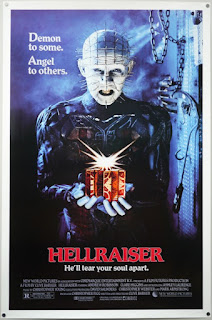
Making a HELLRAISER Musical?

I'm a regular participant in the Concellation Facebook group created to provide people who would have attended conventions canceled due to COVID with a social outlet. In late December I adapted my blog post about how Labyrinth is Hellraiser for kids into a YouTube video and posted it in the group. Someone asked if Hellraiser had a musical number, what would it look like? My response was that you could actually make a full-blown Hellraiser musical.


So here's where I plot out a Hellraiser musical. Some ideas for songs and sequences, complete with the relevant film clips.

*At the beginning, Frank Cotton has a musical number while he solves the Lament Configuration. He discusses how he's experienced every pleasure the world has to offer (with some pretty big hints that many of these pleasures are illegal and/or immoral) and now he's looking for pleasures beyond the world. As he solves the box and the boundaries between the worlds start to thin, an ominous chorus of the Cenobites join in. The song culminates in the solving of the box, the chain-attack on Frank, and the first appearance of Pinhead. Here's the relevant scene in the film.

*When Larry Cotton (Frank's brother) and his second wife Julia move into Frank's old house, we could have a three-person musical number featuring Larry, Julia, and Larry's daughter Kirsty from his first marriage. Larry is hoping moving back to Julia's hometown in Britain will help save their marriage, Julia is lamenting how boring it is to be married to Larry, and Kirsty (arriving later to help) sings about how she misses her biological mother and how much she dislikes Julia.

*Frank's resurrection from the floorboards of the room where he was taken to Hell, culminating in a terrible scream, might be an instrumental number. Alternatively, it could have Frank recounting in some kind of spoken-word fashion the horrible things the Cenobites did to him as his body reassembles itself from the floor.

*Bored at a party attended by Larry, some of his work friends, Kirsty, and Kirsty's new boyfriend Steve, Julia goes to investigate the strange noises in the attic, culminating in the encounter with the skeletal resurrected Frank. There's a duet between the two where Frank begs her to help him fully regain his body while Julia is torn between her disgust at this meatless bony monstrosity and her memories of Frank seducing her before her marriage to Larry. At the end of the song, she agrees to help Frank, provided no harm comes to Larry. Despite his obvious contempt for Larry, Frank agrees.

*We next have a musical montage number (possibly some kind of ballet?) of Julia luring men back to the house and killing them for Frank to feed on. Some near-misses where Larry nearly discovers what's going on and Julia has to come up with an increasingly bad series of excuses to conceal her and Frank's activities.

*Befuddled by his wife's odd behavior, Larry takes Kirsty out to lunch and they discuss the situation. This could be dialogue-only, or a sweet-natured duet between the two of them.

*Kirsty sees Julia bringing a man into the house and comes in, only to see Frank kill him and eat him. Frank then attacks her, either in a sexual fashion or to simply eat her too, but she's able to fight him off with the puzzle box and escape the house. She's taken to the hospital with the box, which she refuses to give up, and locked into her room by the staff, plays with it and accidentally solves it. This calls forth the Cenobites and we have a whole musical number about how the Cenobites are "explorers of the furthest reaches of experience, demons to some [and] angels to others" and how, since she's solved the box, Kirsty must come with them and "taste their pleasures." The terrified Kirsty manages to bargain with them, offering them Frank in return for herself.

*As Kirsty rushes home to warn her father, Frank and Julia murder him and Frank skins him. This is something that wasn't in the movie, but should have been, so the confrontation between the brothers and Larry's murder should be a musical number culminating in Frank's horrific appearance and Larry's death. Kirsty arrives and, momentarily deceived by Frank's disguise as her father, briefly encounters the Cenobites in the house as they brood over Larry's corpse. Frank attacks Kirsty, accidentally killing Julia (whom he feeds on as she's dying) and pursues Kirsty into the attic room where Larry's body is. There Kirsty tricks Frank into confessing his true identity and the Cenobites arrive to claim him.

*The Cenobites then try to abduct Kirsty anyway ("we have such sights to show you"), but she uses the box to banish them. Steve arrives and the two attempt to destroy the box, only for a vagrant to appear, take the box, and transform into a dragon before flying away.

You guys like? There's a ballet based on Dracula and a musical based on Evil Dead, so as long as the musical retains the film's score (or at least a version of it) and the best lines, this could be better cool. Heck, some of the film's best lines like "we have such sights to show you" could be the titles of songs.

(Also, check out the Myopia Movies episode on Hellraiser.)

Saturday, December 4, 2021

LABYRINTH Is HELLRAISER For Kids

The other day I watched Labyrinth on the elliptical at the gym and while ironing some clothes. The thought hit me that it has a lot in common with, surprisingly enough, Hellraiser and its sequel Hellraiser 2: Hellbound. Beware spoilers for all three films.

Firstly, both franchises have significant stepmother-stepdaughter drama. Hellraiser protagonist Kirsty Cotton and her stepmother Julia clearly don't get along at the beginning of the first film and once supernatural forces get involved, it escalates into outright violence. In the second film, once Julia has been thoroughly corrupted, she explicitly refers to herself as the wicked stepmother and the evil queen and mocks Kirsty as "Snow White." Meanwhile, protagonist Sarah Williams is openly disrespectful toward her stepmother Irene in Labyrinth, and Irene clearly does not know what to do with her. Knowing her stepdaughter's interest in fantasy, Irene complains that Sarah treats her as a "wicked stepmother."

Furthermore, at the beginning of the film when we first meet here, I get serious Julia vibes off Irene. They're both dressed formally (albeit for different reasons--Irene and Sarah's father are going on a date and Julia just seems like an ice-queen in general) and their hairstyles are somewhat alike. Although there's more open hostility between the two than between Kirsty Cotton and her stepmother Julia in the first Hellraiser, Sarah is several years younger than Kirsty and significantly less mature. Perhaps Julia and Kirsty were similarly hostile when Kirsty was a young teen, although if that were the case I doubt Kirsty's father Larry would have been so foolish as to assume a now-adult Kirsty would want to live with them in their new town or later ask her to help him figure out why Julia is acting so strangely.

Later, when Sarah becomes frustrated by baby Toby's crying, she wishes the Goblin King would take him "far away from me." The crying abruptly stops and when Sarah goes to investigate, we see goblins in the walls, moving under mattresses, etc. That gave me major Hellraiser vibes, especially given how Kirsty's sinister uncle Frank Cotton's personal hell in the second film involved sensual women under sheets (who disappeared when he removed them), how doorways to Hell formed in the walls, etc. You can see some of that in the clips below.

Also, Kirsty in the first Hellraiser solved the puzzle box and summoned the Cenobites completely ignorant of what the box actually did. She was curious about this device that her undead uncle was so protective of, started fiddling with it, and then this happened. 


Like Kirsty, Sarah had no idea that her frustrated wish to be rid of her baby half-brother would actually summon a supernatural being. And although Jareth and his goblin cronies are significantly less rough than Pinhead and his crew are, there are definitely similarities. Here are two YouTube clips depicting Sarah summoning him and his arrival:


The Goblin King is nowhere near as dangerous as Pinhead--the latter is a Dracula-like sadist who attempts to welch on his bargains, while Jareth is more whimsical and kid-friendly--but both are dangerous and sexual creatures with an unhealthy interest in the young, brunette female protagonist.

Oh, and there's that. Pinhead describes himself as his crew as "explorers of the furthest reaches of experience, demons to some and angels to others" and they subjected Frank to "pain and pleasure indivisible" when he was under their control. The almighty TVTropes describes the Cenobites as "the priests of an S&M religion." In the climax of Hellraiser, Pinhead attempts to abduct Kirsty, telling her that, "We have such sights to show you," while the in second film, he confidently allows Kirsty to freely wander his realm, informing her that, "We have eternity to know your flesh." 

The sexuality in Labyrinth is a bit more subtle given how this is a children's movie, but Jareth's infamous bulging crotch has been discussed at length online, we see David Bowie as Sarah's mother's new boyfriend in a newspaper (a romantic rivalry with one's own mother?), and Jareth gets very testy at the notion of Sarah kissing Hoggle, a dwarfish creature whom she befriends in the Labyrinth. This culminates in Sarah essentially getting roofied and dancing with Jareth at a ball, a scene that is downright rapey. And Jareth later straight-up propositions Sarah, telling her, "I ask for so little. Just let me rule you, and you can have everything that you want. Just fear me, love me. Do as I say and I will be your slave."

Finally, both franchises have elaborate mazes. Sarah must solve the titular Labyrinth in thirteen hours to rescue her brother from Jareth, while Kirsty briefly ventures into the Cenobites' realm when she solves the box in the first Hellraiser film. The second film features a more extensive exploration of the Cenobites' maze-like realm.

So although rarely does one associate a children's fantasy film (albeit one with some significant adult subtext) like Labyrinth with the sexual horror of Hellraiser, there are an interesting number of similarities.

Friday, November 5, 2021

Movie Review: THE BLOB (1988)

Once upon a time in elementary school, I was a regular reader of the Crestwood Monsters series, a series of children's books in which the tales of the classical movie monsters (Dracula, the Wolfman, etc.) were retold using black-and-white film stills as illustrations. One such book was centered around the 1950s horror film The Blob. I was aware there was a remake in the 1980s, but never got around to seeing it until Myopia Movies did an episode on it. I wasn't able to participate, but I saw it later when the episode came out.


The Plot

In a ski town in what's probably Colorado, a meteor lands, bringing with it a very hungry life-form that gets bigger the more it eats. A bunch of small-town types like earnest high school football player Paul (Donovan Leitch), cheerleader Meg (Shawnee Smith, who later went on to play Amanda in the Saw films), and biker delinquent Brian (Kevin Dillon) now have much bigger problems than who's going out with whom and who needs tools to work on their motorcycle.

The Good

*In a lot of horror movies, the characters make bad decisions in order to move the plot along. In this film, most of the characters make good decisions and the bad decisions make sense in context (i.e. Brian storms off because he has a big chip on his shoulder and feels disrespected). This makes the titular Blob especially dangerous--in order to deal with people who are mostly not complete fools, it has to be pretty cunning itself.

*Some characters who could be clichés have surprising depths and twists.

*The movie seriously goes for Anyone Can Die. Not going to go into detail for reasons of spoilers, but they definitely avoid the horror-movie problem of the audience pretty much knowing who's going to die from early in the film.

*They use late 1980s practical effects and minimal if any CGI. It looks good. And definitely gross--they were going for ghastly here and it works.

*There are some laugh-out-loud moments, such as one of the football players figuring out who his date's father is.

The Bad

*There's a prolonged opening featuring shots of the town and then we cut to the high-school football game. There are two actual meet-cutes. There's no hint we're dealing with a threat from beyond until at least fifteen minutes in. Some of the stuff is necessary because it introduces the characters but it could stand to be tightened up, like the shots of the empty streets. If that was intended as some kind of fake-out to make the audience think the Blob had already eaten the town, it didn't work.

*There's a subplot involving the town's Catholic priest (at least I think he's supposed to be Catholic based on how he's dressed) that doesn't make a lot of sense and eats up too much screen time. Not going to go into detail for possible spoiler reasons, but his Biblical interpretations and later actions sound more like an End Times enthusiast Protestant, not a Catholic.

The Verdict

Well-made and definitely worth a watch. 8.5 out of 10.

Saturday, October 16, 2021

Movie Review: DUNE (2021)

Thanks to an online group I'm in, I managed to get into an early screening of the 2021 adaptation of Frank Herbert's science fiction classic Dune. I'd seen the 1980s film (and even participated in a podcast about it) and the early 2000s miniseries on the Sci-Fi Channel, so I was definitely looking forward to it getting the Lord of the Rings treatment.

(Seriously, owing to COVID concerns I said I'd see the movie in a spacesuit if I needed to.)

So how was it when I finally got to see it nearly a year after the original release date? Here we go...


The Plot

In a space empire thousands of years in the future, the noble House Atreides headed by Duke Leto (Oscar Isaac) is granted the planet Arrakis as a fief by the Emperor Shaddam IV, taking it away from rival House Harkonnen headed by the nefarious Baron Vladimir Harkonnen (Stellan Skarsgård). Arrakis is the sole source of the spice melange, which makes interstellar travel possible, and it is extraordinarily valuable. However, it's a trap--the jealous emperor seeks to destroy Duke Leto, whom he views as a rival.

Into this comes Leto's son Paul (Timothée Chalamet) by his Bene Gesserit (a sort of order of space witches) concubine Lady Jessica (Rebecca Ferguson). Trained by his mother in Bene Gesserit techniques like the commanding Voice, he's been having visions of the future, including the young woman Chani (Zendaya), a warrior from Arrakis's native Fremen people. 

When the emperor's nefarious plot goes into motion, will he be able to draw on the "desert power" envisioned by his father?

The Good

*The cinematography of this movie is quite simply awesome. It is absolutely a magnificently beautiful film, and I cannot say this enough. Caladan, the Atreides homeworld, is a beautiful place of magnificent coasts and oceans, while the Harkonnens rule over a polluted urban hellscape. Salusa Secundus, where the emperor draws his elite Sardaukar armies, is the unholy admixture of the two. They manage to make the Sardaukar disturbing, and that's good.

*One of the great flaws of the 1984 adaptation was how clumsily it handled the exposition needed for this gigantic science fiction universe, and that's not the case here. The filmmakers manage to convey so much with shots or small sequences. For example, rather than explaining the whole back-story about how too-advanced computers are illegal and how specially-trained humans known as Mentats have replaced them, we just see Atreides Mentat Thufir Hawat (Stephen McKinley Henderson) do this peculiar thing with his eyes a couple times, the same with the Harkonnen Mentat Piter de Vries (David Dastmalchian). That the Atreides are benign to their subjects and the Harkonnens harsh and cruel is also show rather than told--Duke Leto is free and easy with visitors on his island paradise and on Arrakis, while people cringe before the Baron and his beastly nephew Glossu "Beast" Rabban (Dave Bautista). And the issues between Jessica and the rest of the Bene Gesserit are handled in glances and a short conversation rather than blah-blah-blah.

*There are some subtle touches of characterization as well, like how in a father-son talk Leto tells Paul that he didn't want to be duke he wanted to be a pilot...and his own father was cool with this, knowing how this would ultimately bring him around to his responsibilities "another way." That skill with piloting comes in handy for several sequences in the film, for both the father and the son. And Leto's father was killed fighting bulls for the entertainment of his subjects--the displayed head of said bull keeps popping up in ominous ways I thought were clever.

*I saw this in IMAX and that's definitely where to see it. Not only will you get the full scope of the visuals, but you'll also get the full force of the soundtrack. Ye gods, the soundtrack. It will crush the life out of you, in a good way.

*The acting of the main characters is impressive. Chalamet does a good job of portraying the teen Paul, portraying his rebelliousness, emotional sensitivity, and giftedness, as well as the steel within that will propel him to his destiny. Isaac is appropriately noble as Duke Leto, while Ferguson is well-cast as Jessica. And although I was skeptical of gender-flipping the Imperial scientist Liet Kynes (the filmmakers came up with this ridiculous reasoning about how women are naturally peacemakers between cultures), I liked Sharon Duncan-Brewster's portrayal, especially later in the film. Josh Brolin does a good job conveying the intensity of Atreides weapons-master and musician Gurney Halleck, while Jason Momoa definitely impresses as the jocular warrior Duncan Idaho.

*The battle sequences are also quite impressive. In the Dune world, personal shielding has reduced firearms to a secondary role at best and much fighting is done with swords. The way the battles take this into account and the way the fight scenes are choreographed is pretty cool.

The Bad 

*Even though they're adapting only the first part of the book, the movie is still very, very long at just over two and a half hours. It starts to drag a couple hours in. That was the single biggest flaw, and kind of a substantial one.

*And even though this is the first half of the book, they still have to leave stuff out. One character who has a lot of internal turmoil is reduced to a non-entity despite their major role in events, as is another character whose actions tie in. Vague to avoid spoilers. :) And I'm wondering if they're consolidating the Harkonnen nephews--we meet Rabban but not Feyd-Rautha, the smarter and more dangerous of the two. Feyd-Rautha isn't to my recollection even mentioned.

*Some of the characters' speech comes off as a bit too present-day for thousands of years in the future.

The Verdict

8.0 out of 10. See it. Go see it. Help it make enough money that we can see the rest of the story on-screen to this degree of glory. Given how the second third to half of the story focuses on the war against the Harkonnens and the Empire, it will almost certainly avoid this film's problem of being too slow-moving.

Thursday, September 23, 2021

Movie Review: HOWARD THE DUCK (1986)

Once upon a time as a child, I wanted to work in movie special effects and at some point read about the special effects for Howard the Duck. I definitely remember a picture of one of the evil aliens, although I don't recall how exactly it was made. Although I have listened to a podcast about the film (possibly the How Did This Get Made episode), I never actually got around to seeing it.

Well, thanks to Myopia Movies, I finally did. Here's the episode. And now for the review...


The Plot

Howard (Ed Gale in the suit, Chip Zien as the voice) is an anthropomorphic duck hailing from Duckworld, a planet where creatures like him are the dominant species rather than humans. After a long day at work, Howard comes home to smoke cigars, watch TV, and read Playduck (yes, really), only to be transported to Earth by scientific accident. He soon rescues small-time rocker Beverly Switzler (Lea Thompson) from punks and she introduces him to her annoying scientist friend Phil Blumburtt (Tim Robbins), who tries to figure out what Howard is and where he came from. Howard tries to make his way in this strange new world, including getting a job, but the experiment overseen by Dr. Walter Jennings (Jeffrey Jones) that brought Howard to Earth soon brings something else as well...

The Good

*The movie is really funny. Not only is there a lot of goofy and slapstick humor, but there're also some more thoughtful jokes, including a sequence where Howard attempts to find a job at the local unemployment office. I laughed out loud several times--I'm really glad I didn't get this movie off Amazon for the Kindle to watch at the gym. Might disturb the others.

(Even though Howard is now a Disney property, you can watch it for free on NBC's Peacock TV streaming service. For now.)

*Gene Siskel's negative review from when the film was released said that Howard wasn't a likeable character, but in-universe it does make sense. He's the only one of his species on Earth, he's a prey animal on top of that (apparently he arrived in Cleveland right before duck-hunting season), people treat him like a pet, a child, and in one memorable scene, a meal, and he's worried he'll never make it home. He's frustrated and lashes out at people, including those who are trying to help him. And that's on top of some of his personal drama from back in Duckworld--he wanted to be a musician but chose to enter medical school to please his parents, only to fail out. The opening also hints at romantic troubles as well.

*The acting is generally good. I particularly found Thompson amusing as Beverly and Robbins amusing, albeit less so, as Phil. Jones, meanwhile, spends much of the movie possessed by an evil alien. If that's really him speaking with the Evil Voice (Brian Steele is listed as the uncredited voice of "The Dark Overlords of The Universe" so it's possible they dubbed him in), props to him for his vocals.

*I did like the soundtrack as well. Also, Thompson did sing as well as act, which is another point to her.

The Bad

*The movie could stand to be tightened up a bit. There's a chase scene that takes way too long even if it does provide some of the aforementioned laugh-out-loud moments.

*Was this movie marketed toward kids or adults? If it was marketed toward kids, no wonder it bombed at the box office. This movie is not for children, at all. That's not a bad thing (nobody thinks Saving Private Ryan is intended for children), but it is something to keep in mind.

*Per my above comment, although Howard being cranky and obnoxious makes sense for the character, he is kind of a jackass early on.

*Although you do eventually get used to it, upon first seeing Howard he's rather off-putting. I wouldn't go so far as to call it Uncanny Valley, but he does look quite weird. Per Wikipedia the original plan was to make him computer-animated but the technology at the time wasn't up to it. Hopefully if they ever remake it, we're looking at something more akin to Avatar.

*There's this elaborate voice-over that starts the film that claims what's real in one world is fantasy in another. So basically Howard is real on his planet, but he's a comic-book character in ours. That's kind of lame. It's also never followed up on--what if Howard were accosted by a crazed fan who knows he's not a man in a costume? You could get really meta.

*Some of the duck puns are really bad--not funny-bad, but just stupid. And if I think a pun isn't funny, you know it's bad.

*The villainous aliens from the climax have not aged well in terms of effects quality.

The Verdict

Worth seeing at least once. I might actually buy it. 8.0 out of 10. Generally speaking remakes should be reserved for good concepts that were executed poorly (or at least not as well as they could have been), so Disney should definitely come up with an MCU version. Thompson has already volunteered to direct, so maybe they should give her a shot. Like the article suggested, her daughter Zoey Deutch could play Beverly in this version too. That'd be hilarious, since they have worked together before and especially considering Thompson said her daughters refused to finish the movie after a...romantic interlude...involving their mother and an alien duck.