Showing posts with label books. Show all posts

Thursday, December 1, 2022

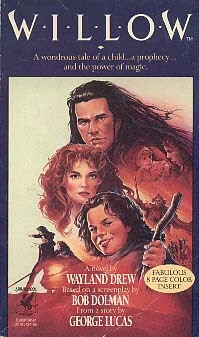
Book Review: WILLOW Novelization (1988)

Since Disney+ is putting out a next-generation sequel to the 1988 fantasy classic Willow, the film podcast Myopia Movies recorded an episode that came out alongside it. I enjoyed the movie, but there were a number of flaws, most notably the lack of explanation and worldbuilding. Given how the movie was intended for children and as-is the host's kindergartner was losing interest toward the end, I figured the novelization would be a big improvement. Fortunately it is available for purchase on Amazon, so I decided to give it a spin.


The Plot

In a faraway land, a prophecy predicts that a child will be born who will overthrow the evil Queen Bavmorda. To that end, Bavmorda, imprisons all late-stage pregnant women and has their child inspected after birth to see if they bear the prophesied mark--and one day the newborn Elora Danan does. A sympathetic midwife smuggles the child out and Bavmorda dispatches her grim General Kael and warlike daughter Sorsha to pursue the child.

But the child falls into the hands of gnomish farmer and family man Willow Ulfgood, who aspires to do magic. Assigned by the gnome village elders to find a human to look after said child, Willow soon encounters the rogue Madmartigan and the transformed sorceress Fin Raziel. Soon they're all allies on a quest to overthrow Bavmorda, with some surprising twists and turns along the way.

(The novelization appears to be based on an earlier draft of the screenplay and includes content cut from the actual film.)

The Good

*The novel beefs up the characterization of Willow himself and emphasizes the danger his quest to protect baby Elora puts him in besides the obvious problem of Bavmorda's murderous soldiers. Basically he's been pursuing his dreams of becoming a wizard to the detriment of working on his farm and owes the bullying village prefect Burglekutt money. Friendly neighbors have had to give him seed for this year's crop and he's apparently one payment away from foreclosure. Although the situation is largely his own fault, if his children had never found the baby he could have easily turned his situation around--he gets a lot of plowing done in a single day.

*Bavmorda, Fin Raziel, and their Fae mentor Charlindea get a lot more back-story and characterization than in the film. In the movie, Bavmorda is basically a live-action version of Snow White's Evil Queen, Fin is a rival she's transformed, and it's not even clear what exactly Charlindea even *is*--on the podcast, I refer to her at one point as the "non-union Mexican equivalent" of Galadriel.

*A monster cut from the film and a monster that appears later in the film have reasons for being there that further build Bavmorda's character. Not only is she a powerful sorceress, but she's also a planner who has fail-safes for her various schemes.

*Burglekutt isn't just an obnoxious small-town moneylender...he's also a prefect in the local government and owns the town's sole seed shop. Willow is not the only person he antagonizes either. If it weren't for his physical cowardice and being completely out of shape physically, he could have been a PG version of small-town gangster Wesley from the Patrick Swayze movie Road House.

*The novel explains some stuff that, in the film alone, don't make a whole lot of sense. For example, the midwife escapes the sinister Nockmaar Castle with the infant Elora by hiding out in some secret passages she knew about (and apparently the guards didn't) until Bavmorda's pursuers are far away before setting off into the wilderness. And once away, she's assisted by people opposed to Bavmorda's regime and even friendly animals. This explains why Elora is a newborn at the beginning of the film but looks significantly older by the time the midwife sets her adrift on the river to save her from the Death Dogs...they've actually been on the run for months. A character who gets captured by the heroes in the film because they insist on being the first one to search a room displays a bit more common sense and sends minions in first.

*The war depicted in the film is also explained in more detail. Bavmorda, having usurped her late husband, rules all the territories he did, and has been making war on the nearby kingdom of Galladoorn. The various rebels, armies, etc. we see in the film are survivors of Galladoorn's army, people within Nockmaar opposed to Bavmorda's rule, etc. The film doesn't really explain the politics of the situation very much or very well.

*There's a scene where we see Nockmaar's army in battle in large numbers (as opposed to Kael and Sorsha's death squad that numbers about fifty people at most) that's pretty cool.

The Bad

*The prose is not very descriptive and doesn't move very quickly until about halfway through the book. There's a lot of telling rather than showing.

*Some of the worldbuilding and back-story is rather silly. Before Bavmorda, apparently all living things in the world lived in harmony and several times characters are assisted by friendly animals. Yes, I know this is a novelization of a children's film and friendly animals are a fairy-tale staple, but still. Although I criticized the movie for oversimplifying matters, the more complex attempts at worldbuilding and back-story raise more questions than they answer. The Willow Blu-Ray has an interview with Ron Howard in which he explains how a whole subplot involving Sorsha's father--the previous king at Tir Asleen and Bavmorda's husband--was ordered cut by the studio and frankly the movie version is better than what's in the novelization. 

(This fan-fic keeps Sorsha's dad dead like the movie at least strongly implies and explains the whole situation better than either the novelization or the film, but beware spoilers.)

Elora's role in the novel is also needlessly complex--some commenter on TVTropes states that she causes Bavmorda's downfall in the film, not by anything she does, but the actions she inspires others to undertake. There's also a lot of Chekov's Guns that aren't fired--worldbuilding that doesn't really tie in with the immediate plot but mostly serves to add pages.

*The way Bavmorda's and Madmartigan's back-stories are explained feature gigantic info-dumps that are basically characters telling stories around the campfire. This is especially the case with Madmartigan. Yes, the back-stories are interesting, but they go on for far too long and are kind of clunky.

*Some stuff from the movie gets left out, like scenes in Nockmaar Castle where Bavmorda interacts with Sorsha and Kael. This would explain the unhealthy family dynamic between Sorsha and her belittling, affection-withholding mother (and why a character's romantic speech, drug-induced though it may be, has such an effect on her) and show the evil kingdom's political dysfunction. Sorsha's first film meeting with the heroes that sets up a lot of stuff that happens later is also left out. Although Willow and Madmartigan benefit from the expanded characterization in the novel, Sorsha (to a point) and especially Kael lose out.

The Verdict

A library read, unless you can get it super-cheap somewhere. Only worth reading once. 6.0 out of 10.

Wednesday, October 26, 2022

Films I Bought Because of Myopia Movies

As my readers know, I'm a regular participant in the film podcast Myopia Movies, organized by one of my friends from the Boy Scouts. To that end, I've probably watched dozens if not hundreds of movies I haven't seen in forever (or never saw at all) over the last eight-odd years we've been recording. Some of these I liked so much I actually purchased them on physical media so I'll have them forever and not lose them to the whims of the streaming company or IP holder. Seriously, the streaming services giveth and the streaming services taketh away.  Netflix in particular has shed a lot of films over the years. And per The New York Times, you don't actually own your digital movies.

And so here are the DVDs or Blu-Rays that I've bought...

How The Grinch Stole Christmas-This is the Jim Carrey Nightmare Fuel edition that my colleagues didn't like but I thought was hilarious. Those damn materialistic Whos needed a wakeup call. The movie even opens with a Black Friday commercialistic nightmare. The episode is slated to premiere December 15 to coincide with the Grinch parody film The Mean One, so I'll update this page when it is.

The Abyss-This underwater science fiction extravaganza was something I first saw in elementary school, but didn't see again until we recorded a podcast on it. Here's my review and here is the episode. It's a blast. Also check out my YouTube video.

The Rocketeer-This and Shipwrecked were the first movies I saw with my mother when I first moved from Kennesaw-ish to East Cobb as a child. The episode was originally recorded for the show's defunct Patreon and won't be out until the planned sequel, but re-watching the movie again was a blast. I even got my college-student younger cousin watching it.

Labyrinth-For years I avoided this film due to seeing some creepy-looking production stills, but I'm glad I finally saw it. Here's the episode and here's the review. I also came up with some other posts based on and even created my first meme. I'm going to be on a panel about the film at the Atlanta fantasy festival CONjuration in early November, where some material from "Labyrinth is Hellraiser for Kids" (here in blog form and here on YouTube) will make an appearance.

Howard The Duck-This was a movie I'd wanted to do an episode on for years and it was a blast. Here's my review. I think I'm one of the few people in the world who non-ironically loves this one. Here's to hoping they let the original Beverly Lea Thompson direct an official MCU version, with one of her daughters playing the new Beverly. As of October 2022, Thompson is still campaigning for job.

Gremlins-This one came out the year I was born and I saw it for the first time at The Plaza Theater in Atlanta. Here's the podcast and here's my review. This one is definitely a hoot.

Highlander-I first saw this one as one of Joe Bob Briggs' late-night movie shows and was a big fan of the spinoff TV series that featured a younger relative of Connor MacLeod, with Connor dropping in now and then. Here's my review and here's the episode. The appearance of the villain Grendel from my steampunk series Battle for the Wastelands was inspired by the evil Kurgan's medieval war-gear, especially the helmet.

Willow-This movie came out when I was in pre-school, but I don't remember being interested. Cheesy and fun. The episode won't come out until December 22 to coincide with the Disney+ spinoff series featuring an older Willow training a new generation of heroes. Watching the film inspired me to purchase an ancient copy of the novelization and gave me more fodder for the 1980s fantasy film panel I'll be on at CONjuration.

Secret of NIMH-The movie that scared me to death in kindergarten. Here's the episode and here's the review. It's a beautiful film with excellent voice-work and animation.

Sunday, September 25, 2022

CONjuration 2022 Panel Schedule

On November 4-6, the Hilton Atlanta Airport in Atlanta, GA will be hosting CONjuration, a convention dedicated to magical fantasy like Harry Potter, Lord of the Rings, The Chronicles of Narnia, etc. The panels are already being assembled and here are the ones I'm slated to participate at present. More than three panels means I don't have to pay for a table, so I anticipate this one being profitable. :)

"The Problem of Fenrir Greyback"-This one is led by Marlena Frank and Kelley Frank from the Atlanta Horror Writers Association chapter. I applied on the strength of my long-ago Harry Potter fanfic "Lord of the Werewolves," in which the werewolf terrorist Greyback plays a prominent role. Although he's still canon's "big bad wolf," I depicted him as someone who'd realistically serve as the war chief of Britain's werewolves--intelligent, strategy-minded, more knowledgeable about Muggle politics and warfare than most of Britain's wizards, and all-too-aware that once his ally of convenience Voldemort has triumphed, he and his aren't long for the world. Since Greyback doesn't appear very often in the actual books, one could imagine his more intelligent actions take place off-screen...not every mastermind type is as dignified and classy as Vito Corleone and someone could be a brute in public and much cleverer in private. 12 PM on Saturday 11/5, Rabun Room.

(And definitely check out "Lord of the Werewolves"--before I started putting out my own books, it was probably the best thing I ever wrote.)

"Unleash the Kraken"-This one is about editing your work, including avoiding being too precious about your own words to judge them objectively. I'm going to talk about my experience with writing groups and professional editors. 4 PM on Saturday 11/5, Ogeechee Room.

"Sorting B-Movie Monsters"-Which Hogwarts house would the giant ants from Them! belong to? I'm thinking Hufflepuff, since ants are hardworking and group-oriented. It'd be easy to shove movie monsters into Slytherin ("any means to achieve their ends"), but I imagine many are more complicated than that. The Predators could be suited to Gryffindor--physical bravery and martial honor. If the selfish and cowardly Peter Pettigrew can end up in Gryffindor because he wished he were as brave as James Potter and Sirius Black, then the Predators who actually do demonstrate at least some of these qualities would fit in. Various mad-scientist types would fit in Ravenclaw, especially the more well-intentioned or tragic ones. Hive-monster types like the Xenomorph or the vampires in Priest would fit in Hufflepuff; the latter's villainous Black Hat might straddle the line between Gryffindor (courageous, daring, proud) and Slytherin (ambitious, cunning, treacherous). Lanier, 7 PM on Friday 11/4.

"Ladyhawkes, Beastmasters, Legends and More: Fantasy Films of the 1980's"-I just saw Willow for a Myopia Movies episode slated for a premiere in November and even went so far as to order the novelization to go deeper into the story. I've also seen many 1980s fantasy movies for Myopia, and plenty on my own. Ogeechee, 4 PM, on Sunday 11/6.

"The Light to Dark Duality of Labyrinth"-Although many people who saw Labyrinth as children will remember the Jim Henson creatures, there's some surprisingly adult content in here. And David Bowie as a threatening yet strangely alluring older man is just part of it. Check out my blog post "Labyrinth is Hellraiser for Kids" if you'd like more. 7 PM on Saturday 11/5, Ogeechee Room.

"Southern Fried Fantasy"-What extra flavor does Southern culture bring to fantasy? I applied for this one because my "Long War" novels (The Thing In The Woods and The Atlanta Incursion) have some distinctly Southern tics even if they're more horror and science fiction. I've also read the sleazier Bringing Home The Rain by Bob McGough, whose protagonist is a meth-addicted small-town wizard. Incidentally, McGough himself will be on the panel. 6 PM on Saturday 11/5, Rabun Room.

"How To Get Your Book Published"-This is about the state of the publishing industry and the ways to get one's books published. I have a good bit of experience with small-press and independent publishing, so this is where I can make myself useful. 3 PM on Sunday 11/6, Harding Room.

Here are the convention membership prices. If you'd like to come see me present and check out a bunch of other cool panels, come on down!

Sunday, September 11, 2022

Donald Trump and the American Principate

Back when I was in college and soon afterward, I plotted out a dystopian novel called The American Principate, named after a period in early Roman history in which the emperors reigned but the Republic continued to theoretically function. The gist of it was that the abuse of federal war powers in the name of the "War on Terror" would lead to civil war and a presidential military dictatorship in the U.S. initially established by Not George W. Bush and solidified by Not Dick Cheney. It was heavily tapped into 2001-2007 anxieties about the Patriot Act, Guantanamo, etc. and its time came and went, so don't expect me to finish writing it.

(I suppose I could go full alternate-history like Lindsay Ellis did with Axiom's End, but this really isn't something I'm interested in doing anymore.)

However, in a discussion with a friend about dystopias in fiction and what in particular I might find dystopic, I sent him the blog post. He said it seemed like a more subtle dystopia that many Americans would tolerate and could lead to a true dystopia later on. I'm inclined to view it as a dystopia already, but I remember that long-ago World Book encyclopedia set that differentiated between "authoritarian" and "totalitarian." An authoritarian state regulates its subjects' political participation but doesn't meddle overmuch in other aspects of their lives. A totalitarian state will try to control everything. The American Principate, with a few exceptions, is the former rather than the latter...it's much more like the very early Soviet Union (in which the Communists, Left Socialist Revolutionaries, and Mensheviks were legal parties and the CP was more democratic internally) than the reign of Stalin in which the whole society was reorganized in a bloodthirsty revolution from above.

And the above brings us to Donald Trump. The American Principate allows the two major parties to operate (the Greens and Libertarians are straight-up outlawed on the grounds they undermine the war effort, which given how Twitter partisans of the two major parties are all convinced they're evil spoilers controlled by their rivals or foreign powers would probably be popular), but the range of acceptable political opinion is narrow. The neoconservative/unitary executive crowd is in ascendance and political positions outside that window are only somewhat less verboten than being a Kadet, Right Socialist Revolutionary, Octobrists, etc. were in the early Soviet Union. Democrats like Joe Lieberman, possibly Joe Biden (who supported the 2003 Iraq War), etc. may operate and at least sometimes win (the election system is federalized), but the ones who opposed the Iraq War, especially the more militant ones, not so much. The paleocon wing of the GOP is probably gone too, especially since I had Not Ron Paul as a prominent opposition leader executed by military elements loyal to the president as the civil war drew to a close. Donald Trump, who was advocating against the Iraq War as early as 2004, would probably be staying very carefully out of politics or else some politically-motivated investigations into his finances and other possible crimes would shut him up real quick.

However, should the American Principate suffer a significant reverse, things might change very quickly. Even with a military version of the bracero program allowing large numbers of Mexicans and other Latin Americans to earn U.S. citizenship for themselves and their families, I imagine the occupation of Iraq, Iran, Egypt, Syria, and Afghanistan and consequent counterinsurgency operations have stretched the military very thinly and cause the U.S. significant financial problems. If something like our world's Arab Spring breaks out, the US might be put in the position of either having to openly, violently crush a non-violent democratic movement in front of the entire world or abandon the post-invasion governments they set up. The latter might end up being inevitable because of fiscal factors alone, especially if China isn't willing to loan the U.S. money anymore. That's going to generate a massive backlash that even the Principate's more authoritarian system might not be able to contain.

And then is where Trump, assuming he hasn't been conveniently jailed already (and possibly even if he has, if he can spin himself as some kind of antiwar martyr jailed by the Deep State--after all, Hungary's semi-dictator Orban was an anti-Soviet political dissident as a young man), might come in. Despite getting only 50% of the vote in the Republican primary, he was able to bend virtually all of the GOP to his will very quickly, and all this despite having personal issues (multiple divorces, avoiding the Vietnam draft, outright contempt for soldiers) that by the standards of 1990s anti-Clinton Republicans would totally disqualify him and one might think would vex the Principate's more militarized society even more. Right now there are 1.9 to 3 million "War on Terror" veterans--more than the two million who served in Vietnam--and in this timeline there are a hell of a lot more due to the occupation of Iran, Egypt, and possibly other countries. Trump calling soldiers "losers" is going to piss off even more people--including party elites who have even more power in this scenario as well as ordinary veterans--than they would have in our history. Although a majority of veterans supported Trump, younger ones didn't, and there are a lot more of them this time. Although this would represent a potential anti-Trump bloc, if he's able to play on their resentment of the system that sent them to a war they couldn't win without indulging in the excesses of the Vietnam-era antiwar movement (yes, they did happen), he might be able to bring them on board or neutralize them politically.

Given the much more aggressive "War on Terror" in this timeline and likely radicalization of U.S.-born Muslims (see the San Bernardino shooting and the Pulse nightclub shooting), I imagine the primary targets for a much more empowered Trump would be Muslims. Trump pushed for a ban on immigration from Muslim countries and although existing US laws limited what could ultimately be implemented significantly, those legal checks are going to be much weaker or nonexistent and terrorism-related precedents could be used to override whatever precedents remain. I would imagine Muslim immigration and/or asylum claims would be sharply limited if not barred completely in this scenario, and American-born Muslims would be subject to much greater surveillance and harassment by state authorities or hyped-up Trump supporters. The Principate would likely play up Bush's post-9/11 "Islam is a religion of peace" rhetoric (especially when they need Muslim cooperation for the expanded "War on Terror"), but under Trump the radicalized base would be in the driver's seat.

Another target for a much more powerful Trump would be Hispanics. Although Hispanic support for the Republican Party grew during his administration, he was very zealous about border enforcement even if it led to human-rights violations. In this world, Hispanic immigration to the US was much, much higher due to the "service for citizenship" program and rather than working and going home, they and their families are staying permanently. I imagine the replacement theory enthusiasts will be losing their minds even more so than in our history. Many, many of the January 6 rioters came from areas where the Hispanic population was rising and the white population was declining. Although the Principate would come down hard on anything resembling January 6 (if Not Bush jailed antiwar protesters using anti-terrorism laws and Not Cheney fought a civil war to crush congressional opposition to what was essentially a presidential military dictatorship, I imagine anything resembling J6 in this timeline would be dealt with much more aggressively), this world's Trump and his allies might be able to channel the same sentiment into support for a more aggressive program against further Hispanic immigration. Given how climate change is still going to be a problem in this world, at least some asylum-seekers in recent years were fleeing natural disasters like hurricanes, and this is projected to get worse, I could imagine a much, much uglier migrant crisis. And there would almost certainly be crackdowns on the enlarged U.S. Hispanic population, especially if they object to the stricter border enforcement regime or some other pretext for jailing or deportation could be found.

And Trump does not take criticism or insult well, much less so than Bush 2.0, Cheney, or Obama. According to the upcoming book Holding The Line, Trump sought to have the Justice Department investigate his critics, including former U.S. Secretary of State John Kerry. In a world where criticism of the government is considered helping terrorists (look at some of the more obnoxious behavior by Republicans in the 2001-2005 period), wartime restrictions of civil liberties were much more severe, and an expanded overseas counterinsurgency to test out new repression techniques, there's plenty of precedent for a President Trump to be much more destructively vindictive than real history. And then there's the prolonged attempt to overturn the 2020 election results, only with a lot fewer if any guardrails against presidential overreach.

So to sum it up, in the world of the American Principate, Donald Trump is much less likely to become president, but if he does, he's going to be much more likely to become a tyrant whose opponents are worthy of the title "the resistance" than the Trump of real life. If Bush 2.0 is Julius Caesar, Dick Cheney is Augustus, and whomever is holding the bag when the Arab Spring breaks out is Tiberius or Claudius, Trump could be the American Caligula, Nero, or Domitian.

Saturday, January 22, 2022

Apex Publications Is Having Big-Time Sale

The other day, I spotted a blog post saying that speculative fiction stalwart Apex Publications is "retiring" 42 titles and was offering a substantial discount until the end of January Given Apex's importance to the small-press scene and the business I've done with publisher Jason Sizemore, this was somewhat concerning, so I checked it out.


It turns out that Apex is reverting the rights to many of its older titles to their original authors, to "trunk" or republish as they see fit. Apparently they're not generating enough money to cover the administrative costs of maintaining them, paying the writers, etc.

From a business perspective, this makes sense. I've looked over the list (more on that below) and a lot of them seem to be short-story collections or shorter works. Collections are generally not strong sellers--on Amazon I've sold three copies of Flashing Steel, Flashing Fire in the last six-odd weeks in comparison to five sales of The Thing in the Woods and three sales of its sequel The Atlanta Incursion. And that's fairly unusual--Thing, TAI, and Battle for the Wastelands typically sell at least all right, while FSFF languishes. This is even more blatant at conventions, where I move lots of novel-length works but few copies of FSFF, my novella Little People, Big Guns, or, in recent years, The Best of Heroic Fantasy Quarterly Vol. 2. I put all of my shorter work (with the exception of Battle prequel "Son of Grendel") on Draft2Digital for wide release and only "Ten Davids Two Goliaths" and "Discovery and Flight" (both set in Lindsay Buroker's Fallen Empire universe) seem to sell.

Since I'm a one-man show without any authors to continue to pay or actual employees (the artists, designers, etc. are all contractors), keeping FSFF and the other shorter works available for purchase is no big deal. However, if for every sale I had to do the paperwork, royalty computation, etc. for multiple authors, that wouldn't be worth the minimal return I get. However, I do have to store my convention stock and the fewer boxes sitting around my apartment the better.

I took a look at the books on the Apex list and here are some that interest me. Appalachian Undead is a collection of zombie stories set in, well Appalachia. It leads with a story entitled "When Granny Comes Marchin’ Home Again," which is certainly attention-grabbing, and even has another story alluding to a John Denver song. Harlan County Horrors operates in a similar vein, with lots of ugly doings in coal country. Breaking The World is about what might happen if the apocalypse actually started during the siege of the Branch Davidian compound in Waco and certain sounds interesting. HebrewPunk is a group of short stories or novellas featuring characters based in Jewish tradition, culminating in all of them joining forces for a heist. Kentucky Kaiju is a Dungeons and Dragons-style monster manual for large creatures inhabiting Kentucky of all places. Severance is about the mishaps that can befall a generation ship bound for another star system. Stay Crazy has a pretty interesting concept--is this woman insane, or is there a being from another dimension recruiting her to fight another extradimensional being? Starve Better by Nick Mamatas is about the writing life; I already own it, but it's been awhile since I've read it. To Each Their Darkness and Yours to Tell also books about the craft of writing, and I'm seriously considering snagging that one while I still can.

My to-be-read pile (including several library books that might lead to fines) is pretty substantial as is, so I'm not sure which of these I'll actually purchase when all is said and done, but those all sound cool. However, if you're interested in helping out someone who's helped me, Sizemore has done a lot for my independent novelist career, including editing Battle back when I was still pitching it to publishers, connecting me with cover designer Mikio Murikami and laying out and assembling some very well-designed e-books.

Sunday, January 2, 2022

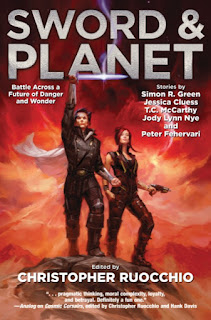
Book Review: SWORD AND PLANET (2021)

"Sword and Planet" is a sub-genre mixing science fiction and fantasy tropes that, although one of the oldest in modern SF (think the Edgar Rice Burroughs stories featuring heroic Earthman John Carter on a habitable Mars) doesn't get the attention it merits. Fortunately Baen put out Sword and Planet, a collection of several such stories, which I got the pleasure of reviewing. Here goes...


The collection starts out with a bang with Tim Akers' "A Murder of Knights." Basically a member of a high-tech knightly order has to investigate some sinister doings and finds himself facing off against something abominable, with a very bloody deadline. It seems like an origin story for a particular character and according to a conversation I had with the author, there's more content out there set in this universe. The fact my first reaction to the story was to see if there was more of it reflects very well on this collection.

Another story I enjoyed was R.R. Virdi's "A Knight Luminary" in which a trainee knight in a future war with a machine intelligence *still* hasn't manifested the psychic powers he needs. He and his fellows investigation an outpost that's gone silent and, as can be expected, things go very, very wrong.

"Bleeding From Cold Sleep" by longtime Warhammer 40K author Peter Fehervari features a fugitive member of what are essentially humanity's Cossacks (the vanguard of human expansion against a myriad of alien races, the first of which are based in a more pulp-fiction version of our own solar system) and just why he's a fugitive. It turns out there's a threat much, much closer to home.

In T. C. McCarthy's "The Test," a world that has regressed into a medieval state features a king, his son who reminds me a lot of Prince Hal from Shakespeare's HENRY IV, and another son who'd like to usurp him. And did I mention there are monsters and priests using advanced technology? This was fun too.

Rounding out my favorite stories is the novella "Queen Amid Ashes," set in author Christopher Ruocchio's SUN EATER universe (which begins with the novel Empire of Silence, the first of several). Our hero Imperial noble Hadrian Marlowe and his companion, the foreign cyborg doctor Valka, and their Imperial troops must liberate a world under attack by the predatory alien Cielcin, but there's much more going on than an alien invasion. There are some very vivid descriptions here.

Unfortunately, not every story in the collection is so grand. I loved the Deathstalker novels when I was in middle school, but Simon R. Green's "Saving The Emperor," which describes the origin of the titular Deathstalker noble family, was disappointing. I had a hard time following Susan R. Matthews' "Operatix Triumphans."

Still, no collection is perfect and I would definitely recommend this one. 8.0 out of 10.

Saturday, January 1, 2022

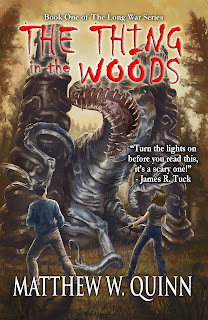
New Year, New Cover for THE THING IN THE WOODS

The first cover for The Thing in the Woods, originally published by Canadian small press Digital Fiction Publishing, was assembled from two pieces of Adobe stock art I found for the publisher. However, the cover for its independently-published sequel The Atlanta Incursion was illustrated by artist Matt Cowdery and laid out by designer Mikio Murikami. Although the fonts are the same, the illustrative style is very different and this is something that has been remarked upon.

Well, since Cowdery's art has been highly praised by pretty much everybody I run into at in-person events and he has done the cover for the planned third novel The Walking Worm, it's time to make the whole "Long War" series consistent. Furthermore, according to some writing podcasts I listen to, a new cover is a good way to spike sales for an older book.

So here's Cowdery's cover for Thing, featuring male lead James Daly and female lead Amber Webb (her first canonical image) confronting the titular horror.


Both the e-book and print book are now live with the new cover. Enjoy!

Tuesday, December 21, 2021

The Origin of LITTLE PEOPLE, BIG GUNS, Or "A Lie Can Travel Around the World and Back Again While The Truth Is Putting On Its Shoes”

There's a supposed quote from American author Mark Twain about how, "A lie can travel halfway around the world while the truth is putting on its shoes." Many times the first media report about something, regardless of its accuracy or whether the complete story is told, will travel far and people will ignore the follow-up. 

This article from NPR discusses the early coverage of the Sandy Hook school shooting, including how somebody else was mistakenly identified as the shooter and how some early reports claimed school officials actually let the shooter into the schoolSunil Tripathi was initially identified as one of the Boston Marathon bombers, only for it to come out later he'd committed suicide long before the bombing. More recently and speaking from my personal experience, I initially thought the episode with the students from Covington Catholic High School and Native American activist Nathan Phillips just involved a confrontation between them--the involvement of a third party (a group of street preachers affiliated with the Black Hebrew Israelites) didn't appear in any of the news I'd read until some time later. This article from The Atlantic breaks down how the major media failed to point out that the BHI preachers had initially confronted the Native Americans and then attempted to redirect the whole situation toward the Catholic students, instead focusing on student Nick Sandmann, who appeared to be smirking at Phillips while he plays the drums. Several media outlets ended up settling lawsuits with Sandmann, whom I remember being vilified online at the time (to the point the school closed due to threats) and even now.


And this is something that applies to my own writing, in particularly my horror-comedy novella Little People, Big Guns from Deadite Press. I got the initial idea for LPBG from a news story that claimed TV chef Gordon Ramsay had a gay dwarf porn star lookalike named Percy Foster, who was found dead in a badger den. However, the Huffington Post did some digging and found that not only had local police no idea what was going on, but nobody in the porn industry had heard of Mr. Foster, who should be more well-known given his stature and appearance. Furthermore, the initial reporting on the incident came from The Sunday Sport, a British tabloid that, among other things, has claimed a WWII bomber had been found on the Moon. However, before this had happened the initial reporting went viral. The story circulated online--here's a Facebook post from 2014 about it and here is a 2018 article from The Daily Mail. 2018--that's seven years after the incident was debunked. Lies can live forever on the Internet it seems.

However, even though it turns out the whole incident with Mr. Foster didn't actually happen, that got my creative juices flowing. The initial story idea (which just focused on the little people and the killer badgers), after some suggestions from then-editor of Deadite Jeff Burk, soon grew into a bizarre almost true-crime saga involving terrorists, car chases, and even an unnaturally large and dangerous animal. If you like your horror spiced with comedy or if your sense of humor trends very dark, I would recommend checking out Little People, Big Guns.

Sunday, December 5, 2021

My Late 2021 And Early 2022 Convention Schedule

Time to round out 2021 and ring in the first quarter of 2022 with the book signings and appearances I've scheduled so far. This blog post may change as I add events or if COVID leads to event cancellations again.

On Saturday, 12/18, I will be signing at Posman Books at Ponce City Market from 1-3 PM. Back when I had just The Thing in the Woods in the fall of 2017, I had a pretty decent signing there and I'm hoping that lightning strikes twice. Especially since now I've got a bunch more books to sell. :) If you want to let me know you're coming, RSVP on the Facebook event here. Bookstore signings tend to be pretty lucrative for me, since there isn't a table cost like there is for conventions.

As far as conventions are concerned, I will have a hall table at the Atlanta Steampunk Exposition February 11-13, 2022. I might also be speaking on writing-related panels, but that's still being worked out. Since AnachroCon has closed up shop, ASE is consolidating the Atlanta steampunk convention scene. :) And it's been two years since a big steampunk convention in Atlanta, so hopefully there'll be people eager to spend money. This will be the first time the Atlanta steampunk crowd will be seeing The Atlanta Incursion and "Son of Grendel," since those were published in 2020, months after AnachroCon. Hopefully they'll like the new additions.

The final convention I have scheduled so far is Toylanta 2022, slated for March 18-22. Here's where you can buy tickets online. I made a decent amount last time I was there, and with COVID vaccinations being more available and COVID numbers in Georgia declining (fingers crossed that Omicron won't change that), hopefully there'll be more people there. I attended the 2021 Toylanta and haven't put out anything new since then (more on that later), so hopefully there'll be lots of new people.

Between my busy teaching schedule and the fact I've fallen dreadfully behind on producing new books (I wanted to have the sequel to Battle for the Wastelands out sometime this year, but I'm at most halfway through it), I think I'm going to try to limit appearances to one convention or so per month. Also, given how quickly $0.35 per mile adds up, I'm going to try to limit my appearances to metro Atlanta until I've got more books to sell.

If you don't anticipate making it to any of these events, email me at mquinn1984@gmail.com and we can discuss an individual order. I can mail signed books anywhere in the U.S. thanks to Media Mail. Non-US orders I can do, but I'll need to build in additional shipping costs.

Thursday, November 25, 2021

Reflections on STRIKE TEAM ALPHA, 30-Odd Years Later

Staying over at my grandparents' house when I was a child in the early 1990s, I found my uncle's trove of 1970s and 1980s geekdom. We're talking Doctor Who novels (I specifically remember Doctor Who and the Dinosaur Invasion), Dragon magazine, etc. And in particular a lot of tabletop war games, including Strike Team Alpha from 1978. That one was my personal favorite, largely because they had a dinosaur-like antagonist race called the T'Rana. Uncle John eventually let me take it home, but I misplaced it somewhere in my parents' house.


Well, after years of sporadically looking for a new copy (including finding and calling up the original creator, who sent me some pictures of game-manual artwork), I found one on eBay and ordered it (as part of a two-pack with Full Thrust, a British space-fleet tabletop game that's still in production today). Although I don't really like playing tabletop wargames, I do really enjoy the lore and I do remember liking Strike Team Alpha's storyline.

So on this merry Thanksgiving, I got the manual out of the plastic sleeve they sent it in and re-read it for the first time in close to 30 years. How did it hold up? Well here goes...

*The backstory predates Warhammer 40,000's "every faction is evil" darkness by nine years. Earth demands a 95% tax rate from asteroid colonists due to the massive self-importance of the people, or at least their leadership ("Earth being the self-acknowledged center of the Universe decided that its asteroid colonies were not paying the proper respect to the birthplace of humanity"). Colonies that cannot or will not pay are wiped out, prompting the surviving colonists to convert their habitats into generation ships and bug out for another solar system. Earth's population, rather than realizing their own greed and tyranny provoked this and failing to acknowledge the sheer courage this took, call this "the Exodus of Cowards." And when the belters foolishly reveal where they've set up their new homes, the result is the founding of a united Earth government that launches an incredibly destructive war of conquest. Like seriously, three-quarters of the colonists on Tau Ceti are killed in the opening nuclear attack and the subsequent "War of Reclamation" is specifically described in the manual as "a war of terror." One gaming scenario involves miners being used for forced labor rebelling and offering the metals they'd mined to mercenaries to help them re-establish self-government. And that's before the wars with the cat-like Sha'anthra (who wage wars almost for fun with other species or with each other) and the T'Rana (who are genocidal Explosive Breeders) kick off. And the outlying colonists, though they're clearly higher on the moral food chain than the Terran Federation, will often fight each other.

(The more I think about it, the more this sounds like Joss Whedon's space Western Firefly and its film adaptation Serenity.)

*Per the above, although the back-story isn't preachy and annoying, you can tell the politics involved. Not only is the initial exodus from Sol driven by a greedy centralized government that taxes people literally to death, but the Terran colonial occupation regime explicitly forbids ownership of energy weapons by private citizens or even local governments. As a result, colonial militias are equipped with broadly late 20th or early 21st Century assault rifles, machine guns, etc. despite the presence of literally predatory alien races, human pirates, etc. And many of the scenarios the game-book provides include colonial rebels and their hired mercenaries fighting collaborators and the Terran Federation years afterward. Live free or die, indeed. The game came out not long before Ronald Reagan became the U.S. President and reflects some of the zeitgeist of that era.

*There's an apocryphal quote out there that says amateurs talk about tactics and dilettantes talk about strategy, but professionals talk about logistics. And the logistics make sense. The game emphasizes small-unit combat because supporting a large army across interstellar space would be a nightmare. The frontier colonies are underdeveloped (likely intentionally, to keep them from rebelling) and the core industrial worlds are so far away. The supplies and gear for super-advanced weaponry used by the Terran Federation's Marines would have be carried across light-years. So campaigns would need to be short and sharp.

*Speaking as someone who is now vastly more knowledgeable about history than when he was eight, the war with the T'Rana looks a lot like WWII, particularly the last madness of Nazi Germany and Imperial Japan. We're talking an overly-aggressive enemy that fights to the death, literally eats their enemies, picks unnecessary fights that ultimately doom them, will destroy conquered territory rather than allow it to be liberated, etc. The end of the war looks like what would have happened if the U.S. had rejected both the atomic bomb and invading the Home Islands and decided to continue the conventional bombing/blockade...something that wouldn't work against something as large and self-sufficient as an entire star system. The T'Rana are (mostly) contained, but there are still raids.

*The game features tactical nuclear weapons, not just small nukes delivered by missile or aircraft that one might expect, but nuclear weapons deployed by individual soldiers. We're not just talking something like the infantry-operated Davy Crockett recoilless rifle that seems like something that would actually be useable (albeit unbelievably risky to due the fact a single infantryman or combat team could start a nuclear war), but nuclear hand grenades. The game was clearly devised in a time before precision-guided weapons that would allow more-accurate conventional weapons to be used in place of battlefield nukes. There are also fusion-beam weapons called "sunguns" that are sort of like flamethrowers, except one needs to wear anti-radiation protective gear.

*However, the game does feature something called a "battlerob," which is essentially a semiautonomous robotic light tank. Groups like Amnesty International have already spoken out against "killer robots," so this is something that's going to be a political issue in the future.

*The game also features rocket-propelled explosive ammunition, much like Warhammer 40,000's bolters.

*One of the play-testers was George Alec Effinger, a noted science fiction writer and winner of both Hugo and Nebula Awards.

*There are quite a number of typos in the manual.

Verdict: Still a fun world to blow things up in (and it was interesting that many concepts were used in later, more successful games), but finding a copy (and especially finding the Ral Partha figures designed for the game) is going to be a real pain. It'd be nice if there was licensed fiction set in this world (that's one reason I reached out to the original creator), but that seems a bit...unlikely at this point.

Friday, November 5, 2021

Movie Review: THE BLOB (1988)

Once upon a time in elementary school, I was a regular reader of the Crestwood Monsters series, a series of children's books in which the tales of the classical movie monsters (Dracula, the Wolfman, etc.) were retold using black-and-white film stills as illustrations. One such book was centered around the 1950s horror film The Blob. I was aware there was a remake in the 1980s, but never got around to seeing it until Myopia Movies did an episode on it. I wasn't able to participate, but I saw it later when the episode came out.


The Plot

In a ski town in what's probably Colorado, a meteor lands, bringing with it a very hungry life-form that gets bigger the more it eats. A bunch of small-town types like earnest high school football player Paul (Donovan Leitch), cheerleader Meg (Shawnee Smith, who later went on to play Amanda in the Saw films), and biker delinquent Brian (Kevin Dillon) now have much bigger problems than who's going out with whom and who needs tools to work on their motorcycle.

The Good

*In a lot of horror movies, the characters make bad decisions in order to move the plot along. In this film, most of the characters make good decisions and the bad decisions make sense in context (i.e. Brian storms off because he has a big chip on his shoulder and feels disrespected). This makes the titular Blob especially dangerous--in order to deal with people who are mostly not complete fools, it has to be pretty cunning itself.

*Some characters who could be clichés have surprising depths and twists.

*The movie seriously goes for Anyone Can Die. Not going to go into detail for reasons of spoilers, but they definitely avoid the horror-movie problem of the audience pretty much knowing who's going to die from early in the film.

*They use late 1980s practical effects and minimal if any CGI. It looks good. And definitely gross--they were going for ghastly here and it works.

*There are some laugh-out-loud moments, such as one of the football players figuring out who his date's father is.

The Bad

*There's a prolonged opening featuring shots of the town and then we cut to the high-school football game. There are two actual meet-cutes. There's no hint we're dealing with a threat from beyond until at least fifteen minutes in. Some of the stuff is necessary because it introduces the characters but it could stand to be tightened up, like the shots of the empty streets. If that was intended as some kind of fake-out to make the audience think the Blob had already eaten the town, it didn't work.

*There's a subplot involving the town's Catholic priest (at least I think he's supposed to be Catholic based on how he's dressed) that doesn't make a lot of sense and eats up too much screen time. Not going to go into detail for possible spoiler reasons, but his Biblical interpretations and later actions sound more like an End Times enthusiast Protestant, not a Catholic.

The Verdict

Well-made and definitely worth a watch. 8.5 out of 10.

Tuesday, July 13, 2021

Productivity Update 7/13/21

It's been awhile since I've posted an update on my current projects. However, I saw that Chris Nuttall had done that and that reminded me. So let's start with my current primary focus...

Serpent Sword: Battle for the Wastelands #2-There are ten completed chapters, and between those and the partial chapters later on, I have a total word count of 53,694. I think the finish product will be somewhat longer than the original Battle for the Wastelands' 89,000 words, so I'm about halfway through perhaps? I already have the cover art (see below) and have written the book copy, but even if I complete the manuscript in, say, October or November, tasks like hiring a professional editor, revising, formatting, finding another author to blurb it, etc. will take time and then releasing it in December might not be a wise idea. It might be better to hold off until early 2022.


I've noticed that at conventions and on Amazon (especially after the BookBub featured deal), the "Long War" novels The Thing in the Woods and The Atlanta Incursion sell significantly better than Battle and its prequel novella "Son of Grendel." Consequently, once I have Serpent Sword out the door, it is my plan to swing back to that series and put out the third novel The Walking Worm (book copy here) and then the fourth novel, Shadowmen before returning to the Wastelands world with the third book, tentatively titled Escape.

(Once Serpent Sword is published, I'm going to try for a BookBub featured deal for Battle on the grounds that an available sequel would make it more likely to get approval and ultimately more profitable--people might get Battle for $0.99 and then pay full price for Serpent Sword and "SOG." If BookBub does for the Wastelands series what it did for Thing and TAI, I might do Escape before Shadowmen, but the Wastelands world is weird--it's secondary-world fantasy without magic, it's steampunk and post-apocalyptic but it's not in our world, etc. And generally horror sells better than steampunk.)

I have already started writing TWW and Shadowmen, although I don't think I have any completed chapters. TWW's current word count is 16,504 and Shadowmen's word count is 11,236. I can definitely complete TWW in 2022 and I could potentially complete Shadowmen in 2022 as well, given how the "Long War" series is less research-heavy than Wastelands and in particular Shadowmen takes place in the same town as Thing.

Like Serpent Sword, I already have the cover for The Walking Worm made. Here you go. That's MJ-12 agent Thomas Bolton (who first appears briefly in Thing but is in TAI a lot more) on the left and our hero James Daly on the right.


Finally, in April I completed the short story "Run, Hide, Feed" and submitted it to a modern-monster collection. They chose not to include it and it was rejected by an online horror magazine soon after. There are still some pro-rate horror publications I haven't submitted to, although the subject matter (it was written to comment on U.S. mass shootings, in particular the amount of media attention paid to the shooters) makes it a bit of a hot potato. We shall see.

Friday, July 2, 2021

Blast from the Past Movie Review: BATTLEFIELD EARTH (2000)

The Myopia Movies pain train rolls on with this Scientological "classic" Battlefield Earth, in which longtime Scientology devotee John Travolta finally gets to adapt Scientology founder L. Ron Hubbard's science fiction novel (well, the first half of of it), to rather lackluster results. Per Box Office Mojo, it grossed $39M against a $73M budget and is considered one of the worst movies ever made.

(A pity, since the book was all right, or at least had some interesting concepts. Then again, if the movie did well, that's more money for Scientology. As you can no doubt tell, I have an extraordinarily low opinion of the organization.)

I don't remember seeing it in theaters, but I did read the book around the time the film came out and I'm pretty sure I saw at least a large chunk of it on television somewhat later. Here's the Myopia episode, which is probably one of the most hilarious and over the top episodes we've ever done. And now for the review...


The Plot

It's the year 3000 AD and Earth is under alien occupation. The greedy Psychlos are strip-mining the planet for minerals and the dwindling human populations are reduced to essentially cavemen. In this bleak environment, Psychlo Terl (John Travolta) enslaves Johnny Goodboy Tyler (Barry Pepper) as part of an off-the-books scheme to make himself rich mining gold in areas too dangerous for the aliens to visit. Trained by Terl to operate Psychlo technology, Tyler ends up leading the remnants of the dying human race in one last battle for freedom...

The Good

*It's not boring, most of the time. A lot of the unintentional hilarity means it'd work as a comedy. Maybe Mystery Science Theater 3000, Rifftrax, or Cineprov can get their hands on this.

*Travolta's campy performance as Terl is pretty funny. Listen to the podcast episode, especially the parts where Daniel is talking, to get a hint of just how horridly glorious (gloriously horrid?) it is. Imagine John Travolta with dreadlocks and costumed to make himself look nine feet tall angrily lisping about "man-animals" and calling people "rat-brain."

*They wisely kept out the whole "psychiatrists made the Psychlos evil" plot from the book, although given how that doesn't show up until the second half (which was supposed to be a sequel film) maybe it wasn't wisdom on the producers' part.

The Bad

*Pretty much everybody in the movie is an idiot. And that's to put it mildly. Terl knows that Johnny is rebellious and has attacked him and other Psychlos several times, but still chooses to entrust him with his off-the-books gold-mining scheme. There are many situations where he should at least be suspicious about what Johnny and/or other humans are up to, but he just goes along with it. His greed and arrogance blind him to an absolutely ridiculous degree. Terl and the various Psychlos keep screwing with each other in order to always have "leverage," to the point TVTropes called it the film's "arc word." One wonders how their society can even function when pretty much everybody has Chronic Backstabbing Disorder. Meanwhile, Johnny is openly discussing his plans in front of Terl, betting on Terl being so arrogant that he never learned to speak English.

*There is some really bad acting on the parts of people who've performed better in other films. That's one cause for the unintentional hilarity.

*The humans, at least in Colorado, have totally forgotten their history and anything above essentially a Neolithic level. When Rome fell, even though most people couldn't read and write, there was still enough of a literate class to preserve quite a bit of knowledge about what came before. If the modern US were destroyed by aliens, the survivors would be almost entirely literate and I imagine they'd at least make some effort to teach their children, and their children's children, etc. Instead all Johnny's tribe seems to know is that in the distant past "demons" came from the sky and punished mankind and they currently live in fear of a dragon outside their village that it turns out is a mini-golf statue. In the book the descendants of Scottish survivors, though they've regressed to a largely medieval state, still know the true story of the alien invasion and how their ancestors managed to protect their homeland. More on that later...

*There's only one major Psychlo base? In the book there were 15, scattered all over the world. That makes a lot more sense. Given the crap that's just lying around (more on that next), this could've been handwaved if Johnny and friends have reactivated some long-dormant intercontinental ballistic missiles and blew them all to hell offscreen. We could have had a nice orbital shot of alien bases getting nuked like the end of Terminator 3 as Johnny and his allies descend on the panicking Psychlo main base in Denver.

*The back-story for the Psychlo conquest of Earth makes little sense. Terl claims the aliens had wiped out all of humanity's military forces in nine minutes, but even 1,000 years later there is an absolute crap-ton of hardware lying around that is still usable, including nuclear weapons. The book's depiction of the conquest of Earth--the Psychlos used a nuke-proof gas drone to wipe out human population centers, then sent in ordinary military forces to mop up any survivors--makes more sense. And given Psychlo vulnerability to uranium--it ignites the gas they breathe--there were surviving human populations in areas where nuclear weapons were used against the aliens or where there were natural concentrations of it.

(In Scotland, for example, a British military force lured Psychlo tanks into a nuclear minefield and the whole region became contaminated with uranium dust, allowing for a medieval-ish Scottish civilization to survive in the Highlands. Our hero's hometown is in a valley where there were either natural uranium deposits or a nuclear cache that's been leaking, which explains the population decline due to sterility and cancer as well as why the Psychlos never bothered them.) 

Given how the final confrontation with the Psychlos goes down, it should have been at least implied Terl was lying about how easily they'd conquered Earth. I hesitate to do a "how I would have done it" for Battlefield Earth lest I give Scientology more time and attention than it deserves, but I would have had a prologue depicting the original Psychlo attack. We'd see the book's last stand of the U.S. Air Force Academy cadets in chemical-weapons gear against massive high-tech Psychlo tanks, since geographically that's nearest to where our hero and friends live. Maybe they're buying time for some civilian refugees (implied to be Johnny's tribe's ancestors) to escape into the mountains. During the last battle, there could be conversations among the soldiers and/or communications from outside, revealing what's happening--some kind of Independence Day-sized craft that can shrug off nuclear hits appeared over Britain and traveled around the world gassing population centers, followed by mysterious detachments of tanks and super-advanced planes teleporting in and hitting surviving cities and military bases. Rumors about nuclear counterattacks in Britain (our friend the Scots) and that the invaders aren't even human. The cadets eventually go down (perhaps killing Psychlo infantrymen or destroying a tank, revealing that the invaders are in fact nine-foot aliens), but they're able to blow up vital bridges or something so the civilians can escape. Then jump to the "present" day of 3000 AD.

The Verdict

If you want alien-invasion movies with varying degrees of cheese, check out Skyline and its two sequels, Battle Los Angeles, Battleship, or Signs instead. If you want alien-invasion books, check out Footfall, which is the most realistic alien-invasion scenario where humans actually win, or my own The Thing in the Woods and its sequel The Atlanta Incursion.

4.0 out of 10. Better  than Spawn, but that's not saying much.

Thursday, June 10, 2021

Blast From The Past Movie Review: SILVER BULLET (1985)

When I was in middle school, I can vaguely recall that my school library (Dickerson Middle School) had a copy of Stephen King's illustrated novella Cycle of the Werewolf available for checkout. I think one had to have parental approval owing to the extremely violent illustrations, but I'm pretty sure I read it. When I was in high school, I remember taping the film adaptation Silver Bullet off UPN and the beginning at least being rather scary.

(Despite largely not being interested in horror, my mother seems to be aware of werewolf movies in general if not this one--she asked if it was the werewolf's heavy breathing that did it. I do remember the opening operates on the "Jaws principle" of not showing the monster. All you really see is the broad outline of the monster moving in the trees, all you hear is the breathing, etc.)

Well, the time came for Myopia Movies to do an episode on it as part of our Werewolf Month for Halloween. Here's the episode. And now for the review...


The Plot

It's 1976 in the town of Tarker's Mill, Maine. Although it's the spring and everybody is cheerful, the narrator reflects on this being when the horrors began. Said horrors start with a drunken railroad worker getting killed by something big and hairy, and every full moon the killings come again. The person who first figures out that the perpetrator is a werewolf is young Marty Coslow (Corey Haim), who is paraplegic and uses a wheelchair, and is soon followed by his older sister Jane (Megan Follows). Eventually, so does their comedically-alcoholic Uncle Red (Gary Busey).

But the werewolf knows they're onto them and the cat-and-mouse game begins...

The Good

*The acting is good. Haim and Follows come off as believable siblings (with Jane resenting having to look after the disabled Marty and her parents' obvious favoritism), while Busey comes off so well as the good-natured alcoholic uncle that some of the podcasters wondered if he were actually drunk on the set. Given Busey's issues with addiction, that wouldn't really be a shock. Everett McGill handles Reverend Lowe's intensity well--when he confronts two characters later in the film, he's creepy. And even though Robin Groves as Jane and Marty's mother Nan isn't in the film much, she does believably demonstrate her frustration with her brother who gets sloppy drunk in front of her young son and who lectures her about parenting her children when he clearly doesn't even have his own life together.

(His third wife has left him due to his drinking and he's picking up floozies in bars.)

*Making the protagonist of the story disabled is pretty innovative. Although Marty is a paraplegic and that makes his life more difficult, to quote The Gummi Bears, "Disabled does not mean unable." The kid has got quite a bit of upper-body strength for his age and thanks to Uncle Red, he has a combo go-cart/wheelchair that allows him to get around Tarker's Mill on his own rather than relying on people to take him in and out of their cars.

*They brought in Stephen King to write the screenplay. Although writing a novel and writing a film are two different skillsets, they overlap a lot better than directing a film (King directed Maximum Overdrive and did a legendarily bad job). And King knows that to work as a movie the story needs to be consolidated.

*There are only 13 full moons per year (it turns out there aren't two per month like I'd thought), so a realistic werewolf story (in which the full moon prompts the werewolf's transformation) would take place over a prolonged period. After all, a werewolf might not kill every month and death by werewolf might be mistaken for death by another cause--people think the town drunk was decapitated by a train. Cycle takes place over an entire year, but Silver Bullet takes place over a more condensed period of time--the first killing is in the spring (probably April or May) rather than January and the climactic battle with the werewolf is on Halloween, not New Year's Eve. Some of the novel's kills are eliminated (the herd of pigs) or simplified (the jackass father of a girl who's crushing on Marty). Plus I think they theorize that the werewolf is at their most deranged and inhuman at the full moon, but transforms more often.

*Although the kids think nobody will believe their idea about a werewolf and therefore they have to solve the problem themselves, the town sheriff is TVTropes Reasonable Authority Figure. He tries to warn the townsfolk off a vigilante hunt for what they think is a human serial killer (which could result in, say, lynching some drifter whom they mistake for the killer or the townsfolk shooting each other in the dark) and actually investigates when Red suggests a particular person. Given that this is a small town and everybody knows everybody, he's probably aware that Red is a drunk with questionable judgement but he gives his suspicions credit.

*Although it is common for Hollywood to malign small-town religious types as uneducated rubes or dangerous nuts, the portrayal of Christianity in the town is respectful even if it is oversimplified. Marty and Jane are Catholic and participate in charitable work overseen by the Church of Christ's Lowe (implying harmonious Catholic-Protestant relations, something that's not a given in 1976), the town's Church of Christ is well-attended, there does not appear to be any racism directed at the town's black residents, and with a few exceptions everybody is broadly decent to each other. One character shows signs of religious-crazy, but they might be suffering a prolonged mental-emotional breakdown rather than simply being a wolf in sheep's clothing or a dangerous fanatic.

The Bad

*The mighty Daniel described this film as "the non-union Mexican equivalent to American Werewolf in London" and he's kind of right. The movie's transformation sequences look like they're going for the same style, but the filmmakers didn't have the money or the skill to pull it off. I refer to the werewolf in the episode as "the bear-wolf" because that's what it kind of looks like. Even though especially early on they try to keep its appearances to a minimum a la Jaws, it's still pretty obviously an actor in a suit that resembles a skinnier Gmork from The Never-Ending Story.

*It's not as spooky/scary as I remember it. To be fair, part of that was because I was seeing it with other people (who were talking) rather than alone, but it seems more like a murder mystery with a werewolf rather than a horror-horror film. And we figure out pretty soon whom the werewolf is, so it's not even really mysterious--it's more "who's going to get whom first."

*The movie is narrated by one of the characters looking back on the events as an adult. That means we know that this character at least survived, so they're never really in danger. Plus it came off to me like The Waltons, in which the character "John Boy," now a prominent writer, tells each episode's story as an extended flashback to his youth.

*Stephen King, who grew up as a Methodist but now comes off as something like a Deist and whose daughter is a Unitarian minister, has a much more nuanced and accurate depiction of religion in the novel than in the film. In the novel they differentiate between Marty and his family (Catholics) and Reverend Lowe (Baptist) and how they don't ordinarily interact with each other. However, although Marty and his sister are Catholic (Marty's St. Christopher Medal and Jane's crucifix are important to the plot), everybody seems to attend Lowe's Church of Christ. Lowe dresses like a Catholic or Anglican priest even though the Church of Christ is much less formal, to say nothing of it being Protestant. He also claims suicide is the worst sin, which is historically something emphasized more by Catholics (see Aquinas's notion that suicide is unforgivable because you cannot repent of it). Lowe is also young and good-looking but isn't married, something you'd see more with Catholics than Protestants. Given how King wrote both the novel and the film, I'm wondering how he got this wrong. They could have included an elderly Catholic priest in the opening scene at the luncheon and depicted the two working together on the charity fundraiser, with Lowe doing most of the work due to his comparative vigor.

*How in control of its actions is the werewolf? In beast-mode it demonstrates high-level intelligence by cutting power lines, disarming an individual victim before killing them, ambushing armed hunters rather than just running at them, and is capable of using weapons. However, in human form the werewolf has nightmares about their actions and begs God for it to stop, seems to be trying to justify their werewolf actions after-the-fact rather than necessarily reveling in them, and may have been trying to keep themselves from killing people by locking themselves in their garage. In the novel the conflict and the werewolf's progressing insanity are much clearer, with the werewolf at times going out of its way to avoid people and the final confrontation with Marty is the only time they try to eliminate someone who knows too much.

*The passage of time is a bit fuzzy. Although there are a couple times in the narration where it's stated that the killing came with the last full moon of the spring, a month before school let out, that's easy to miss. It would've been clearer if the scene where we first meet Marty and Jane takes place at a church Easter luncheon rather than just some random community event. If school lets out in May, the first killing would be sometime in April and then you could have Easter afterward. Or if Easter doesn't work due to always taking place after the full moon, maybe make it a Memorial Day event? In Portland at least, schools end for students in June, not May, so Memorial Day would be before the end of the school year

*Kent Broadhurst, who plays the father of Marty's murdered friend Brady, simply cannot pull off the man's grief. Given his role in the story--his speech to the sheriff encourages the townsfolk to go hunting the werewolf on their own against the sheriff's orders--that's kind of a problem. Given his extensive work in theater, I'm wondering how that happened.

The Verdict

A good rental, but I wouldn't buy it. 7.0 out of 10. If you want to hear us discuss (and make fun of) the film, here's the episode.