Showing posts with label George Lucas. Show all posts

Thursday, December 1, 2022

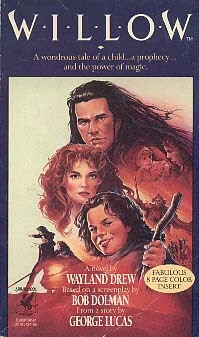
Book Review: WILLOW Novelization (1988)

Since Disney+ is putting out a next-generation sequel to the 1988 fantasy classic Willow, the film podcast Myopia Movies recorded an episode that came out alongside it. I enjoyed the movie, but there were a number of flaws, most notably the lack of explanation and worldbuilding. Given how the movie was intended for children and as-is the host's kindergartner was losing interest toward the end, I figured the novelization would be a big improvement. Fortunately it is available for purchase on Amazon, so I decided to give it a spin.


The Plot

In a faraway land, a prophecy predicts that a child will be born who will overthrow the evil Queen Bavmorda. To that end, Bavmorda, imprisons all late-stage pregnant women and has their child inspected after birth to see if they bear the prophesied mark--and one day the newborn Elora Danan does. A sympathetic midwife smuggles the child out and Bavmorda dispatches her grim General Kael and warlike daughter Sorsha to pursue the child.

But the child falls into the hands of gnomish farmer and family man Willow Ulfgood, who aspires to do magic. Assigned by the gnome village elders to find a human to look after said child, Willow soon encounters the rogue Madmartigan and the transformed sorceress Fin Raziel. Soon they're all allies on a quest to overthrow Bavmorda, with some surprising twists and turns along the way.

(The novelization appears to be based on an earlier draft of the screenplay and includes content cut from the actual film.)

The Good

*The novel beefs up the characterization of Willow himself and emphasizes the danger his quest to protect baby Elora puts him in besides the obvious problem of Bavmorda's murderous soldiers. Basically he's been pursuing his dreams of becoming a wizard to the detriment of working on his farm and owes the bullying village prefect Burglekutt money. Friendly neighbors have had to give him seed for this year's crop and he's apparently one payment away from foreclosure. Although the situation is largely his own fault, if his children had never found the baby he could have easily turned his situation around--he gets a lot of plowing done in a single day.

*Bavmorda, Fin Raziel, and their Fae mentor Charlindea get a lot more back-story and characterization than in the film. In the movie, Bavmorda is basically a live-action version of Snow White's Evil Queen, Fin is a rival she's transformed, and it's not even clear what exactly Charlindea even *is*--on the podcast, I refer to her at one point as the "non-union Mexican equivalent" of Galadriel.

*A monster cut from the film and a monster that appears later in the film have reasons for being there that further build Bavmorda's character. Not only is she a powerful sorceress, but she's also a planner who has fail-safes for her various schemes.

*Burglekutt isn't just an obnoxious small-town moneylender...he's also a prefect in the local government and owns the town's sole seed shop. Willow is not the only person he antagonizes either. If it weren't for his physical cowardice and being completely out of shape physically, he could have been a PG version of small-town gangster Wesley from the Patrick Swayze movie Road House.

*The novel explains some stuff that, in the film alone, don't make a whole lot of sense. For example, the midwife escapes the sinister Nockmaar Castle with the infant Elora by hiding out in some secret passages she knew about (and apparently the guards didn't) until Bavmorda's pursuers are far away before setting off into the wilderness. And once away, she's assisted by people opposed to Bavmorda's regime and even friendly animals. This explains why Elora is a newborn at the beginning of the film but looks significantly older by the time the midwife sets her adrift on the river to save her from the Death Dogs...they've actually been on the run for months. A character who gets captured by the heroes in the film because they insist on being the first one to search a room displays a bit more common sense and sends minions in first.

*The war depicted in the film is also explained in more detail. Bavmorda, having usurped her late husband, rules all the territories he did, and has been making war on the nearby kingdom of Galladoorn. The various rebels, armies, etc. we see in the film are survivors of Galladoorn's army, people within Nockmaar opposed to Bavmorda's rule, etc. The film doesn't really explain the politics of the situation very much or very well.

*There's a scene where we see Nockmaar's army in battle in large numbers (as opposed to Kael and Sorsha's death squad that numbers about fifty people at most) that's pretty cool.

The Bad

*The prose is not very descriptive and doesn't move very quickly until about halfway through the book. There's a lot of telling rather than showing.

*Some of the worldbuilding and back-story is rather silly. Before Bavmorda, apparently all living things in the world lived in harmony and several times characters are assisted by friendly animals. Yes, I know this is a novelization of a children's film and friendly animals are a fairy-tale staple, but still. Although I criticized the movie for oversimplifying matters, the more complex attempts at worldbuilding and back-story raise more questions than they answer. The Willow Blu-Ray has an interview with Ron Howard in which he explains how a whole subplot involving Sorsha's father--the previous king at Tir Asleen and Bavmorda's husband--was ordered cut by the studio and frankly the movie version is better than what's in the novelization. 

(This fan-fic keeps Sorsha's dad dead like the movie at least strongly implies and explains the whole situation better than either the novelization or the film, but beware spoilers.)

Elora's role in the novel is also needlessly complex--some commenter on TVTropes states that she causes Bavmorda's downfall in the film, not by anything she does, but the actions she inspires others to undertake. There's also a lot of Chekov's Guns that aren't fired--worldbuilding that doesn't really tie in with the immediate plot but mostly serves to add pages.

*The way Bavmorda's and Madmartigan's back-stories are explained feature gigantic info-dumps that are basically characters telling stories around the campfire. This is especially the case with Madmartigan. Yes, the back-stories are interesting, but they go on for far too long and are kind of clunky.

*Some stuff from the movie gets left out, like scenes in Nockmaar Castle where Bavmorda interacts with Sorsha and Kael. This would explain the unhealthy family dynamic between Sorsha and her belittling, affection-withholding mother (and why a character's romantic speech, drug-induced though it may be, has such an effect on her) and show the evil kingdom's political dysfunction. Sorsha's first film meeting with the heroes that sets up a lot of stuff that happens later is also left out. Although Willow and Madmartigan benefit from the expanded characterization in the novel, Sorsha (to a point) and especially Kael lose out.

The Verdict

A library read, unless you can get it super-cheap somewhere. Only worth reading once. 6.0 out of 10.

Movie Review: WILLOW (1988)

On the 100th episode of the Blasters and Blades podcast, I briefly discussed the movie Willow with the hosts. I referred to the movie as being "before my time" (it turns out I was actually around four years old, but at that point I was mostly interested in cartoons), much to the slightly-older host's annoyance. At the time I had not seen it, but lo and behold some time later, the film podcast Myopia Movies added it to the Season Nine lineup. So not long after DragonCon 2022, I watched it for the podcast...


Here's the link to the podcast. And now for the review...

The Plot

In a faraway land, a prophecy predicts that a child will be born who will overthrow the evil Queen Bavmorda (Jean Marsha). To that end, Bavmorda, imprisons all late-stage pregnant women and has their child inspected after birth to see if they bear the prophesied mark--and one day the newborn Elora Danan (twins Kate and Ruth Greenfield) does. A sympathetic midwife smuggles the child out and Bavmorda dispatches her grim General Kael (Pat Roach) and warlike daughter Sorsha (Joanne Whalley) to pursue the child.

But the child falls into the hands of the farmer and family man Willow Ulfgood (Warwick Davis), who aspires to do magic. Assigned by the village elders to find a human to look after said child, Willow soon encounters the rogue Madmartigan (Val Kilmer) and the transformed sorceress Fin Raziel (Patricia Hayes). Soon they're all allies on a quest to overthrow Bavmorda, with some surprising twists and turns along the way.

The Good

*For starters, Willow and his kindred are a very specific fantasy race--they're gnomes. This is the first and so far only time I've seen gnomes in an actual film. For the scenes in the gnome village it looks like Lucasfilm hired every dwarf actor in Hollywood--every adult seems to have some form of dwarfism and there are a lot of them who can play musical instruments, fight with weapons, etc. The only ordinary-sized people seem to be the children. This is a good thing on multiple levels--it's more authentic and real-looking and it provides employment for people who often live rather difficult lives. And their characterizations are varied--the gnome village has an obnoxious moneylender who covets Willow's land, there are full-time soldiers (who are actually fairly skilled--on Twitter I called them "the littlest pikemen"), and even a wizard. We even see their form of government--they seem to have a town council and direct democracy on certain major issues. These aren't a bunch of circus performers, but an actual complex society.

*Also, this is a world where there are non-human fantasy races in addition to ordinary people. In a world of only Homo sapiens sapiens who often look different, practice different religions, etc. we're often bigoted enough toward each other. Willow and the other gnomes get repeatedly referred to as "pecks" (a reference to a unit of measurement, approximately 12-14 pounds) even by people who are supposed to be heroic. It's a major sign of a character's moral growth that this person starts referring to them by how they call themselves (Nalwyn) rather than "peck."

*The film also has a good cast. I liked all three of the main trio--Davis, Kilmer, and Whalley.

*The movie is fast-moving and entertaining, albeit a bit on the cheesy side.

The Bad

*Unfortunately, I can kind of tell where the filmmakers are getting a lot of their inspiration from. Willow and his friend Meegosh, after being captured by the brownies, are sent on a quest to protect Elora by some kind of forest sorceress whom I refer to on Twitter as Galadriel's "non-union Mexican equivalent." Apparently the novelization explains more--including her relationship to Fin Raziel and Bavmorda--but I shouldn't have to refer to the novelization, deleted scenes, etc. for a movie to make sense. According to the novelization she was a senior sorceress (and also a forest fairy of some kind) mentoring Raziel and Bavmorda, the latter of whom went bad. In the film it's not even clear if she's human or some kind of elf, fairy, etc. Hence "Galaldriel's non-union Mexican equivalent." Making her human--and perhaps involved in the military resistance against Bavmorda we see elsewhere in the film--would be more original, but again, it's not in the film.

*Per the above, there's a lot of missing material that's included in the novelization, earlier drafts of the script, comic books, etc. that would have helped the movie make a lot more sense. For example, Bavmorda believes that even if she killed baby Elora, she'd be reborn in a new body and the prophecy would kick back in. Hence the elaborate ritual to banish Elora's soul to another dimension and/or destroy it completely so that never happens rather than simply murdering her at first chance. There's also a character's defection that has a lot more back-story in the extended universe, but in the actual movie it seems like they're mostly doing it out of love (or at least lust) for one of the good guys.

(I suggested in the podcast the movie could be a bit longer to fix these issues, but Nic cited the example of his own child getting bored later in the movie to point out this risks losing the attention of the primary audience. The deleted scenes pertaining to the defector character--beware spoilers--don't add many minutes to the film, although the last bit involving a character conscious while imprisoned in a crystal is so ridiculous and cheap-looking. A few bits of dialogue here and there would be fine, but lots and lots of new scenes, not so much. I still think it'd be doable, although we're about 34 years too late. If you want an alternative take that's not overly elaborate, check out this fan-fic here. Spoilers beware.)

The Verdict

Not perfect, but a fun and entertaining fantasy film. Also a means of teaching good values to the target audience (kids) without being preachy and annoying to adults. 8.5 out of 10.

And while you're at it, check out my novella Little People, Big Guns. Although it on the surface it looks rather tacky and exploitative, my intention was to get into the real life issues little people face--people ignoring them because they can't see them, problems functioning in a world designed for people much larger than themselves, health difficulties, bullying by bigger people, and even weird fetishization. Davis actually runs an acting agency that started out representing his coworkers with dwarfism and later included those who were unusually tall.

Tuesday, October 30, 2012

Disney, Star Wars, and An Idea for the "Sequel Trilogy"

I heard earlier today that Disney is buying LucasFilm and production on a new Star Wars movie, the beginning of a new trilogy, has begun. Although some people are skeptical of the project, given how Disney was ultimately behind the awesomeness that was The Avengers,I think this could go in some really good directions.

In particular, I'm hoping they adapt Timothy Zahn's Thrawn trilogy--Heir to the Empire, Dark Force Rising,and The Last Command. The three books are especially beloved by the Star Wars fan community, which has oftentimes been greatly disappointed by the things Lucas has done to the SW universe.

Furthermore, the Thrawn trilogy has elements that would make it very attractive to the general audiences who loved the original films (and the prequels).

*We have Grand Admiral Thrawn as a powerful and threatening, but not wholly evil, villain. He's a man (sort of) who rose to a position of high honor and respect in Palpatine's Empire despite Palpatine's anti-alien racism and was entrusted with the Empire's continued military expansion in the outer regions of the galaxy while Palpatine and Vader ruled at home. He's someone who could provoke the same fascination/admiration that Vader did, and pose the same threat to our heroes.

*And we also have Joruus C'Boath, an insane Dark Jedi clone of a Jedi Master of the Old Republic, who can provide a Force-using villain and an opponent for Luke to have lightsaber duels with. He can also serve as a spiritual threat, much like how Vader and Palpatine were to Luke--his price for aiding Thrawn was that he would be given Luke Skywalker, the Princess Leia, and Han and Leia's two children to "mold."

*We have Mara Jade as a love interest for Luke, who never had one in the movies (except for Leia, who it turned out was his long-lost twin sister). Mara Jade was one of the Emperor's Hands, elite Dark Side-wielding assassins, and the last command she received from the dying Palpatine (this was via the Force) was to kill Luke Skywalker. This gnaws at her the entire trilogy, and leads to questions of loyalty. Character conflict is interesting too. :)

*It's set a decade after the original trilogy, much like how the prequels were set 20-30 years earlier. We'll get to see how Luke is reconstituting the Jedi Order and how Leia is putting together a New Republic. We can throw in other stuff, like how Han and Leia married and how the various warlords who emerged from the Empire's collapse were dealt with, as back-story.

Other than the fact there's a new trilogy coming, nothing has been announced. I'll keep everyone posted on what I hear.

Friday, July 29, 2011

"Red Tails" Movie Trailer


Now this looks cool.  I don't know about the Red Tails specifically, but the Wikipedia article about the movie depicts them as being part of the Tuskegee Airmen.

The air battle sequences look cool and I'm interested in both war and history, so I'll definitely be seeing this one.

Wednesday, April 20, 2011

David Lynch Directing "Return of the Jedi" -- Alternate "Star Wars" Ideas

A member of my alternate-history forum said that, according to Wikipedia, George Lucas asked David Lynch to direct The Return of the Jedi but Lynch refused, stating that Lucas should follow his own vision rather than use Lynch's take on it.

This spawned the following discussion.

Some people seemed to think with Lynch at the helm, the story would be more complex and morally gray.  That got me thinking, so here are some alternate ROTJ scenarios that you fan-fiction aficionados might appreciate:

An Alternate Throne Room Battle:

We've already seen Luke tempted by the Dark Side and in the beginning of ROTJ, he uses what later SW works have described as a "Dark Side" Force power--when he Force-chokes one of Jabba's guards.  However, he is also intent on redeeming his father Darth Vader, something that Obi-Wan and Yoda think is impossible.

If he can hold onto that focus more strongly, he won't go totally berserk on Vader when the Dark Lord penetrates Luke's mind, learns that Leia is his sister, and suggests if Luke will not join the Dark Side, perhaps Leia will.  He'll still be angry enough to beat Vader into submission, but if he disarms Vader in a less brutal manner than severing his sword hand, he won't realize just how far he's gone.

So he beats Vader and Palpatine starts his "take your father's place at my side" speech.  Luke, still verging on the Dark Side, attacks Palpatine.  They duel and Luke, facing a more powerful and skilled opponent, draws on the Dark Side and surprises Palpatine with Force Lightning.  Palpatine is older (to the point of walking with a cane) and overconfident, so Luke might be able to overpower him.

Vader has at this point recovered and starts his speech about how now that Luke has beaten Palpatine, they can rule together--all he needs to do is finish the Emperor.  Meanwhile, Palpatine seeks to regain control of the situation and reveals to Luke the coming Yuuzhan Vong, an extragalactic warlike race whose scouts have already reached Imperial territory, and states that the Rebellion is jeopardizing the united galaxy needed to stop them.

(For those of you less familiar with the SW universe, the Vong invaded many years after the Empire's fall.  There is some canonical material suggesting Palpatine knew they were coming and that was one of his motivations for taking over and militarizing the galaxy.)

Luke, who had thrown himself to what he thought was his death rather than submit to Vader's tutelage in the Dark Side in The Empire Strikes Back, would likely get a similar "system shock" from Vader's offer that he got in the canonical film when he severed his father's hand.  Think the TVTrope "Your Approval Fills Me With Shame," on top of the realization that he's on the verge of seriously going evil.  He announces that a Jedi does not murder a defeated opponent and turns his back on Palpatine.

Bad idea.  Palpatine, angry that he has been knocked around by a teenager as well as angry at being spurned, lashes out with the Force Lightning.  He's even more overtly sadistic about it than in the canonical film, which "reawakens" Anakin Skywalker.  Vader then throws Palpatine to his doom and that part of the story ends more or less the same way as canon.

The end result of this scenario is that Luke is somewhat "grayer," having gone much close to falling to the Dark Side than he did in the actual film, and the Empire is shown to have a good reason for doing some of what it does.  And the "Good is Dumb" aspect of Luke is cranked up if he actually turns his back on a living Palpatine, albeit one whom he has defeated, in the name of not unnecessarily killing.

Making a Deal With the Devil

One board member suggested a reptilian race, which are traditionally depicted as evil, on the side of the good guys.  In keeping with Lynch's grayness, they would still be unpleasant--he suggested lizard-equivalents of Ewoks eating Imperial soldiers alive.

That reminded me of the novel The Truce at Bakura, in which it is revealed that Palpatine allowed an alien race called the Ssi-Ruuk to attack isolated Imperial worlds in exchange for their technology.  After Palpatine died in canon, the Ssi-Ruuk went all open-season on the Empire, leading to an alliance between the Rebels and at least one Imperial garrison to deal with them.

I'm thinking that allowing aliens to ravage human-inhabited worlds would not be popular with Imperial military commanders if it got out.  Palpatine, to forestall a possible military challenge to his rule (according to non-movie sources, there was at least one in the canonical timeline), decides to backstab the Ssi-Ruuk.

The Ssi-Ruuk--who believe that if they die away from a consecrated homeworld, their soul will be lost forever and thus will be especially angry if any of them die in Palpatine's betrayal--approach the Rebels.  They will assist the Rebel fleet against the Empire if they get Imperial POWs to "entech"--basically use their souls to power their automated war machines they use for most combat.

The Rebels are horrified by this and reject the Ssi-Ruuk offer.  However, when they attack the second Death Star, they find that it's operational and protected by a heavy-duty energy shield.  The phrase "it's a trap!" comes to mind.  So when things get bad, Akbar calls the Ssi-Ruuk and accepts their offer.  The Ssi-Ruuvi fleet arrives and helps defeat the Imperial fleet over Endor, but then the Ssi-Ruuk demand their pound of flesh (the Imperial garrison of Endor and anyone rescued from destroyed Imperial ships)...

Another member of the message-board suggested another unsavory reptilian ally for the Rebellion could be the Trandoshans, a race of slavers who particularly like picking on Wookiees.  They were allied to the Empire and procured Wookiee slaves for them, but given the Empire's anti-nonhuman racism, I imagine there was friction.

If the Trandoshans decide to ally with the Rebels against Palpatine, that'd caused a lot of friction within the Rebellion, especially with the Wookiees like Chewbacca who'd suffered at their hands.  Bonus points if they commit atrocities against Imperial soldiers and worlds and sell Imperial POWs into slavery.  This would make the Rebellion a lot more morally "gray" too.

Heck, here's something for anyone who wants to rewrite ROTJ to be dark and grim (or at least less black and white morally)--use both of my suggestions.  I'd recommend picking either the Ssi-Ruuk or the Trandoshans for the second one, since using both of them would be a lizard overload.

If you use the ideas, please link back to this blog.