Showing posts with label science fiction. Show all posts

Thursday, September 15, 2022

Movie Review: SOYLENT GREEN (1973)

Once upon a time, there was a Charlton Heston film called Soylent Green, set in the far-off year of 2022 in which Earth has become massively overpopulated and...desperate measures...are required to keep everybody fed. Since we have finally reached that year and the human population has actually started to decline, the film podcast Myopia Movies is doing a very special episode on the film. Here is the podcast episode. And now for my review...

The Plot

New York City Police Department officer Robert Thorn (Charlton Heston) and analyst Sal Roth (Edward G. Robinson) live in an NYC where there are 40 million people, at least half of whom are unemployed. Real food is rare and ludicrously expensive, with most people living on different varieties of "Soylent" made--supposedly--from processed vegetable matter.

When the wealthy William Simonson (Joseph Cotten) is murdered, Thorn investigates and soon finds himself unraveling a conspiracy with the help of Shirl (Leigh Taylor-Young), Simonson's former concubine (more on that later).

The Good

*The film touches on a lot of issues that are still timely. Although the movie is clearly a product of a time where overpopulation was the major ecological fear, the movie also mentions the greenhouse effect and other types of air, water, and soil pollution. Those are still problems, especially the former. It also touches on wealth inequality--New York City in 2022 has a population of 40M people, at least 20M of whom are unemployed. Thorn and Roth are police officers living in a tiny apartment with unreliable power, while most people live in even more wretched conditions. (I'm assuming) due to the massive unemployment and poverty, many women are willing to serve as concubines so degraded they're referred to as "furniture" and can serve particular individuals or whomever happens to be resident in a particular apartment. That's some Epstein-level stuff there. Homeless people literally fill the streets and fire exits. Food prices are rapidly skyrocketing--at one point Roth mentions $150 for a jar of strawberries, and the rarity of real beef reminds me of the early days of COVID when many meatpacking workers were sick.  Crime is so severe than the superintendents of ordinary apartment complexes carry assault rifles--although urban crime is nowhere near the levels of the late 1960s to early 1990s, it has been rising in recent years. Meanwhile, there is a ludicrously wealthy elite living in extreme luxury and fenced off from everybody else like something in Latin America or Africa.

(Someone on Twitter claimed dystopia is when privileged people are subject to the same horrors as the poor and marginalized--a lot of the stuff I've mentioned exists in real life, but for the most part not in the United States. Yet...the film mentions supply chain problems affecting day-to-day living in New York City, even for the wealthiest people, and even causing the decline of the book-publishing industry. Sound familiar?)

The film even touches on the alienation of people from each other...Simonson, who is wealthy enough to afford personal servants and even a concubine, has no next of kin to receive his death benefits. The "furniture" girls, exploited by their employers and on at least one occasion bullied by senior employees, seem to have only each other to rely on.

*Even though the film was made in 1973, there doesn't seem to be any overt racism. The (I assume) WASP Thorn banters with his black boss and Jewish roommate without any hint of snobbery or friction and he treats Martha (Paula Kelly), not only a black woman but the "furniture" of a suspected criminal, politely rather than lording it over her as a police officer and as a man. Although there are obviously still problems that need fixing, the negative of impact of discrimination has been in decline for some time.

*The acting is good. Heston is good as Thorn and Robinson is good as Roth, while Leonard Stone is appropriately reprehensible as the abusive butler Charlie. 

*Rather than a talkie-talk explanation of how just everything went bad, the dystopian aspects of the world are depicted initially by an opening-credit montage depicting population growth and pollution and then by details on-screen...heaps of homeless people, food lines, old people reminiscing about the days when the planet was more habitable, casual discussion of ludicrously-inflated food prices. No infodumping.

*The more you think about it, the more morally gray the situation becomes. Is the conspiracy investigated in the film the lesser evil, in order to reduce human pressure on the already collapsing environment?

*Finally, although this is pedantic, there's no TVTropes Bottomless Magazines here. In one fight sequence, the fact Thorn has to stop and reload his gun is important.

*When we see the cover's "riot control bulldozers" unleashed, the shots are so well-timed that they're actually a bit intimidating. It reminded me of the scene in The Wolfman where a man beats the wolfman to death with his silver-headed cane, but all the audience sees is the rising and fall of the cane over the fog.

The Bad

*The opening montage could have been tightened up a bit. The point could have been made a lot faster.

*The movie overall is rather slow-moving. There's a lot of "this is what dystopia looks like" where not a lot actually actually happens. Things do pick up later in the film though.

*Given the importance of the Catholic Church to the events in the film, there's a missed opportunity to depict the Catholic hierarchy conniving with the villains. Given how we see ordinary Catholic priests and nuns caring for the poor and providing spiritual solace, it wouldn't make the film anti-Catholic. All you'd really need to make the point is to depict a bishop or archbishop involved, which would make the ending more impactful and less vague.

The Verdict

Worth seeing once, but not the classic I expected. 8.0 out of 10.
Sunday, January 2, 2022

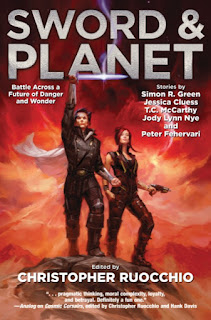
Book Review: SWORD AND PLANET (2021)

"Sword and Planet" is a sub-genre mixing science fiction and fantasy tropes that, although one of the oldest in modern SF (think the Edgar Rice Burroughs stories featuring heroic Earthman John Carter on a habitable Mars) doesn't get the attention it merits. Fortunately Baen put out Sword and Planet, a collection of several such stories, which I got the pleasure of reviewing. Here goes...


The collection starts out with a bang with Tim Akers' "A Murder of Knights." Basically a member of a high-tech knightly order has to investigate some sinister doings and finds himself facing off against something abominable, with a very bloody deadline. It seems like an origin story for a particular character and according to a conversation I had with the author, there's more content out there set in this universe. The fact my first reaction to the story was to see if there was more of it reflects very well on this collection.

Another story I enjoyed was R.R. Virdi's "A Knight Luminary" in which a trainee knight in a future war with a machine intelligence *still* hasn't manifested the psychic powers he needs. He and his fellows investigation an outpost that's gone silent and, as can be expected, things go very, very wrong.

"Bleeding From Cold Sleep" by longtime Warhammer 40K author Peter Fehervari features a fugitive member of what are essentially humanity's Cossacks (the vanguard of human expansion against a myriad of alien races, the first of which are based in a more pulp-fiction version of our own solar system) and just why he's a fugitive. It turns out there's a threat much, much closer to home.

In T. C. McCarthy's "The Test," a world that has regressed into a medieval state features a king, his son who reminds me a lot of Prince Hal from Shakespeare's HENRY IV, and another son who'd like to usurp him. And did I mention there are monsters and priests using advanced technology? This was fun too.

Rounding out my favorite stories is the novella "Queen Amid Ashes," set in author Christopher Ruocchio's SUN EATER universe (which begins with the novel Empire of Silence, the first of several). Our hero Imperial noble Hadrian Marlowe and his companion, the foreign cyborg doctor Valka, and their Imperial troops must liberate a world under attack by the predatory alien Cielcin, but there's much more going on than an alien invasion. There are some very vivid descriptions here.

Unfortunately, not every story in the collection is so grand. I loved the Deathstalker novels when I was in middle school, but Simon R. Green's "Saving The Emperor," which describes the origin of the titular Deathstalker noble family, was disappointing. I had a hard time following Susan R. Matthews' "Operatix Triumphans."

Still, no collection is perfect and I would definitely recommend this one. 8.0 out of 10.

Saturday, January 1, 2022

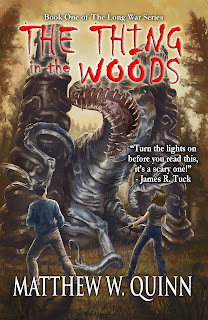
New Year, New Cover for THE THING IN THE WOODS

The first cover for The Thing in the Woods, originally published by Canadian small press Digital Fiction Publishing, was assembled from two pieces of Adobe stock art I found for the publisher. However, the cover for its independently-published sequel The Atlanta Incursion was illustrated by artist Matt Cowdery and laid out by designer Mikio Murikami. Although the fonts are the same, the illustrative style is very different and this is something that has been remarked upon.

Well, since Cowdery's art has been highly praised by pretty much everybody I run into at in-person events and he has done the cover for the planned third novel The Walking Worm, it's time to make the whole "Long War" series consistent. Furthermore, according to some writing podcasts I listen to, a new cover is a good way to spike sales for an older book.

So here's Cowdery's cover for Thing, featuring male lead James Daly and female lead Amber Webb (her first canonical image) confronting the titular horror.


Both the e-book and print book are now live with the new cover. Enjoy!

Thursday, November 25, 2021

Reflections on STRIKE TEAM ALPHA, 30-Odd Years Later

Staying over at my grandparents' house when I was a child in the early 1990s, I found my uncle's trove of 1970s and 1980s geekdom. We're talking Doctor Who novels (I specifically remember Doctor Who and the Dinosaur Invasion), Dragon magazine, etc. And in particular a lot of tabletop war games, including Strike Team Alpha from 1978. That one was my personal favorite, largely because they had a dinosaur-like antagonist race called the T'Rana. Uncle John eventually let me take it home, but I misplaced it somewhere in my parents' house.


Well, after years of sporadically looking for a new copy (including finding and calling up the original creator, who sent me some pictures of game-manual artwork), I found one on eBay and ordered it (as part of a two-pack with Full Thrust, a British space-fleet tabletop game that's still in production today). Although I don't really like playing tabletop wargames, I do really enjoy the lore and I do remember liking Strike Team Alpha's storyline.

So on this merry Thanksgiving, I got the manual out of the plastic sleeve they sent it in and re-read it for the first time in close to 30 years. How did it hold up? Well here goes...

*The backstory predates Warhammer 40,000's "every faction is evil" darkness by nine years. Earth demands a 95% tax rate from asteroid colonists due to the massive self-importance of the people, or at least their leadership ("Earth being the self-acknowledged center of the Universe decided that its asteroid colonies were not paying the proper respect to the birthplace of humanity"). Colonies that cannot or will not pay are wiped out, prompting the surviving colonists to convert their habitats into generation ships and bug out for another solar system. Earth's population, rather than realizing their own greed and tyranny provoked this and failing to acknowledge the sheer courage this took, call this "the Exodus of Cowards." And when the belters foolishly reveal where they've set up their new homes, the result is the founding of a united Earth government that launches an incredibly destructive war of conquest. Like seriously, three-quarters of the colonists on Tau Ceti are killed in the opening nuclear attack and the subsequent "War of Reclamation" is specifically described in the manual as "a war of terror." One gaming scenario involves miners being used for forced labor rebelling and offering the metals they'd mined to mercenaries to help them re-establish self-government. And that's before the wars with the cat-like Sha'anthra (who wage wars almost for fun with other species or with each other) and the T'Rana (who are genocidal Explosive Breeders) kick off. And the outlying colonists, though they're clearly higher on the moral food chain than the Terran Federation, will often fight each other.

(The more I think about it, the more this sounds like Joss Whedon's space Western Firefly and its film adaptation Serenity.)

*Per the above, although the back-story isn't preachy and annoying, you can tell the politics involved. Not only is the initial exodus from Sol driven by a greedy centralized government that taxes people literally to death, but the Terran colonial occupation regime explicitly forbids ownership of energy weapons by private citizens or even local governments. As a result, colonial militias are equipped with broadly late 20th or early 21st Century assault rifles, machine guns, etc. despite the presence of literally predatory alien races, human pirates, etc. And many of the scenarios the game-book provides include colonial rebels and their hired mercenaries fighting collaborators and the Terran Federation years afterward. Live free or die, indeed. The game came out not long before Ronald Reagan became the U.S. President and reflects some of the zeitgeist of that era.

*There's an apocryphal quote out there that says amateurs talk about tactics and dilettantes talk about strategy, but professionals talk about logistics. And the logistics make sense. The game emphasizes small-unit combat because supporting a large army across interstellar space would be a nightmare. The frontier colonies are underdeveloped (likely intentionally, to keep them from rebelling) and the core industrial worlds are so far away. The supplies and gear for super-advanced weaponry used by the Terran Federation's Marines would have be carried across light-years. So campaigns would need to be short and sharp.

*Speaking as someone who is now vastly more knowledgeable about history than when he was eight, the war with the T'Rana looks a lot like WWII, particularly the last madness of Nazi Germany and Imperial Japan. We're talking an overly-aggressive enemy that fights to the death, literally eats their enemies, picks unnecessary fights that ultimately doom them, will destroy conquered territory rather than allow it to be liberated, etc. The end of the war looks like what would have happened if the U.S. had rejected both the atomic bomb and invading the Home Islands and decided to continue the conventional bombing/blockade...something that wouldn't work against something as large and self-sufficient as an entire star system. The T'Rana are (mostly) contained, but there are still raids.

*The game features tactical nuclear weapons, not just small nukes delivered by missile or aircraft that one might expect, but nuclear weapons deployed by individual soldiers. We're not just talking something like the infantry-operated Davy Crockett recoilless rifle that seems like something that would actually be useable (albeit unbelievably risky to due the fact a single infantryman or combat team could start a nuclear war), but nuclear hand grenades. The game was clearly devised in a time before precision-guided weapons that would allow more-accurate conventional weapons to be used in place of battlefield nukes. There are also fusion-beam weapons called "sunguns" that are sort of like flamethrowers, except one needs to wear anti-radiation protective gear.

*However, the game does feature something called a "battlerob," which is essentially a semiautonomous robotic light tank. Groups like Amnesty International have already spoken out against "killer robots," so this is something that's going to be a political issue in the future.

*The game also features rocket-propelled explosive ammunition, much like Warhammer 40,000's bolters.

*One of the play-testers was George Alec Effinger, a noted science fiction writer and winner of both Hugo and Nebula Awards.

*There are quite a number of typos in the manual.

Verdict: Still a fun world to blow things up in (and it was interesting that many concepts were used in later, more successful games), but finding a copy (and especially finding the Ral Partha figures designed for the game) is going to be a real pain. It'd be nice if there was licensed fiction set in this world (that's one reason I reached out to the original creator), but that seems a bit...unlikely at this point.

Friday, November 5, 2021

Movie Review: THE BLOB (1988)

Once upon a time in elementary school, I was a regular reader of the Crestwood Monsters series, a series of children's books in which the tales of the classical movie monsters (Dracula, the Wolfman, etc.) were retold using black-and-white film stills as illustrations. One such book was centered around the 1950s horror film The Blob. I was aware there was a remake in the 1980s, but never got around to seeing it until Myopia Movies did an episode on it. I wasn't able to participate, but I saw it later when the episode came out.


The Plot

In a ski town in what's probably Colorado, a meteor lands, bringing with it a very hungry life-form that gets bigger the more it eats. A bunch of small-town types like earnest high school football player Paul (Donovan Leitch), cheerleader Meg (Shawnee Smith, who later went on to play Amanda in the Saw films), and biker delinquent Brian (Kevin Dillon) now have much bigger problems than who's going out with whom and who needs tools to work on their motorcycle.

The Good

*In a lot of horror movies, the characters make bad decisions in order to move the plot along. In this film, most of the characters make good decisions and the bad decisions make sense in context (i.e. Brian storms off because he has a big chip on his shoulder and feels disrespected). This makes the titular Blob especially dangerous--in order to deal with people who are mostly not complete fools, it has to be pretty cunning itself.

*Some characters who could be clichés have surprising depths and twists.

*The movie seriously goes for Anyone Can Die. Not going to go into detail for reasons of spoilers, but they definitely avoid the horror-movie problem of the audience pretty much knowing who's going to die from early in the film.

*They use late 1980s practical effects and minimal if any CGI. It looks good. And definitely gross--they were going for ghastly here and it works.

*There are some laugh-out-loud moments, such as one of the football players figuring out who his date's father is.

The Bad

*There's a prolonged opening featuring shots of the town and then we cut to the high-school football game. There are two actual meet-cutes. There's no hint we're dealing with a threat from beyond until at least fifteen minutes in. Some of the stuff is necessary because it introduces the characters but it could stand to be tightened up, like the shots of the empty streets. If that was intended as some kind of fake-out to make the audience think the Blob had already eaten the town, it didn't work.

*There's a subplot involving the town's Catholic priest (at least I think he's supposed to be Catholic based on how he's dressed) that doesn't make a lot of sense and eats up too much screen time. Not going to go into detail for possible spoiler reasons, but his Biblical interpretations and later actions sound more like an End Times enthusiast Protestant, not a Catholic.

The Verdict

Well-made and definitely worth a watch. 8.5 out of 10.

Saturday, October 16, 2021

Movie Review: DUNE (2021)

Thanks to an online group I'm in, I managed to get into an early screening of the 2021 adaptation of Frank Herbert's science fiction classic Dune. I'd seen the 1980s film (and even participated in a podcast about it) and the early 2000s miniseries on the Sci-Fi Channel, so I was definitely looking forward to it getting the Lord of the Rings treatment.

(Seriously, owing to COVID concerns I said I'd see the movie in a spacesuit if I needed to.)

So how was it when I finally got to see it nearly a year after the original release date? Here we go...


The Plot

In a space empire thousands of years in the future, the noble House Atreides headed by Duke Leto (Oscar Isaac) is granted the planet Arrakis as a fief by the Emperor Shaddam IV, taking it away from rival House Harkonnen headed by the nefarious Baron Vladimir Harkonnen (Stellan Skarsgård). Arrakis is the sole source of the spice melange, which makes interstellar travel possible, and it is extraordinarily valuable. However, it's a trap--the jealous emperor seeks to destroy Duke Leto, whom he views as a rival.

Into this comes Leto's son Paul (Timothée Chalamet) by his Bene Gesserit (a sort of order of space witches) concubine Lady Jessica (Rebecca Ferguson). Trained by his mother in Bene Gesserit techniques like the commanding Voice, he's been having visions of the future, including the young woman Chani (Zendaya), a warrior from Arrakis's native Fremen people. 

When the emperor's nefarious plot goes into motion, will he be able to draw on the "desert power" envisioned by his father?

The Good

*The cinematography of this movie is quite simply awesome. It is absolutely a magnificently beautiful film, and I cannot say this enough. Caladan, the Atreides homeworld, is a beautiful place of magnificent coasts and oceans, while the Harkonnens rule over a polluted urban hellscape. Salusa Secundus, where the emperor draws his elite Sardaukar armies, is the unholy admixture of the two. They manage to make the Sardaukar disturbing, and that's good.

*One of the great flaws of the 1984 adaptation was how clumsily it handled the exposition needed for this gigantic science fiction universe, and that's not the case here. The filmmakers manage to convey so much with shots or small sequences. For example, rather than explaining the whole back-story about how too-advanced computers are illegal and how specially-trained humans known as Mentats have replaced them, we just see Atreides Mentat Thufir Hawat (Stephen McKinley Henderson) do this peculiar thing with his eyes a couple times, the same with the Harkonnen Mentat Piter de Vries (David Dastmalchian). That the Atreides are benign to their subjects and the Harkonnens harsh and cruel is also show rather than told--Duke Leto is free and easy with visitors on his island paradise and on Arrakis, while people cringe before the Baron and his beastly nephew Glossu "Beast" Rabban (Dave Bautista). And the issues between Jessica and the rest of the Bene Gesserit are handled in glances and a short conversation rather than blah-blah-blah.

*There are some subtle touches of characterization as well, like how in a father-son talk Leto tells Paul that he didn't want to be duke he wanted to be a pilot...and his own father was cool with this, knowing how this would ultimately bring him around to his responsibilities "another way." That skill with piloting comes in handy for several sequences in the film, for both the father and the son. And Leto's father was killed fighting bulls for the entertainment of his subjects--the displayed head of said bull keeps popping up in ominous ways I thought were clever.

*I saw this in IMAX and that's definitely where to see it. Not only will you get the full scope of the visuals, but you'll also get the full force of the soundtrack. Ye gods, the soundtrack. It will crush the life out of you, in a good way.

*The acting of the main characters is impressive. Chalamet does a good job of portraying the teen Paul, portraying his rebelliousness, emotional sensitivity, and giftedness, as well as the steel within that will propel him to his destiny. Isaac is appropriately noble as Duke Leto, while Ferguson is well-cast as Jessica. And although I was skeptical of gender-flipping the Imperial scientist Liet Kynes (the filmmakers came up with this ridiculous reasoning about how women are naturally peacemakers between cultures), I liked Sharon Duncan-Brewster's portrayal, especially later in the film. Josh Brolin does a good job conveying the intensity of Atreides weapons-master and musician Gurney Halleck, while Jason Momoa definitely impresses as the jocular warrior Duncan Idaho.

*The battle sequences are also quite impressive. In the Dune world, personal shielding has reduced firearms to a secondary role at best and much fighting is done with swords. The way the battles take this into account and the way the fight scenes are choreographed is pretty cool.

The Bad 

*Even though they're adapting only the first part of the book, the movie is still very, very long at just over two and a half hours. It starts to drag a couple hours in. That was the single biggest flaw, and kind of a substantial one.

*And even though this is the first half of the book, they still have to leave stuff out. One character who has a lot of internal turmoil is reduced to a non-entity despite their major role in events, as is another character whose actions tie in. Vague to avoid spoilers. :) And I'm wondering if they're consolidating the Harkonnen nephews--we meet Rabban but not Feyd-Rautha, the smarter and more dangerous of the two. Feyd-Rautha isn't to my recollection even mentioned.

*Some of the characters' speech comes off as a bit too present-day for thousands of years in the future.

The Verdict

8.0 out of 10. See it. Go see it. Help it make enough money that we can see the rest of the story on-screen to this degree of glory. Given how the second third to half of the story focuses on the war against the Harkonnens and the Empire, it will almost certainly avoid this film's problem of being too slow-moving.

Thursday, September 23, 2021

Movie Review: HOWARD THE DUCK (1986)

Once upon a time as a child, I wanted to work in movie special effects and at some point read about the special effects for Howard the Duck. I definitely remember a picture of one of the evil aliens, although I don't recall how exactly it was made. Although I have listened to a podcast about the film (possibly the How Did This Get Made episode), I never actually got around to seeing it.

Well, thanks to Myopia Movies, I finally did. Here's the episode. And now for the review...


The Plot

Howard (Ed Gale in the suit, Chip Zien as the voice) is an anthropomorphic duck hailing from Duckworld, a planet where creatures like him are the dominant species rather than humans. After a long day at work, Howard comes home to smoke cigars, watch TV, and read Playduck (yes, really), only to be transported to Earth by scientific accident. He soon rescues small-time rocker Beverly Switzler (Lea Thompson) from punks and she introduces him to her annoying scientist friend Phil Blumburtt (Tim Robbins), who tries to figure out what Howard is and where he came from. Howard tries to make his way in this strange new world, including getting a job, but the experiment overseen by Dr. Walter Jennings (Jeffrey Jones) that brought Howard to Earth soon brings something else as well...

The Good

*The movie is really funny. Not only is there a lot of goofy and slapstick humor, but there're also some more thoughtful jokes, including a sequence where Howard attempts to find a job at the local unemployment office. I laughed out loud several times--I'm really glad I didn't get this movie off Amazon for the Kindle to watch at the gym. Might disturb the others.

(Even though Howard is now a Disney property, you can watch it for free on NBC's Peacock TV streaming service. For now.)

*Gene Siskel's negative review from when the film was released said that Howard wasn't a likeable character, but in-universe it does make sense. He's the only one of his species on Earth, he's a prey animal on top of that (apparently he arrived in Cleveland right before duck-hunting season), people treat him like a pet, a child, and in one memorable scene, a meal, and he's worried he'll never make it home. He's frustrated and lashes out at people, including those who are trying to help him. And that's on top of some of his personal drama from back in Duckworld--he wanted to be a musician but chose to enter medical school to please his parents, only to fail out. The opening also hints at romantic troubles as well.

*The acting is generally good. I particularly found Thompson amusing as Beverly and Robbins amusing, albeit less so, as Phil. Jones, meanwhile, spends much of the movie possessed by an evil alien. If that's really him speaking with the Evil Voice (Brian Steele is listed as the uncredited voice of "The Dark Overlords of The Universe" so it's possible they dubbed him in), props to him for his vocals.

*I did like the soundtrack as well. Also, Thompson did sing as well as act, which is another point to her.

The Bad

*The movie could stand to be tightened up a bit. There's a chase scene that takes way too long even if it does provide some of the aforementioned laugh-out-loud moments.

*Was this movie marketed toward kids or adults? If it was marketed toward kids, no wonder it bombed at the box office. This movie is not for children, at all. That's not a bad thing (nobody thinks Saving Private Ryan is intended for children), but it is something to keep in mind.

*Per my above comment, although Howard being cranky and obnoxious makes sense for the character, he is kind of a jackass early on.

*Although you do eventually get used to it, upon first seeing Howard he's rather off-putting. I wouldn't go so far as to call it Uncanny Valley, but he does look quite weird. Per Wikipedia the original plan was to make him computer-animated but the technology at the time wasn't up to it. Hopefully if they ever remake it, we're looking at something more akin to Avatar.

*There's this elaborate voice-over that starts the film that claims what's real in one world is fantasy in another. So basically Howard is real on his planet, but he's a comic-book character in ours. That's kind of lame. It's also never followed up on--what if Howard were accosted by a crazed fan who knows he's not a man in a costume? You could get really meta.

*Some of the duck puns are really bad--not funny-bad, but just stupid. And if I think a pun isn't funny, you know it's bad.

*The villainous aliens from the climax have not aged well in terms of effects quality.

The Verdict

Worth seeing at least once. I might actually buy it. 8.0 out of 10. Generally speaking remakes should be reserved for good concepts that were executed poorly (or at least not as well as they could have been), so Disney should definitely come up with an MCU version. Thompson has already volunteered to direct, so maybe they should give her a shot. Like the article suggested, her daughter Zoey Deutch could play Beverly in this version too. That'd be hilarious, since they have worked together before and especially considering Thompson said her daughters refused to finish the movie after a...romantic interlude...involving their mother and an alien duck.

Thursday, July 22, 2021

Blast From The Past Movie Review: THE ABYSS (1989)

Once upon a time in elementary school, I spent a weekend or two with my friend Robert at some lakeside property his family owned. And one thing we did a couple of the times we were there is watch the 1989 underwater science fiction film The Abyss. I hadn't seen the movie since then ("then" being in the 1995-1996 range), but it definitely fits the Myopia Movies timeframe--more than 10 years old and you hadn't seen it in five years, with the fact I saw it when I was 10-11 years old even more useful. So I suggested it for the podcast and we did it for this most wonderful season eight.

Here's the podcast episode. And now the review.

The Plot

It's the near-future year of 1994 and an Ohio-class ballistic missile submarine the U.S.S. Montana wrecks in the Caribbean or Gulf of Mexico not far from Cuba. As Soviet and Cuban naval vessels gather, the United States Navy hires a group of deep-sea oil drillers led by Virgil "Bud" Brigman (Ed Harris) to use their underwater drilling platform to send in a SEAL team to rescue survivors. Coming along to make sure everything goes according to plan is Dr. Lindsey Brigman (Mary Elizabeth Mastrantonio), designer of the platform and Bud's estranged wife.

However, the mysterious forces of the deep ocean that caused the wreck of the Montana are still there and interested in these surface-world visitors...

The Good

*The acting is very good. I particularly liked Mastrantonio as Dr. Brigman. She does well as an engineer who's better with machines than people and can really sell grief and panic in a more subtle way than Ed Harris. Michael Biehn does a good job as the psychologically-deteriorating SEAL Lieutenant Hiram Coffey. I got some serious Caine Mutiny vibes off him, especially later in the film. And Todd Graff is fun as "Hippy," a conspiracy theorist who's quite attached to his pet rat.

*The script is well put together. The climactic events of the film are well-foreshadowed (I make a lot of "Chekhov's _________" comments in the Twitter-stream). Although an aggressive military man as opposed to a more peacenik kind-of scientist is the main conflict in the film, it's subverted rather than stereotypical--Coffey is suffering from a legitimate mental illness, the rest of his team seem like decent enough people even if (at first) they follow the orders of a man having a break with reality, and the anti-military clichés (soldiers are unthinking order-following robots, they can only see enemies) are criticisms coming from flawed characters rather than being treated as the actual truth by the narrative.

*For a movie made in 1989, the special effects for the most part hold up really well. The underwater aliens (at this point we all know what's really going on) are very well-done, as is the famous "water tentacle." Only at the end do they falter even a little, and even then it's not bad.

*Even though I'd seen the movie before and generally knew what would happen--and spent much of the film live-tweeting it--there are sequences of legitimate suspense. Had I never seen the movie before or been more focused, this would be even more well-done.

*With the exception of some of the nuclear stuff, the science works. Per the almighty Wikipedia, director James Cameron got the idea for the film in high school while seeing a presentation on liquid breathing and that plays a key role in the climax. Another major plot point revolves around deep hypothermic circulatory arrest, which is also a real thing.

*The entire cast had to become certified SCUBA divers for the film and lot of the underwater stuff rings true (I got my PADI open-water diving license in middle school). Overhead situations (i.e. wrecks and caves), diving so deep you need to use special mixes of oxygen and other gases rather than compressed air, panicking underwater, and the need to avoid decompression sickness are all portrayed as the tricky and dangerous situations they'd be.

*There are some fun action sequences once Coffey starts to go totally insane, including what's essentially submarine demolition derby.

The Bad

*When Ed Harris is supposed to display deep emotion--worry, grief, etc.--he overacts big time. Although given the circumstances it's pretty obvious he'd be upset, he kind of overdoes it.

*A lot of the lesser characters aren't given that much to do. Several characters die in early on when part of the underwater rig is flooded and if they'd been better-developed, their deaths would have hurt more.

*The theatrical release was rather long and the director's cut (which I didn't watch) was nearly three hours. This is definitely a time investment and although it starts out great, it does drag a bit later. The director's cut might have some improvements--I think it elaborates on why the Brigmans are heading for divorce and how the wreck of the Montana is becoming an international crisis--but the length sounds pretty intimidating.

The Verdict

9.0 out of 10. This is definitely worth seeing again. I ended up ordering the DVD off eBay, since I would have otherwise had to get a full-on Amazon Prime subscription to watch it. Thanks Videodrome, the last video rental shop in Atlanta!

Saturday, July 17, 2021

Bad Movie Review: THE DEADLY SPAWN (1983)

I was returning Valerian and the City of a Thousand Planets to Videodrome the other day and there were a couple films I saw in horror section that caught my attention. One was The Deadly Spawn, which I remembered coming across uploaded to YouTube earlier. As an ethical matter I want to pay creators for their work and I was already there, so I rented it.

Now to review it...


The Plot

A meteor crashes to Earth, bringing with it a predatory alien (according to a prequel comic in the DVD extras it's a bioweapon) that chows down on some campers and then hides away in a basement. It proceeds to snack on anybody who comes down while spawning (hence the title) lots and lots of little monsters. The family living in the house above goes about their day, but it becomes increasingly obvious there's a problem.

The Good

*The concept of a family going about their day (a visiting uncle is preparing for a psychology conference; the older brother is having friends over to study) while being completely unaware there's an alien monster lurking in their basement is clever. I also liked the atypical protagonists--a bunch of college science students and retirees rather than typical dumb teens just waiting for Jason to kill them.

*The filmmakers, especially early in the film, are pretty clearly following the Jaws principle of never showing their monster. There are shadows, silhouettes, and partial glimpses, as well as blood spattering from kills, but it's not until around a third in that we see the big kahuna. Given how cheap the creature ends up looking, that's wise.

*Although they didn't have the resources to make a decent-looking monster, the creature design and concept is pretty cool.

*There are some interesting character dynamics, like two characters who are conspiracy theorists and another who's a skeptic--and did I mention there's an incipient love triangle? They play well off each other.

*Not going to go into more detail for reasons of spoilers, but it does have an epilogue showing just what happens after the events of the film that's slightly amusing.

The Bad

*The acting simply isn't very good. In the opening sequence where a couple campers get mauled, they don't seem to be putting much effort into emoting or delivery. The main cast is better, but not by much, and lesser characters who appear later in the film (an old ladies' luncheon from hell) are about as bad as the campers from the beginning. It's not impressive at all. Taking a look at IMDB, most of the people didn't seem to have been in anything else, or only in a small number of films. It would have been a lot better if they'd just consolidated the cast.

*The main characters aren't really built up well, so I didn't really care much about whether or not they ended up monster chow or not. Note that I don't use any of their names in the review--there's a reason for that. :(

*The movie takes too long to get anywhere, despite its relatively short runtime of 78 minutes. There are many overlong shots that are increasingly-obvious padding, especially toward the end.

*The monster-puppet is cheap-looking and not very good.

*The lighting isn't very good. Half the time one can't see anything at all, especially at night or in a darkened basement. Done well, shadows can be spooky, but this just looks cheap and poorly made. There are several occasions where the film is straight-up blurry, which doesn't help.

*There's a major moment relatively early in the film where a character would be literally dead meat if the monster acted like it did earlier, but it was uncharacteristically unaggressive. This is intended to reveal the creature is blind and hunts by sound, but I didn't get that at the time. And what seems like a prolonged standoff lasts so long that one wonders why nobody noticed the character is missing.

*There's some really weird camerawork and editing.

*The monster is pretty big, but not only can it move very quickly, but also very quietly as the plot demands.

The Verdict

Some good ideas, but very poorly executed. Don't bother unless you really like cheap 1980s horror films. If you really want a good creature feature from that era, watch the original Gremlins or Slugs instead. 3.5 out of 10.

Wednesday, July 14, 2021

Movie Review: VALERIAN AND THE CITY OF A THOUSAND PLANETS (2017)

While I was at Videodrome renting a copy of The Abyss for a future Myopia Movies podcast episode, I saw a copy of the film Valerian and the City of A Thousand Planets, which I thought about seeing in theaters back in 2017, dawdled, and ended up missing. Like my father says, if you wait long enough, "I don't know," becomes "no." I eventually got around to renting the film, and now it's time to review it.


The Plot

In the distant future, humanity is one of a vast number alien species coexisting throughout the galaxy and what was once the International Space Station has grown into a galaxy-traveling city of millions. It's also the base of operations for an interstellar police force, two agents of which are Major Valerian (Dane DeHaan) and his partner Sergeant Laureline (Cara Delevingne). Although they both clearly have romantic feelings for each other, she isn't content to be one of his many sexual conquests and he's commitment-phobic.

Into this drops a mission to retrieve a rare "Mul Converter" from a gang of black marketeers. The two officers stumble into a conspiracy involving a planet officially erased from the records and a high-level military cover-up.

The Good

*The acting and characterization are very good. I really liked DeHaan and Delevingne playing their characters as essentially Harry Potter's Ron and Hermione, if Ron were James Bond in terms of martial capability and libido and Hermione were much more sarcastic and rebellious and had a shorter temper and more explicitly traditional views about sex and family. The two have really good chemistry and are fun to watch.

*Writer and director Luc Besson, the mastermind behind The Fifth Element, is clearly having a blast adapting one of his favorite comics to the screen. It's clearly a labor of love and very well-done. This shows in the casting--Besson put in the effort to cast well-known performers like Clive Owen and Rihanna and the costuming, art, etc. are all awesome. Owing to the obscurity of its source material, it's a hell of a lot more interesting than the endless remakes and sequels of more well-known films that dominate today's market.

*The overall plot is a lot more thoughtful than a lot of sci-fi films.

*There are some good uses of "show, don't tell," like a scene early on when Laureline uses the ship's computers to make a point about Valerian's love life.

*There are a lot of fun action sequences.

*The opening montage in which the International Space Station grows to include more and more Earth nations as well as increasing numbers of alien species to the point it becomes a city in space is very well-done, and even includes some cool science bits like how artificial gravity is introduced.

*Although this is hundreds of years in the future, religion--touched on however briefly when Valerian and Laureline are about to go on a mission and during a conspiracy flashback--is something that still exists and is respected, even by a lothario like Valerian. Valerian's offer to find a priest specifically is also a nice tie-in with Laureline from the comics--she was a medieval French peasant who was brought into the future and thus likely to be an actual Catholic.

The Bad

*The movie is about thirty minutes too long. This wouldn't be a problem if an entire subplot involving Laureline getting kidnapped--something that shouldn't be possible if her armor and martial skill are half that of Valerian's--got cut down or excised completely. Seriously, it basically came off as an excuse to have a Rihanna dance number, plus it also relies on a section of the titular space station essentially being off-limits to federal law enforcement agents. That makes no sense.

*There's a sequence at the end where a character introduces some elements that would make the overall situation much more morally gray, but it isn't handled well. And Valerian and Laureline make some ludicrous deductive leaps to figure out parts of it. More details about the war we see before we meet Valerian and Laureline would have been nice, as it would explain a villain's actions.

*There are some Chekov's guns that are put on the mantle but not fired. Valerian's promiscuity could have caused problems during the main plot--perhaps he's betrayed by a bitter ex-lover--but it doesn't really come up.

*There's also a major suspension-of-disbelief problem with a group of aliens who play a key role in the climax of the film.

*Early on some people our heroes are supposed to be close to get killed, but they don't seem to care.

The Verdict

It's definitely good and I hope that Besson eventually gets his way and produces a sequel, but it's got some flaws. Worth a rental, or buying cheap. 7.5 out of 10.

Tuesday, July 13, 2021

Productivity Update 7/13/21

It's been awhile since I've posted an update on my current projects. However, I saw that Chris Nuttall had done that and that reminded me. So let's start with my current primary focus...

Serpent Sword: Battle for the Wastelands #2-There are ten completed chapters, and between those and the partial chapters later on, I have a total word count of 53,694. I think the finish product will be somewhat longer than the original Battle for the Wastelands' 89,000 words, so I'm about halfway through perhaps? I already have the cover art (see below) and have written the book copy, but even if I complete the manuscript in, say, October or November, tasks like hiring a professional editor, revising, formatting, finding another author to blurb it, etc. will take time and then releasing it in December might not be a wise idea. It might be better to hold off until early 2022.


I've noticed that at conventions and on Amazon (especially after the BookBub featured deal), the "Long War" novels The Thing in the Woods and The Atlanta Incursion sell significantly better than Battle and its prequel novella "Son of Grendel." Consequently, once I have Serpent Sword out the door, it is my plan to swing back to that series and put out the third novel The Walking Worm (book copy here) and then the fourth novel, Shadowmen before returning to the Wastelands world with the third book, tentatively titled Escape.

(Once Serpent Sword is published, I'm going to try for a BookBub featured deal for Battle on the grounds that an available sequel would make it more likely to get approval and ultimately more profitable--people might get Battle for $0.99 and then pay full price for Serpent Sword and "SOG." If BookBub does for the Wastelands series what it did for Thing and TAI, I might do Escape before Shadowmen, but the Wastelands world is weird--it's secondary-world fantasy without magic, it's steampunk and post-apocalyptic but it's not in our world, etc. And generally horror sells better than steampunk.)

I have already started writing TWW and Shadowmen, although I don't think I have any completed chapters. TWW's current word count is 16,504 and Shadowmen's word count is 11,236. I can definitely complete TWW in 2022 and I could potentially complete Shadowmen in 2022 as well, given how the "Long War" series is less research-heavy than Wastelands and in particular Shadowmen takes place in the same town as Thing.

Like Serpent Sword, I already have the cover for The Walking Worm made. Here you go. That's MJ-12 agent Thomas Bolton (who first appears briefly in Thing but is in TAI a lot more) on the left and our hero James Daly on the right.


Finally, in April I completed the short story "Run, Hide, Feed" and submitted it to a modern-monster collection. They chose not to include it and it was rejected by an online horror magazine soon after. There are still some pro-rate horror publications I haven't submitted to, although the subject matter (it was written to comment on U.S. mass shootings, in particular the amount of media attention paid to the shooters) makes it a bit of a hot potato. We shall see.

Friday, July 2, 2021

Blast from the Past Movie Review: BATTLEFIELD EARTH (2000)

The Myopia Movies pain train rolls on with this Scientological "classic" Battlefield Earth, in which longtime Scientology devotee John Travolta finally gets to adapt Scientology founder L. Ron Hubbard's science fiction novel (well, the first half of of it), to rather lackluster results. Per Box Office Mojo, it grossed $39M against a $73M budget and is considered one of the worst movies ever made.

(A pity, since the book was all right, or at least had some interesting concepts. Then again, if the movie did well, that's more money for Scientology. As you can no doubt tell, I have an extraordinarily low opinion of the organization.)

I don't remember seeing it in theaters, but I did read the book around the time the film came out and I'm pretty sure I saw at least a large chunk of it on television somewhat later. Here's the Myopia episode, which is probably one of the most hilarious and over the top episodes we've ever done. And now for the review...


The Plot

It's the year 3000 AD and Earth is under alien occupation. The greedy Psychlos are strip-mining the planet for minerals and the dwindling human populations are reduced to essentially cavemen. In this bleak environment, Psychlo Terl (John Travolta) enslaves Johnny Goodboy Tyler (Barry Pepper) as part of an off-the-books scheme to make himself rich mining gold in areas too dangerous for the aliens to visit. Trained by Terl to operate Psychlo technology, Tyler ends up leading the remnants of the dying human race in one last battle for freedom...

The Good

*It's not boring, most of the time. A lot of the unintentional hilarity means it'd work as a comedy. Maybe Mystery Science Theater 3000, Rifftrax, or Cineprov can get their hands on this.

*Travolta's campy performance as Terl is pretty funny. Listen to the podcast episode, especially the parts where Daniel is talking, to get a hint of just how horridly glorious (gloriously horrid?) it is. Imagine John Travolta with dreadlocks and costumed to make himself look nine feet tall angrily lisping about "man-animals" and calling people "rat-brain."

*They wisely kept out the whole "psychiatrists made the Psychlos evil" plot from the book, although given how that doesn't show up until the second half (which was supposed to be a sequel film) maybe it wasn't wisdom on the producers' part.

The Bad

*Pretty much everybody in the movie is an idiot. And that's to put it mildly. Terl knows that Johnny is rebellious and has attacked him and other Psychlos several times, but still chooses to entrust him with his off-the-books gold-mining scheme. There are many situations where he should at least be suspicious about what Johnny and/or other humans are up to, but he just goes along with it. His greed and arrogance blind him to an absolutely ridiculous degree. Terl and the various Psychlos keep screwing with each other in order to always have "leverage," to the point TVTropes called it the film's "arc word." One wonders how their society can even function when pretty much everybody has Chronic Backstabbing Disorder. Meanwhile, Johnny is openly discussing his plans in front of Terl, betting on Terl being so arrogant that he never learned to speak English.

*There is some really bad acting on the parts of people who've performed better in other films. That's one cause for the unintentional hilarity.

*The humans, at least in Colorado, have totally forgotten their history and anything above essentially a Neolithic level. When Rome fell, even though most people couldn't read and write, there was still enough of a literate class to preserve quite a bit of knowledge about what came before. If the modern US were destroyed by aliens, the survivors would be almost entirely literate and I imagine they'd at least make some effort to teach their children, and their children's children, etc. Instead all Johnny's tribe seems to know is that in the distant past "demons" came from the sky and punished mankind and they currently live in fear of a dragon outside their village that it turns out is a mini-golf statue. In the book the descendants of Scottish survivors, though they've regressed to a largely medieval state, still know the true story of the alien invasion and how their ancestors managed to protect their homeland. More on that later...

*There's only one major Psychlo base? In the book there were 15, scattered all over the world. That makes a lot more sense. Given the crap that's just lying around (more on that next), this could've been handwaved if Johnny and friends have reactivated some long-dormant intercontinental ballistic missiles and blew them all to hell offscreen. We could have had a nice orbital shot of alien bases getting nuked like the end of Terminator 3 as Johnny and his allies descend on the panicking Psychlo main base in Denver.

*The back-story for the Psychlo conquest of Earth makes little sense. Terl claims the aliens had wiped out all of humanity's military forces in nine minutes, but even 1,000 years later there is an absolute crap-ton of hardware lying around that is still usable, including nuclear weapons. The book's depiction of the conquest of Earth--the Psychlos used a nuke-proof gas drone to wipe out human population centers, then sent in ordinary military forces to mop up any survivors--makes more sense. And given Psychlo vulnerability to uranium--it ignites the gas they breathe--there were surviving human populations in areas where nuclear weapons were used against the aliens or where there were natural concentrations of it.

(In Scotland, for example, a British military force lured Psychlo tanks into a nuclear minefield and the whole region became contaminated with uranium dust, allowing for a medieval-ish Scottish civilization to survive in the Highlands. Our hero's hometown is in a valley where there were either natural uranium deposits or a nuclear cache that's been leaking, which explains the population decline due to sterility and cancer as well as why the Psychlos never bothered them.) 

Given how the final confrontation with the Psychlos goes down, it should have been at least implied Terl was lying about how easily they'd conquered Earth. I hesitate to do a "how I would have done it" for Battlefield Earth lest I give Scientology more time and attention than it deserves, but I would have had a prologue depicting the original Psychlo attack. We'd see the book's last stand of the U.S. Air Force Academy cadets in chemical-weapons gear against massive high-tech Psychlo tanks, since geographically that's nearest to where our hero and friends live. Maybe they're buying time for some civilian refugees (implied to be Johnny's tribe's ancestors) to escape into the mountains. During the last battle, there could be conversations among the soldiers and/or communications from outside, revealing what's happening--some kind of Independence Day-sized craft that can shrug off nuclear hits appeared over Britain and traveled around the world gassing population centers, followed by mysterious detachments of tanks and super-advanced planes teleporting in and hitting surviving cities and military bases. Rumors about nuclear counterattacks in Britain (our friend the Scots) and that the invaders aren't even human. The cadets eventually go down (perhaps killing Psychlo infantrymen or destroying a tank, revealing that the invaders are in fact nine-foot aliens), but they're able to blow up vital bridges or something so the civilians can escape. Then jump to the "present" day of 3000 AD.

The Verdict

If you want alien-invasion movies with varying degrees of cheese, check out Skyline and its two sequels, Battle Los Angeles, Battleship, or Signs instead. If you want alien-invasion books, check out Footfall, which is the most realistic alien-invasion scenario where humans actually win, or my own The Thing in the Woods and its sequel The Atlanta Incursion.

4.0 out of 10. Better  than Spawn, but that's not saying much.

Monday, May 10, 2021

Two THE ATLANTA INCURSION #BookTube Reviews In Two Days

One strategy I've been using to promote my work is seeking out booktubers to discuss my books on their channels. Early-mid May has been, to quote the great Borat, "Very nice." I have gotten two largely positive video reviews on YouTube for my novel The Atlanta Incursion, the sequel to The Thing In The Woods.

Here's the one posted May 9 from Jeremy Fee, a Texan who liked the small-town feel of the original Thing and followed the survivors to the big city for the sequel:


And here's the one posted May 10 from Lady Jane Books, who got very excited about it:


This was a very nice couple of days. If you're interested after watching these videos, you can find both The Thing in the Woods and The Atlanta Incursion on Amazon. They're both in Kindle Unlimited. And if you're not, check out their YouTube channels--they might have books you would enjoy.

Wednesday, April 7, 2021

Summer and Fall 2021 Convention Schedule (So Far)

Given how lucrative conventions are for me--one convention's profits equate to several months' Amazon royalties--and COVID seems to be waning, I'm getting events lined up for this summer and fall. This is still in-progress, so I might come back and edit this post as necessary. Hopefully there won't be any COVID spikes or political nonsense that could interfere...

Confirmed Events

June 5, 2021: The Middle Georgia Comic Convention in Macon, GA. I want to expand outside of the Atlanta market without hotel expenses cutting into my profits, so a one-day event an hour and a half or so outside of Atlanta is just perfect. I made sure to contact some of the local media in advance--the newspaper did a preview story (and the editor came by to purchase two books), while the local TV station announced it was coming and then interviewed one of my Horror Writers Association Atlanta Chapter colleagues. I made a decent profit and got 17 new e-mails for my newsletter, which will be helpful in the long run.

July 10, 2021: Comics and Collectibles Show in Braselton, GA. I think a lot of the people involved in Toylanta 2021 were involved in this one and Braselton is convenient to both heavily-populated Gwinnett County and Athens, the home of the University of Georgia. And cheap table cost too. :)

August 6-8, 2021: Atlanta Comic-Con-This is the big kahuna--I made all the money I mentioned above when I split the table cost with C.S. Johnson and I've got a partner for this one as well, fellow Atlanta Horror Writers Association member Venessa Giunta. And last time I only had two books, The Thing in the Woods and The Best of Heroic Fantasy Quarterly Vol. 2, the latter of which I straight-up sold out on. This time around I'll have seven books available, including the Thing sequel The Atlanta Incursion (great for two-for-one deals) and the completely new (to ACC) steampunk Wastelands series. I'm also going to set Thing and Battle for the Wastelands e-books to $0.99 and hand out a lot of cards with QR codes linking to them, a strategy that has ginned up e-book sales before.

Also, Cineprov, an Atlanta film comedy troupe whose membership overlaps significantly with Myopia Movies, may be performing there as well. Come for the humor, stay for the products. :)

August 14, 2021: FarleyCon-I found out about this event at Toylanta in mid-March. Although I'm leery of out-of-state events due to hotel costs eating my profits, this event takes place in a suburb outside of Chattanooga, pretty close to the Georgia line. Table costs were pretty low, although owing to the distance mileage is going to be an expense.

August 15, 2021: Atlanta Comic Convention-This is a relatively short event relatively close to Emory University. I've been there a couple times before, but this time I've got a lot more stuff than last time.

October 2, 2021: NextChapterCon-This event is dedicated to independent authors and books solely. I attended two previous events and served as a panelist on multiple panels, so it's good to carry on the tradition. Furthermore, this year's event will be in Dalton rather than Ringgold, meaning hopefully a larger audience given how it's a larger community to start with and Dalton State College is located there..

In-Process

October 8-10, 2021: Monsterama-This is another relatively new convention. It's a bit of a hike from my day job and so last time I dawdled so much that I ended up not being able to get a table when I finally decided to apply. However, Toylanta showed that going straight from work to a convention that officially starts Friday night in the northern suburbs is completely doable.

Saturday, December 26, 2020

My Recent Reading List (December 2020)

Being that I'm a high-school teacher, I get a lot more time off than the average bear. This past week-ish, I've been using my free time to either catch up on reading or take notes from books I've read previously but had sitting around for weeks or months.

Here's a partial list of books I've read, books I'm reading, and books I've heard about and am trying to get hold of. If any of these sound interesting, please buy through Amazon because these are Associates links. :)


Bitterly Divided: The South's Inner Civil War-This is about how the South was far from united during the (American) Civil War. It makes the very strong case that if you combined the poor whites and the slaves, the majority of people in the South actually opposed secession, and many people who had supported it became disillusioned as the war went on owing to the mistreatment of the common people by the Confederate government, widespread poverty at home, draft-dodging by the rich and the plantation owners, etc. This is prime research material for the sequels to Battle for the Wastelands, since this world is roughly between the Civil War and WWI in terms of technology and social development (with the exception of slavery) and the late-war Confederacy provides a good example of how a society during this time period could collapse internally.

(The Confederacy also made some obvious mistakes that Grendel, the Wastelands series' Big Bad, can avoid. For example, the planters promised to grow food crops to feed the Confederate armies...but instead grew cotton and tobacco for the mountains of cash they could make. Although the cotton trade helped the Confederacy secure armaments and other useful materials from abroad--the book doesn't touch on that--it also contributed to starvation at home that prompted riots in the cities and desertion from the armies. Grendel, who's been a soldier since he was fifteen and is now in his mid fifties, will have the experience to know this is a bad idea and the dictatorial power and strength of will to make sure this doesn't happen.)

Sapiens: A Brief History of Humankind-A condensed history of the human race I got as a birthday present but only now just got around to reading. Very simple and to the point, very detailed. Some interesting ideas about the nature of human thought processes versus that of our extinct kindred like the Neanderthals and how that extends to things like the establishment of communities beyond the tribe (i.e. a nation, a religion, an economic system, etc). I'd already read the author's book Homo Deus, but not this one.

Artemis-Another birthday book I've only just gotten started on. Crime and shenanigans in the first city on the Moon. :) This is by the author of The Martian, which I found in a free-book box but haven't read yet.

A People's History of the Civil War-This covers a lot of the same ground as Bitterly Divided (it is, after all, by the same author), but also includes the experiences of Native Americans out west and poor people, white and black, in the North. Basically there was a very strong anti-conscription movement in the North, which is typically only discussed in the context of the New York City draft riots. Given how I've noted the steampunk era was full of class conflict, I can mine this for information as well.

Stars In Their Courses: The Gettysburg Campaign-In Battle for the Wastelands and its companion novella "Son of Grendel," most of the action is centered on a platoon (30-40 men) or company (100 men). The largest combat sequences in Battle involve forces that are perhaps a brigade (3,000 to 5,000 men) in size. Things scale up in the sequels significantly. I've also requested author Shelby Foote's novel about the Battle of Shiloh from the library to similarly pillage, since a novel would go into more detail about the experiences of a man on the ground so to speak.

A Nest of Corsairs: The Fighting Karamanlis of Tripoli-This is an older book about a pirate dynasty that ruled Tripoli as the (nominal) subordinates of the Ottoman sultan, but it has some truly vivid descriptions of the environment of Ottoman Tripoli that I copied wholesale into my notes to use as inspiration for sequences in the Wastelands world involving the Iron Desert as well as a "flintlock fantasy" set in a fantasyland version of the early modern Mediterranean. Although it's old-fashioned in some of its language, it's a very interesting read.

Dominion: How The Christian Revolution Remade The World-The Cobb County library has it but the Atlanta-Fulton library doesn't, so I requested an interlibrary loan. Since those are closed down right now, who knows when I'll actually read it. This book discusses the Christianization of Rome and the resulting effects on both Roman and broader Western society. Based on the reviews, the author (although not a Christian and sometimes very critical of Christianity) makes the argument that this improvement has been broadly positive.

Sea Stories: My Life In Special Operations-This is an autobiography of Admiral William McRaven, a longtime Navy SEAL who ultimately planned the raid that killed Osama bin Laden. A lot of interesting stuff about the military in the late 20th and early 21st Centuries, plus some of the Wastelands books involve dirigible raids with assassination in mind, so I can use this as a model.

The Great Influenza: The Story of the Deadliest Pandemic In History-I haven't read this yet, but I have put it on hold from the library. It's about the Spanish Flu, which spread like COVID-19 but killed far worse, and its effect on science, world politics, etc. There are a bunch of people ahead of me in the line for it at the library, so a lot of people are seeing the COVID-19 parallels.

Civil War Commando: William Cushing and the Daring Raid to Sink The Ironclad CSS Albemarle-I vaguely remember reading about this episode as a child in one of my grandparents' Civil War books, but I recently heard about this on the History Unplugged podcast. This sounds like a pretty cool episode in and of itself, plus it's more research material for Wastelands. The Atlanta-Fulton library doesn't have it and interlibrary loans are shut down, so I might have to bite the bullet and buy it.