Showing posts with label music. Show all posts

Tuesday, December 28, 2021

Making a HELLRAISER Musical?

I'm a regular participant in the Concellation Facebook group created to provide people who would have attended conventions canceled due to COVID with a social outlet. In late December I adapted my blog post about how Labyrinth is Hellraiser for kids into a YouTube video and posted it in the group. Someone asked if Hellraiser had a musical number, what would it look like? My response was that you could actually make a full-blown Hellraiser musical.
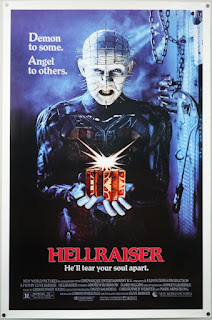

So here's where I plot out a Hellraiser musical. Some ideas for songs and sequences, complete with the relevant film clips.

*At the beginning, Frank Cotton has a musical number while he solves the Lament Configuration. He discusses how he's experienced every pleasure the world has to offer (with some pretty big hints that many of these pleasures are illegal and/or immoral) and now he's looking for pleasures beyond the world. As he solves the box and the boundaries between the worlds start to thin, an ominous chorus of the Cenobites join in. The song culminates in the solving of the box, the chain-attack on Frank, and the first appearance of Pinhead. Here's the relevant scene in the film.

*When Larry Cotton (Frank's brother) and his second wife Julia move into Frank's old house, we could have a three-person musical number featuring Larry, Julia, and Larry's daughter Kirsty from his first marriage. Larry is hoping moving back to Julia's hometown in Britain will help save their marriage, Julia is lamenting how boring it is to be married to Larry, and Kirsty (arriving later to help) sings about how she misses her biological mother and how much she dislikes Julia.

*Frank's resurrection from the floorboards of the room where he was taken to Hell, culminating in a terrible scream, might be an instrumental number. Alternatively, it could have Frank recounting in some kind of spoken-word fashion the horrible things the Cenobites did to him as his body reassembles itself from the floor.

*Bored at a party attended by Larry, some of his work friends, Kirsty, and Kirsty's new boyfriend Steve, Julia goes to investigate the strange noises in the attic, culminating in the encounter with the skeletal resurrected Frank. There's a duet between the two where Frank begs her to help him fully regain his body while Julia is torn between her disgust at this meatless bony monstrosity and her memories of Frank seducing her before her marriage to Larry. At the end of the song, she agrees to help Frank, provided no harm comes to Larry. Despite his obvious contempt for Larry, Frank agrees.

*We next have a musical montage number (possibly some kind of ballet?) of Julia luring men back to the house and killing them for Frank to feed on. Some near-misses where Larry nearly discovers what's going on and Julia has to come up with an increasingly bad series of excuses to conceal her and Frank's activities.

*Befuddled by his wife's odd behavior, Larry takes Kirsty out to lunch and they discuss the situation. This could be dialogue-only, or a sweet-natured duet between the two of them.

*Kirsty sees Julia bringing a man into the house and comes in, only to see Frank kill him and eat him. Frank then attacks her, either in a sexual fashion or to simply eat her too, but she's able to fight him off with the puzzle box and escape the house. She's taken to the hospital with the box, which she refuses to give up, and locked into her room by the staff, plays with it and accidentally solves it. This calls forth the Cenobites and we have a whole musical number about how the Cenobites are "explorers of the furthest reaches of experience, demons to some [and] angels to others" and how, since she's solved the box, Kirsty must come with them and "taste their pleasures." The terrified Kirsty manages to bargain with them, offering them Frank in return for herself.

*As Kirsty rushes home to warn her father, Frank and Julia murder him and Frank skins him. This is something that wasn't in the movie, but should have been, so the confrontation between the brothers and Larry's murder should be a musical number culminating in Frank's horrific appearance and Larry's death. Kirsty arrives and, momentarily deceived by Frank's disguise as her father, briefly encounters the Cenobites in the house as they brood over Larry's corpse. Frank attacks Kirsty, accidentally killing Julia (whom he feeds on as she's dying) and pursues Kirsty into the attic room where Larry's body is. There Kirsty tricks Frank into confessing his true identity and the Cenobites arrive to claim him.

*The Cenobites then try to abduct Kirsty anyway ("we have such sights to show you"), but she uses the box to banish them. Steve arrives and the two attempt to destroy the box, only for a vagrant to appear, take the box, and transform into a dragon before flying away.

You guys like? There's a ballet based on Dracula and a musical based on Evil Dead, so as long as the musical retains the film's score (or at least a version of it) and the best lines, this could be better cool. Heck, some of the film's best lines like "we have such sights to show you" could be the titles of songs.

(Also, check out the Myopia Movies episode on Hellraiser.)

Sunday, June 14, 2020

After-Action Report: ConFinement 2020

On Saturday (6/13) and Sunday (6/14), I attended ConFinement, an impromptu convention in Dalton, GA put together by people who really, really wanted to go LibertyCon in Chattanooga, canceled this year due to coronavirus concerns. My main goal was to sell books, although networking and just plain enjoying myself was a nice plus.

Before I get into the sales part, here are some fun things that happened:

*I'd anticipated only fans from Georgia and Tennessee and maybe a few outliers from states that are farther out but still nearby, but people came from all over. I spoke to a young-adult librarian volunteer from Florence, Texas about their possibly stocking The Thing in the Woods and met people who'd come down from Raleigh, Detroit, somewhere in Virginia, and even New York City. And although the Facebook event only had 60 confirmed and 80 maybes, around 118 people actually showed up. For a convention that only had two months to prepare and wasn't heavily advertised, this was impressive.

*One person couldn't leave Sunday morning because a cat had gotten into the engine of her hybrid van. The hybrid part is important because the undercarriage is sealed off rather than being open like a conventional engine--the cat would either have to get in/out via the axle/wheel well or up through the engine. I got some of a breakfast casserole to try to lure it out with the smell of meat, but that didn't work. I called the county animal control in hopes they had people with the skills and tools to get an animal out (maybe some kind of lasso or hook), but we had three police cars show up instead. It must've been a very slow morning. :) I ended up going back inside, since I doubted I could be of any more use than three policemen with flashlights and the car's actual owner. I later went back to check on everybody and both the driver and the police were gone. The hotel manager said he didn't know exactly how the "crisis" was resolved.

(Cue the Unsolved Mysteries or X-Files theme songs. The great mystery of ConFinement 2020--what happened to the cat?)

*Enough people came that the convention organizer--Baen Books author Michael Z. Williamson--ordered Chili's for everybody. Given the severe hit that COVID-19 inflicted on the economy in general and restaurants in particular, I'm willing to bet that huge order of sliders, ribs, Southwestern egg rolls, and vegetables with ranch dipping sauce was well-appreciated.

*Since the hotel only provided the most basic continental breakfast (i.e. honey-buns), people chipped in food for a con suite. We're talking homemade cookies and brownies, candy, fruit, pastries, deli-type sandwiches, soft drinks, and water. I tend to bean-count to make sure I cover my costs at every event, so not having to buy any meals (other than some McDonalds in Acworth when the sugar crash from the birthday cake I'll get to in a later anecdote hit on the way home) was really nice.

*The whole event, including the panels and all the vending, was in one large room. So from my table I could hear everything being discussed. For example, on a panel about actually running conventions, I learned a bit about labor laws and why chocolate or cheese fountains at conventions are not really good ideas. :)

*Sunday was somebody's birthday, so a big sheet cake was acquired. Another nice boost for the local economy. And free cake. :)

*Late Saturday night, I got to listen to Baen Books Acquiring Editor Gray Rinehart play on his guitar a parody of Looking Glass's "Brandy (You're A Fine Girl)" about a fan who wants to go to LibertyCon. He also played "Another Romulan Ale" (a Star Trek song that also references other science-fiction franchises) and a short parody of "Freebird" about not playing "Freebird" on request. That song was pretty funny. And he's got a BandCamp page, so if you want to listen to his songs, here you go.

(And although Baen had rejected Battle for the Wastelands, Mr. Rinehart was so kind as to send me all the commentary, both positive and negative, from the editorial readers. I used that to make the final edits before hiring Jason Sizemore to put together an independent print and e-book edition for me. I showed him the final product and he liked what he saw.)

*Baen Books Publisher Toni Weisskopf gave me a free copy of the science-fiction novel Frozen Orbit because I'm a teacher. Ms. Weisskopf went all-in on the free books--for teachers, for parents of teens, for people who'd never attended a Baen "road show" at a convention before, etc. I think I'll review Frozen Orbit when I've got the time to read it.

As far as selling went, I sold that second backer copy of the tabletop war-game Stalin's Final War that I helped fund on Kickstarter. I'd helped fund the game because I liked the concept, not because I'm a gamer, but realized that I could independently sell my backer copies much like I independently sell my books for money. I also sold five copies of Thing, five copies of Little People, Big Guns, two copies of Battle, one copy of my short-story collection Flashing Steel, Flashing Fire, and two copies of the short-story collection The Best of Heroic Fantasy Quarterly Vol. 2 in which my Viking monster story "Nicor" appears. I sold a bunch in "two for $20 deals" and made one "three for $30" deal that, although they meant less per-book profit, meant more books got moved.

Having reviewed my figures, if I don't include the cost of SFW (which I backed more to be a patron of the arts rather than get a product to sell), I made a profit of $34.19 for the whole weekend. If I include the cost of SFW, however, it's a loss of around $35. Not including SFW, period, means a loss of $15. I also got ten e-mail addresses for the newsletter, which will be of particular importance with The Atlanta Incursion (the Thing sequel) slated for release in later June or early July and one person saying they'd prefer Thing and Battle as e-books.

Still, for the fun had and most if not all of the costs covered (I definitely got more than my money's worth on all the food), I would count this as a success. :)

Saturday, August 10, 2019

Tim Hawkins' Parody Songs About Chick-Fil-A

I was at a Horror Writers Association meeting the other day and a fellow group member showed me these two videos by Christian singer and comedian Tim Hawkins about none other than Chick-fil-A. Here's the first, parodying the Beatles' "Yesterday."


And here's another one, parodying Lee Greenwood's "God Bless The USA."


Is that Truett Cathy there at the end? :)

Thursday, December 20, 2018

Movie Review: Labyrinth (1986)

I don't call my review of Labyrinth a "blast from the past" review because I never saw it when I was a kid, except perhaps for the opening animated owl on the Disney Channel. I knew about the movie from film books (I remember reading about the special effects in a book that also shows how they did the unmasked Vader for Return of the Jedi, for example) and always found the concepts and some of the imagery rather creepy, so I actually avoided watching the film.

(I did know enough about the film to make jokes about David Bowie's excessively tight pants when I was older.)

Well, the film podcast Myopia: Defend Your Childhood is discussing the film and so here I am finding the motivation to watch the movie. Here's the podcast. And now for the review...


The Plot

Teenage Sarah Williams (Jennifer Connelly) is not taking her parents' divorce, her father's remarriage, and the presence of her baby half-brother Toby (Toby Froud) very well. She retreats into her imagination and fantasyland far more than is healthy. Required to babysit Toby one night so her father and stepmother can go on a date, she becomes so frustrated with him that she wishes the Goblin King would take him away.

Well be careful what you wish for. None other than the Goblin King Jareth (David Bowie) and various Muppet minions show up. Sarah immediately realizes the horrible mistake she's made, but Jareth requires her to solve a magical labyrinth in 13 hours or else Toby will be transformed into a goblin forever.

Sarah now has to traverse a dangerous and magical world, making friends and allies and learning life lessons along the way.

The Good

*Although TVTropes (and some of the reviews from the time) talk crap about her acting, Jennifer Connelly does a great job as Sarah. She starts out as a selfish, immature, annoying, bratty teenager. Seriously, there is a lot of flouncing and excessive drama going on here (plus her speech to Toby about how he's a selfish brat shows quite a bit of projection) and it makes her really unsympathetic. However, through the events of the film, she grows out of it. Even when she's in full brat mode she still shows some sisterly concern for Toby, and Connelly does a good job projecting her growing horror when she realizes that she did set the goblins on him. And when the Goblin King takes Toby away, she sets right to getting him back, although she takes some time to grow out of her demanding and selfish tendencies. Sarah's character arc is extraordinarily well done and much of the credit goes to Connelly.

*The character Hoggle (voiced by Brian Henson) is given real depth and is played very sympathetically. He's short, ugly, has low self-esteem, apparently never had any friends until he met Sarah, and gets abused and threatened by Jareth, but although he does some bad stuff he's not truly bad. I liked him.

*There are moments of legitimate suspense, like the intercut of real, actual goblins observing Sarah about to invoke them and her over-dramatic speech in which she makes the wish that the goblins would take Toby away. If I didn't know the general story already, I would have definitely found it more suspenseful, and if I were a little kid (i.e. the target audience), even more so. And the Junk Lady (Denise Bryer) is pretty creepy too, given what she ultimately plans on doing.

*The movie teaches good moral lessons for children, especially those who might have a new sibling they resent or are part of a blended family. Sarah learns over the course of it to be unselfish, brave, humble, ask nicely for things, not judge by appearances, persevere when things get tough, understand that things aren't always what they seem, and solve her own problems using her own intelligence. She also uses the kindness we see even in full brat mode to recruit allies.

*The movie gets off to a quick start and moves along quickly. Sarah's invocation of the Goblin King is ten minutes in and she enters the labyrinth at around fifteen.

*Although Shelley Thompson isn't in the film much as Sarah's stepmother, she does a good job with her small part. Although I can easily imagine her rubbing Sarah the wrong way, I can definitely see her point of view that Sarah isn't respectful and needs to have a more normal social life. And her and Sarah's issues are shown, not told, in one scene that was painful to watch.

*There are a lot of good subtle touches, and nothing is in the film by accident. For example, Sarah has a scrapbook with clippings of her actress mother's career and a man beside her in the image is David Bowie. To be fair I might not have noticed if I hadn't already known from others' comments on the film that Jareth is really is her mother's new boyfriend (yikes, a sexual rivalry with one's own mother?), but just because someone doesn't notice subtext doesn't mean it's not there. Another example is all the toys and fairy-tale stuff in Sarah's room. Despite being presumably 15-16 (Connelly's actual age at the time), this shows rather than tells her immaturity, as does the fact that she utterly loses it when Toby and/or her stepmother take one of the toys for him to play with. Yes, teenage girls don't want people messing with their things (as Nic pointed out in the podcast), but I was a better sharer at 3-4 (when my little brother was born/big enough to want to play with my toys) than she is at 16.

*The costumes and creature design are very well-done. Giving Bowie's Goblin King different-colored eyes makes for an unsettling introduction, besides the obvious fact that he's come in through Toby's bedroom window and is looming over a teenage girl. There's also a straight-up Goblin Mecha Muppet at one point that's pretty cool, as well as armies of goblins with what look like elderly velociraptor cavalry and machine guns.

The Bad

*The opening sequence goes on for too long with that damn owl flying around. All with the David Bowie soundtrack too. It goes on for nearly three minutes. Come on people, let's get going.

*Speaking of David Bowie, he's not that impressive as an actor. When he first appears to Sarah he's rather monotone and dull. He does manage to project his subtle contempt for Sarah well with his speech about how she should go back to her toys and forget about Toby and it seems like he really is having fun in "Magic Dance." However, I think he's mostly there for the singing, and his acting ability pales in comparison to Connelly.

*There's too much David Bowie music in the soundtrack. Yes, I know he has a major part in the movie, but the Bowie songs are jarring when the rest of the film's soundtrack is more typical of an 80s fantasy film and him actually singing in-scene (other than "Dance, Magic Dance") was even worse. A Bowie concept album based on the film (exploring themes like coming of age, sexual awakenings, parental divorce, etc) would have been an interesting idea though, just like Songs in the Key of X for The X-Files. It would have been better to save the actual Bowie songs in the opening and closing credits of the film rather than have him awkwardly bursting into song in the midst of his appearances. "Dance, Magic Dance" kind of works, but it comes off to me as what TVTropes would call a Big-Lipped Alligator Moment. Although I could imagine it's there to show that Jareth is bored lording it over a bunch of dim-witted gremlins (i.e. motivation for messing with Sarah and/or wanting to keep her and her brother as companions) and that he's more affectionate with Toby than his own sister, it just comes off like an excuse to have a Bowie number. Actual musicals integrate the numbers into the plot far better. And although one could excuse "DMD" as Jareth just being bored and having a musical performance for kicks, him bursting into song at other times really didn't work for me. "Within You" is a really blatant example.

*And as far as Big-Lipped Alligator Moments are concerned, the singing and dancing vaguely Caribbean fire creatures took too much time on-screen, event though they do serve as an additional peril for Sarah and give her a chance to demonstrate her cleverness in dealing with them. The blue-screen effects aren't very good either. I admit I do like the song though. :)

*Some of the dialogue is a little too on the nose, like Sarah's bit about how she took it for granted after Hoggle lectures her about not taking things for granted.

The Verdict

A charming children's fantasy with some flaws. 8.5 out of 10. Of, and for anybody who's interested, someone typed up the entire novelization here. It goes into a lot more detail about the psychological and family dynamics driving the plot if you're into that sort of thing.

Wednesday, March 28, 2018

Adapting Mercedes Lackey's "Werehunter" for Film

A few years back I attended a panel at DragonCon featuring author S.M. Stirling in which he said that short stories make good movies, while books make good miniseries or TV shows. Although I don't watch nearly as much television as I used to, The Stand and Moby Dick are good examples of books adapted to 3-4 hour miniseries and Game of Thrones and The Expanse are excellent of examples of making each book in a series a season for a television show. I even plotted out a nine episode adaptation of my novel The Thing in the Woods as a short TV series in the vein of British shows.

At my various day jobs I typically run YouTube videos to have a soundtrack while I work. The other day I found the song "Golden Eyes" by Heather Alexander, which is an adaptation of Mercedes Lackey's short short "Werehunter." Here's the music video for your entertainment:


I remembered what Stirling said about short stories making good movies when I read the story. "Werehunter" tells the tale of Glenda, an impoverished and friendless young woman who, pursued by some young men with bad intentions, ends up at a creepy old house presided over by a "crazy" woman. Said woman offers her the chance to go to a different world if there's nothing for her here, an offer that she obviously accepts.

Soon after arriving in this new world she learns that thanks to a ring passed down to her by a mother she never knew (she was raised by an unpleasant aunt who didn't like her brother's choice of a wife) she can change her form into a leopard. She finds life as a leopard a lot better than living as a human, but the villagers whose livestock she preys on soon hire a hunter with secrets of his own.

"Werehunter" could be adapted as a film. From the beginning of the story (her getting turned down for welfare from a clerk who clearly has better things to do) to her arriving in another world and her first transformation into a leopard could take fifteen to thirty minutes. There could be a montage of her learning the ropes of living as a predator and how to outwit the villagers and their dogs by using her shape-shifting ability to confuse her tracks and scents.

(That could make adapting it in a movie tricky, as until the very end whenever she appears as a human she'd be naked. The nudity wouldn't be sexual in nature, but that would still jack up the rating for a movie that could otherwise probably be PG. Unless, of course, it was shot at clever angles.)

However, in terms of material resources needed to adapt the film, you wouldn't need that much. Glenda and the hunter are the most distinctly described--Glenda is brunette and plain with odd yellow-brown eyes (and given the nature of the role, the actress would need to be rather...adventurous) and the hunter is a brunette man and strikingly handsome. The welfare clerk, the "crazy" woman, some thug types, her unpleasant aunt for flashbacks, and some peasant-villager types get much less description, so there's more flexibility in casting them. The beginning would take place in the student ghetto in what sounds to me like the Pacific Northwest, but most of the book would take place in the forests and plains of a fantasy world. There're references to a war being fought in the past with "strange" technology that could imply a Dark Tower-like situation that could make flashbacks more expensive if the creators decide to "show" and not "tell" the hunter's back-story. However, if the money's not available or if it's too distracting, that could be elided over or left out completely.

The movie could also be very timely--Glenda ends up the situation in the first place due to predatory men and chooses to spend almost all of her time as a leopard because as a woman alone in a strange world she's vulnerable, but as a leopard she's a fearsome predator. It's a #MeToo fantasy movie, but it wouldn't beat the viewer over the head with a message and thus possibly alienate people.

What do you think?

Friday, December 22, 2017

Music Inspired By Other Faiths I Enjoy

As most of you know, I am a Christian. I'm a member of the Presbyterian Church (USA), although given the theological liberalism of much of the PC-USA, ECO is looking more and more interesting. However, that doesn't mean I don't enjoy listening to music inspired by other faiths. Here are some examples:


Given how this is based on Miriam's "Song of the Sea" from the Book of Exodus and Christianity has no validity except as the successor of Judaism, this isn't really "another faith" per se. It's still in Hebrew--"mi chomocha" means "who is like you, Lord?" according to a Jewish friend. The artist is Debbie Friedman, who seems like the Jewish equivalent of a contemporary Christian artist.


This one invokes the Horned God of Wicca, the lord of the hunt, and this one is actually a bit raunchy. The notion of the gods coming down and having their way with mortals is alien to the Abrahamic tradition (before anyone starts, the conception of Jesus was a non-sexual supernatural act--we don't worship Zeus here), but many polytheistic cultures have plenty of demigods. One wonders what it's like to be part of a religious tradition where getting knocked up by a god is a distinct possibility. This song is by S.J. Tucker, who has liked some of my comments on Twitter.


The Norse story of Ragnarok has always been interesting to me, especially since I read the story of Thor and his Mutual Kill with the serpent Jormundgand in James Byron Huggins' novel Leviathan. A pity iTunes doesn't have this, because I'd love to buy it. For the record, this is a Sabaton cover of a song by Amon Amarth, but since Sabaton actually enunciates, it sounds a lot better. There are Christian songs celebrating Jesus's return like Nicole Sponberg's "Hallelujah" or the various versions of "Days of Elijah," so a song celebrating Thor's self-sacrifice in destroying a monstrous world-devouring snake would work too.


This is about ritual magic I think, and given the reference to "so mote it be," perhaps it refers to Wicca. In S.M. Stirling's The Protector's War (I think), a Wiccan priestess thinks to herself "I will have him. So mote be it" or something to that effect upon meeting the man who will eventually become her husband. This is also by S.J. Tucker. Let the record state that the Bible condemns all forms of occultism, not just "black magic," so listen to the song if you wish but don't go doing what's described.

(Also let the record state that the magic in Harry Potter isn't the type of magic the Bible condemns with the exception of divination, which is generally depicted as fraudulent.)


This one is by Manowar. If I were an Asatruar (a practitioner of the Norse religion), I'd be interested in licensing "Loki God of Fire" for religious purposes. It gets the character of Loki right--in most of the Norse myths, he was a trickster but was still a friend of the gods. I suspect the influence of Christianity made him into a more overtly demonic entity, although I'm not sure. Evidence for the worship of Loki in ancient times is scant but it's not nonexistent, but there are some modern Asatruar who worship him. Given my propensity for shocking people, I could imagine going for Loki-ism as a means of seeking attention. :)


Sometimes it's hard to understand what exactly they're saying, but they're invoking the names of various mythological goddesses like Astarte (Semitic), Inanna (Mesopotamian), Kali (Hinduism), Isis (Egyptian), Hecate (Greek), Demeter (Greek), and Diana (Roman). It's my understanding that Wiccans believe that all the gods are aspects of the Horned God and all goddesses are aspects of the Goddess (in one of S.M. Stirling's books the Hebrew God is referred to as the "jealous" aspect), which would allow for deities to be invoked willy-nilly despite being members of different pantheons.

Although I've got a friend who really loves Muslim nasheeds (which might have contributed to his conversion to Sufism), I haven't got any here. I've never listened to them. Perhaps I'll check them out.

Many of these songs are produced by actual musicians. If these are songs you're interested in listening to, I would recommend you purchase them on iTunes. Even though I found most of these on YouTube, I ultimately purchased them so the artist could be paid for their work.

Sunday, November 26, 2017

Untold Stories Behind Other Stories

Sometimes when you see a movie, read a book, etc., there's something that indicates there's another interesting story in this world waiting to be told. Think Obi-Wan's reminiscing about how Darth Vader "had been a pupil of mine before he turned to evil" and "was seduced by the Dark Side of the Force." Although the Star Wars prequels weren't all they could have been to say the least (I left Revenge of the Sith straight-up laughing after "NOOOOO!"), it's my understanding the Clone Wars cartoon (the various versions of them) is well-done and the fall of Anakin Skywalker could have been a great tragedy in the Greek sense. He has his tragic flaws...fear of loss, anger...and between the negative influence that drawing on the Force using these emotions has and the fact a dark lord has been grooming him since the age of ten, things don't end well for Anakin, Obi-Wan, Padme, the Jedi Order, etc.

Well, that can be applied to some other stories, ones much less well-known than Star Wars.

*I saw a high-school stage version of The Wedding Singer with a former girlfriend and there's a line where Julia reminisces that her young-Trump boyfriend Glenn used to be much sweeter before he got so much money. There might be a story there...Glenn could have entered the New York business world a much better person (perhaps emulating or working for a relative...there's a line in one of the songs "don't cry uncle unless your uncle's the CEO") and got seduced by the money, power, sex, perhaps drugs, etc. that this world offered and turned into a massive jerk. The Glenn we see in TWS is a selfish, controlling, narcissistic jerk, but the murderous warlord Darth Vader was once a pleasant little boy who loved his mother, had lots of friends, and wanted to free the slaves.

*Although I've never seen the Australian Western film The Man From Snowy River (at least in its entirety), I did become curious about it and found there was actually actually a live musical "arena spectacular." It tells broadly the same story as the original film--a penniless young cowboy proves his worth as a man and woos the daughter of a wealthy station owner--but look closely at the cast. One of the side characters is named "Harrison" and is a young cowboy who made a fortune betting on horse racing. The disapproving (until the sequel) father of the spirited young Jessica is named Harrison and he made the money he used to build his ranch betting on horses. The musical is actually a prequel to the film.

(Given how zealous he seems to be about keeping his daughter away from protagonist Jim Craig in the films, the love story from the "arena spectacular" might have ended badly and soured him on the whole "redneck cowboys wooing ranch heiresses" thing. Yes, Harrison is a controlling ass whose behavior alienated his brother, his dead wife, and his daughter, but if it turns out there's some actual wisdom hidden in the class prejudice, sexism, and narcissism it takes the events of both films to at least mitigate, it would make him more interesting.)

*In the Sharpe television series, there's a soldier named Harris who the other characters say should write a book. He's based on a real soldier, who wrote an enlisted man's account of the Napoleonic Wars entitled The Recollections of Rifleman Harris. How Harris "wrote" that book--an illiterate man, he dictated it to an officer friend who eventually got it published--could be an interesting story too.

(The fictional Harris is literate and dies at Waterloo in the TV series, but if Michael Crichton can do the "mostly dead" thing for Ian Malcolm in The Lost World--he dies in Jurassic Park but shows up in the sequel--so could Cornwell and friends if there's any interest.)

And there are plenty of other examples. The TVTropes "Hero of Another Story" and "Villain of Another Story" have plenty. The Avengers depicts Hawkeye and Black Widow bantering about something that went down in Budapest that I think could make a good basis for a prequel movie. In my Wastelands world (the first of many planned novels is under consideration by a major publisher, so fingers crossed), I have the villain Grendel's son Falki reference events I later turned into the novella "Son of Grendel. I also have another planned novella explaining just why Sergeant Ezekiel Thaxton fears the Blood Alchemy Host (an army of mutants bred in the shadow of an abandoned nuclear reactor) so much.

Saturday, January 23, 2016

Redgum, Or More Aussie Rock Courtesy of YouTube

Here're another couple of cool songs from Australia that I found via YouTube. The first is "I Was Only Nineteen," by Redgum.


I'd known that there were Australian soldiers who'd fought beside Americans in Vietnam since I read Peter F. Hamilton's second Reality Dysfunction novel in high school. That one featured a dead Australian Vietnam veteran possessing a living convict in the distant future.

(It's a long story.)

Something notable about this song is that the Australian protagonist has an experience very similar to that associated with American Vietnam veterans (and veterans in general, although Post-Traumatic Stress Disorder became more well-known in the Vietnam generation). He can't sleep at night due to the nightmares, the news helicopter frightens him, and "the rash that comes and goes" might be caused by Agent Orange.

And thanks to "I Was Only Nineteen," I found "Poor Ned," which is about the Australian outlaw Ned Kelly.


The song conflates Kelly with the Eureka Rebellion ("hoist the flag of stars"), in which a bunch of Australian gold miners rebelled against the unpleasant British colonial government. Imagine the Battle of Bunker Hill, only if the Patriots got crushed immediately after inflicting little damage on the enemy but were found innocent of any crime due to jury nullification and ended up getting into elected into the government.

Eureka was many years before Ned Kelly, but Kelly did release a manifesto denouncing the government and calling for justice for the Australian poor. The song lyrics tie in heavily with the manifesto, including defending his shooting of some police (he claims self-defense) and claiming mistreatment of his family by the police. I haven't read Eric Hobsbawm's Bandits, but I do know what a "social bandit" is and Kelly seems to fit the description.

YouTube For You: "I Am Australian"

Awhile back I found "I Was Only 19," a song told from the perspective of an Australian Vietnam veteran, while doing research for another project. Thanks to the wonders of YouTube, I soon came across another song, "I Am Australian."


It's by a band called The Seekers. iTunes, at least in the U.S., does not have the song, or else I would buy it. It's a beautiful song that does justice to the difference cultures that made Australia (the Aborigines, the convict settlers, the gold prospectors, and others) while at the same time promoting a united Australian identity. Although I'm not familiar with Australian political culture, I do know a little bit about the country's history and it's somewhat similar to our own--they're a British settler colony, but the population is not exclusively British in origin or in culture and the country has attracted immigrants from all over. Like them, "from every land on Earth we come."

I wonder if a similar song could be written about the United States? "We are one, but we are many" applies to the U.S. too. Heck, it's our motto and its on our coins--e pluribus unum, "out of many, one." You can acknowledge the contributions of different groups (and marginalized ones) without indulging in rootlessness, anti-patriotism, and cynicism.

*Instead of the Aborigines, you could start with the Native Americans. Perhaps a specific individual like Squanto, or the tribes who helped the Pilgrims in general?

*Instead of the convict laborers, perhaps poor (European) indentured servants or African slaves. It parallels the convicts who "fought the land" and "endured the lash" and acknowledges that things weren't always great for everybody without wallowing in self-flagellation.

*We had our Gold Rush too, so instead of "the daughter of a digger,"a 49er? Alternatively, since they would have come at the same time and to emphasize the "freedom from political oppression angle" that's so strong a part of our identity, we could have those fleeing the repression of the European revolutions of 1848? It was liberal Germans who played a major role in abolitionism and the defeat of the Confederacy. Perhaps they could be combined--a German political refugee who becomes a gold miner and later fights the Confederates at Glorietta Pass? I'm sure someone like that existed.

*The song references several well-known Australians, including the outlaw Ned Kelly and the Aborigine artist (and trailblazer in many ways--he was the first Aborigine to get Australian citizenship) Albert Namatjira. I'd rather not glorify the Confederate die-hard Jesse James, but perhaps one of the Founding Fathers instead? They certainly stuck it to The Man, in that case the British Empire. Not sure about an artist analogue to Namatjira (although Emanuel Leutze did paint the iconic "Washington Crossing the Delaware"), but if you want to go with the civil-rights angle, Martin Luther King?

Apparently a lot of Australians want to make the song their national anthem. I'm disinclined to change ours from "The Star-Spangled Banner," but that doesn't mean I can't appreciate other songs like Lee Greenwood's "God Bless The USA." An American version could rise alongside it.

Sunday, March 1, 2015

Free Skeptic-Friendly Ghost Story To Good Home

The other day my friend Drake Dunaway posted on Facebook a link to the song Ballad Of The Great Eastern by the musician Sting, which appeared on his new album The Last Ship.

I first became aware of the Great Eastern when I was in elementary school and was strongly interested in all the Bigfoot, paranormal, unexplained-type stuff. According to legend, two workmen were accidentally sealed up alive inside the ship's double hull during construction. The ship was plagued for years by various problems and the crew and even the captain reported hearing a mysterious pounding sound. The Great Eastern turned into a major economic loss for most of its owners, and according to the legend, when the ship was finally broken up, they found two skeletons inside. Sting makes it even more poignant by suggesting that the dead men were a father and a son.

However, like most stories of the paranormal, there's a mundane fact that undermines the whole thing. Apparently the inner hull of the Great Eastern had inspection hatches. Even if the workmen had become trapped (the bit about the skeletons is rumor and in different versions of the story there's one skeleton or two, the skeleton is of a shipwright rather than a common worker, etc.), they could use the hatches to escape.

However, that doesn't mean you still can't have an interesting story. Here goes...

The workmen are briefly trapped inside, but use the hatches to escape. Them realizing they're trapped and trying to find a way out before they suffocate or overheat, with nobody able to hear their cries for help over the noise of the construction, could be a terrifying start for the tale. After they get out, they confront the foreman or even shipbuilder Isambard Brunel himself (the villain of the Sting song) over what happened. Fearing the bad publicity, worker unrest, etc. this could cause (according to the song Brunel was rushing construction), Brunel has a couple goons kidnap the two men and take them to some faraway place and dump them. He reckons it will take them a long time to get home and the ship will be finished and launched by then, so even if they do manage to raise a stink, it won't be a major problem.

One of the workers--perhaps unhinged by claustrophobia during his entrapment or by the pounding of the hammers (that the two hulls would amplify)--makes his way back to the Great Eastern in time for it to launch. He hides inside the double hull and commits various acts of sabotage over the years like a sort of working-class Phantom of the Opera,starting with the death of Brunel himself. You could throw in some class envy and poverty by depicting him sneaking out of his lair and eating the kind of luxurious ocean-liner food he could never afford as a Victorian industrial worker. If you want to go with the "skeleton found in the hull" aspect of the legend, perhaps he's killed as the result of one of his sabotages or in some other sort of mishap (like the time the hull got gashed at sea) and his body is found when the ship is broken up, thus spawning the legend.

You like? It's a "rational explanation" for an apparent haunting (hence the title of this post) but still touches on things like workplace safety, the rich and powerful being above the law, poverty, etc. Between my graduate school obligations and higher-priority projects I can't write this one, so if you think you can make a go of this, feel free to write it.

I'd like some kind of acknowledgement though. :)

Thursday, February 5, 2015

Blast from the Past Movie Review: Fern Gully (1992)

For my friend Nick's podcast Myopia: Defend Your Childhood, we watched the 1992 environmental film Ferngully - The Last Rainforest. Here's the individual podcast. Let the games begin...


The Plot

Young fairy Crysta is not interested in the lessons her mentor-figure Magi is trying to teach her. Instead, she's more interested in learning more about humans, whom the fairy population of the Australian rain forest near Mount Warning think have been extinct for thousands of years, ever since a volcanic eruption unleashed the demonic Hexxus. Some mysterious smoke on the horizon and the arrival of a mentally ill, traumatized bat signal the return of humans, who are logging the nearby forests with a gigantic scary logging machine. Crysta uses magic to shrink logger Zach to save him from being accidentally killed by said machine, which soon frees Hexxus from his tree prison. Trouble ensues...

The Good

*The background animation was quite often beautiful and well-done. I prefer 2D old-fashioned animation to the 3D Pixar-style stuff that's more popular these days, so it's always good to go back to a time when that animation ruled. And it's always good to see something not done by Disney.

*There are some good symbolic bits like when Crysta touches an "X" marked on a tree to be logged and her hand comes away covered in what looks like blood. It's red paint, but the effect is what's important.

*Robin Williams, who plays the experimented-on escaped lab bat Batty Koda, did a very good job voice-acting. I liked how the character despised humans and even tried to get Zach killed early on, which given his back-story makes a lot of sense.

*Although my fellow podcasters didn't seem to agree with me, I liked the "Batty Rap," in which Williams raps about being experimented on by humans. According to some of the material I've read about the movie, the song had to be toned down due to how dark it gets when you listen to the lyrics. Another good song is "Toxic Love," sung by none other than Tim Curry. Finally, I liked the rap number by Tone-Loc in which he voices a goanna lizard that tries to eat Zach.

*The jerkish fairy Pips has a character arc. Although he's hostile toward Zach--whom he recognizes as a rival for Crysta's affection--he does save him from falling to his death and helps him get into the logging machine to deactivate it. Considering how downright nasty his facial expressions get in the scene where Zach uses his fallen Walkman to lead the other fairies in a musical number, there's definitely some bad emotions to overcome. And Batty overcomes his prejudices against humans, at least as far as Zach is concerned.

*Although Hexxus looks a lot like a smoky version of Oogie Boogie from The Nightmare Before Christmasfor most of the film, his final appearance as a skeletal monstrosity breathing fire and wearing a cloak of tar is quite impressive. Very reminiscent of the "Nightmare on Bald Mountain" sequence from Fantasia.

*Although it's an environmentalist film, humans are not depicted as destroying the environment for no reason. Instead humans make poor decisions based on lack of respect for something they don't really understand and short-sightedness. It's the demonic Hexxus who spurs the loggers on toward deliberate destruction (to take revenge for the fairies imprisoning him), something they don't really question because it means overtime.

The Bad

*The movie kind of dragged in many places. The romantic song between Zach and Crysta in which they romp through the rain forest was a particularly bad offender. Considering how the movie isn't even an hour and a half long, the fact that it's dull in any places at all is particularly damning.

*The dialogue was very late 1980s/early 1990s, with such wonders as "tubular" and "bodacious babe." It was like watching Teenage Mutant Ninja Turtles again, but not in a good way.

*Hexxus has been imprisoned in the tree since the Stone Age, but in "Toxic Love," he references diesel fuel, acid rain, and egg chow mein, things he should have no idea about. As TVTropes put it, does he have cable in his tree?

*And speaking of the Stone Age, the fairies call Mount Warning by its Western name rather than its Aboriginal one (Wallumbin). Since their last contact with humans was with Australian Aborigines (see my bit about the opening later), this would make more sense. I can understand concerns the producers might have that the viewers wouldn't know the Aboriginal name, but Crysta could refer to the mountain as Wallumbin and Zach doesn't initially recognize it, then snaps his fingers to say "Mount Warning."

*The environmental message was kind of heavy-handed and there was some serious anarcho-primitivist stuff going on. When Zach asks Crysta what she does for a job, she doesn't seem to know what a "job" actually is. And of course capitalism (fallen trees transform into coins in "Toxic Love") and machines (Crysta thinks the logging machine is a monster) are destroying the pure, natural environment where nobody is in danger of starving and the endemic predation is only vaguely touched on. It wasn't as obnoxious and heavy-handed as I remember Captain Planet being, but that's a pretty low bar to jump. I have no objection to films teaching environmental lessons, but subtlety can be a good thing.

*The opening artwork is done in the style of Australian aboriginal art, but the opening music gives off a very Caribbean steel-drums vibe. Since this was a joint Australian-American co-production and Mount Warning is a real mountain, why not have at least some Australian Aboriginal music? Bringing in some didgeridoos would have been cool.

*The movie takes place in Australia, but nobody has an Australian accent. Even if having a largely American cast was necessary to get the movie funded, they could at least try to do the accent. And they could have at least employed Australians for some of the characters. Thanks to the Crocodile Dundee films, Paul Hogan was big at this point. He'd sound too old to do Zach or Pips, but maybe Krista's dad or one of the older guys driving the logging machine?

*The animation quality was often inconsistent. In the scene where Crysta approaches the mysterious source of smoke, the smoke moves against a background that looks like a still painting. Toward the end when Zach is climbing down from the scary logging machine, the whole scene looks washed out.

*The sound mixing needed work. Seriously, sometimes things get LOUD out of nowhere.

*"Magi" is both the character's name and job description. Come on. They could have been more creative than that.

The Verdict

See it once, maybe. 5 out of 10.

Wednesday, May 28, 2014

On Pete Seeger, the FBI, and the USSR

Awhile back, I got into a big argument with a friend of one of the pastors of my church on his Facebook wall about Pete Seeger, who had recently died. Seeger was a fairly controversial fellow and most of the discussion centered around the legitimacy of his being investigated by the House Un-American Activities Committee. Al-Jazeera this morning had an article on the release of FBI files pertaining to him.

The common view of those under HUAC's scrutiny, particularly among those on the political left, is that they were innocent victims of a witch-hunt who were being persecuted for their beliefs. To a large extent that is true. The person I was arguing with acted as though Seeger was this kindly fellow oppressed for his support of peace and love and was particularly aggravated that I accorded HUAC any legitimacy whatsoever. However, this position ignores the historical context of these events and the nature of foreign Communist parties.

After the signing of the Molotov-Ribbentropp Pact that divided Eastern Europe between Hitler and Stalin, Moscow instructed foreign Communist parties to support the Germans. Although to be fair this disillusioned many Communists (who subsequently left the party), those who remained deliberately undermined the Allied fight against the Nazis. In France, for example, the French Communist Party took an antiwar line politically, committed acts of sabotage in the armament industry, and during the German occupation, published anti-British and anti-socialist propaganda with tacit German consent. The British Communist Party strongly supported strikes during the war and claimed the working class had no dog in the fight. There is a quote from the book Warlords: In the Heart of Conflict 1939-45 that's basically a Soviet order to the British Communists that "no steps should be taken" to stop a German invasion on the grounds that Nazi occupation would be a step forward on the road to Communism. The Western Communist parties of course changed their tune once the Soviet Union was attacked, with the British Communists claiming strikers were really agents of Leon Trotsky and the French Communists forming an effective resistance group (seriously, better late than never).

In the United States the risk of sabotage and overt collaboration with a military invader was essentially nil, but there was the strong danger of espionage. According to The Haunted Wood, there was a fair bit of espionage by Communists in the United States, including an effort to run a Soviet-backed candidate for Congress. Fortunately Stalin's purges of his intelligence apparatus and the American Communists' own ineptitude rendered that rather ineffective.

What does this have to do with Seeger? Well, during the period of the Nazi-Soviet Pact, Seeger and his group the Almanacs put out anti-war songs, including several on the album Songs for John Doe. When the Nazis attacked the USSR, this album got yanked and a new album, Dear Mr. President, that supported the war effort was released.

Seeger obviously had the right to speak his mind. Randolph Bourne said "war is the health of the state" and James Madison said that if "tyranny and oppression" were ever to come to the United States, it would be in the name of fighting a foreign enemy. One should always be skeptical of the use of "WE'RE AT WAR" to justify trying to shut down dissent at home, something I admit (with shame) that I'd participated in before I realized how much of a bad idea the Iraq War was.

However witch-hunty McCarthyism in general was and how amusing Seeger's retorts to Congress were (see the one about Pontius Pilate), the government's investigation of Seeger did not occur in a vacuum. Seeger and other American Communists had been for all intents and purposes propagandists for a foreign government, one that after WWII was an enemy of the United States. HUAC investigating pro-Soviet individuals is the next logical step, given how it was originally formed to investigate pro-Nazis. To Seeger's credit he later realized what manner of monster he'd been propagandizing for and went so far as to claim that if the U.S. became a Communist country he'd have been imprisoned immediately.