One of the causes for the decline and fall of the (Western) Roman Empire is the revival of the old enemy Persia under the vigorous Sassanid dynasty. This gave Rome a major military threat to the east at the same time the Germanic tribes were growing larger and more organized and the weaknesses of the Roman imperial system (namely how the armies could make emperors in the provinces) were becoming apparent. However, although the Sassanids could hurt the Romans, their richest province Mesopotamia and their capital Ctesiphon were close to Roman Palestine and Anatolia and so the Sassanids got the worst of it more often than not. And it was the Romans that ultimately survived in Constantinople while the Arabs overran Persia.
But here's an alternative timeline "The Darling of the World: A Persian TL." This time around, the Sassanids do even better, something that combined with the Crisis of the Third Century has the following effects...
*The combination of the betrayal of the Romans by the precursor to the Palmyrene Empire after a series of Sassanid successes deprives Rome of the riches of the East, especially Egypt's grain supply. This in turn leads to a series of usurpations at the same time as the Plague of Cyprian. Taking advantage of the weakening of Rome, the Goths push through the borders earlier than in real history and establish a new kingdom in the Balkans, putting the boot in on the Romans when someone manages to raise an army to contest them. And then the Alemanni invade Italy itself...
*China is reunited after the fall of the Han by the Wu Dynasty rather than the later Sui. The Wu implement the imperial examination system much earlier than in real history and expand into Central Asia much like the later Tang.
*Although the timeline is meant to showcase a more successful Sassanid dynasty, the Persians' various political problems--too many squabbling princes, a powerful nobility, etc. The Persian emperors who crippled their Roman rivals don't have long to enjoy their victory before they start fighting among themselves over the spoils. And the Palmyrenes who helped the Sassanids bring the Romans low start thinking they deserve more.
*Even though Rome itself falls much earlier than in real history, one of real history's breakaway states--the Gallic Empire--manages to hold the Rhine and rides out the storm. Not only that, but they have the loyalties of Britain and Spain. With the armies and resources of these realms, they're able to (eventually) launch a reconquest of Italy, like a western Justinian centuries earlier.
*Ethiopia becomes the world's first Christian state.
Although the author hasn't updated it since late July (a little over two weeks at the time of this writing), there's still plenty of stuff to chew on in the meantime.
Showing posts with label Europe. Show all posts
Showing posts with label Europe. Show all posts
Friday, August 14, 2020
Saturday, July 18, 2020
A Hungarian Byzantine Dynasty? Venetian Revival? Italy (Mostly) United in 1848?
Although I'm still self-banned from the alternate-history forum and have no inclination to go back (cutting down on Twitter usage to free up time and avoid social media anger fatigue as well), I still drop in on the public forums. The pre-1900 section has some fun stuff lately.
A History of the Oungrikos Dynasty of Roman Emperors: The Six Emperors – 1180 to 1330-My first professional publication was an article in a military history magazine on the Battle of Manzikert, so the Byzantines during their early decline (after Manzikert, before the Fourth Crusade) is a period of particular interest. Apparently there was an episode of Byzantine history in which seemed a dynastic union of the Byzantine Empire and the kingdom of Hungary was possible--sometime last year someone wrote a timeline called "The Turul on the Bosporus" that covers the same ground (and has a more entertaining narrative besides). In this version, the personal union allows for a revival of Byzantine fortunes in Anatolia and a formal alliance with the Mongol Ilkhanate, which benefits my favorite maybe-heretical Christian branch the Nestorian Church of the East.
(They established the first large-scale presence of Christians in China under the Tang Dynasty, a Japanese Nestorian may have been the inspiration for the alleged grave of Jesus in Japan, and the Mongol ruler Sartaq Khan was either Nestorian or Orthodox.)
The Lion of St. Mark: Venice and the Morean War-The divergence from our history seems to be the early death of Louis XIV, who in real life died in 1715 but in this timeline dies in 1683. This in turn affects The Great Turkish War and leads to a very different Louis XV--the Sun King's adult son, not his real-life grandson. I think the overall "point" of the timeline is that the decline of Venice is averted and its Mediterranean empire continues. I once read a book called City of Fortune about the medieval Venetian republic and although they were oftentimes very unpleasant people (the Fourth Crusade comes to mind, as does their chronic mistreatment of the Greeks under their rule), they were masters of trade and the inspiration for the city-state of Everett in my steampunk novel Battle for the Wastelands.
(Although Grendel, first lord of the Northlands, is the master of the land, Everett controls the sea and thus the majority of the trade with the lands beyond the Iron Desert. They play quite a role in the future of the series.)
The timeline seems to have only just started, but the Hapsburg dynasty of Austria in particular seems to be doing better. No Bourbon dynasty in Spain will also have plenty of effects on Latin America.
Italico Valore - A more successful 1848 revolution in Italy - a TL-The revolutions of 1848 were a major lost opportunity in terms of human freedom, with the kings ultimately suppressing the people and maintaining some form of the monarchical regimes for another generation or so (longer if you count the imperial government in Germany). This time around, the Italians are more decisive and effective when the Austrians are at their weakest and northern Italy is unified in a sort of federal constitutional monarchy, with the son of the Sardinian king as the new king of Sicily. Only Naples remains under the old regime. Side effects include the permanent legal exclusion of the Bonaparte family from power in France, so there's no Second Empire. Good riddance.
A History of the Oungrikos Dynasty of Roman Emperors: The Six Emperors – 1180 to 1330-My first professional publication was an article in a military history magazine on the Battle of Manzikert, so the Byzantines during their early decline (after Manzikert, before the Fourth Crusade) is a period of particular interest. Apparently there was an episode of Byzantine history in which seemed a dynastic union of the Byzantine Empire and the kingdom of Hungary was possible--sometime last year someone wrote a timeline called "The Turul on the Bosporus" that covers the same ground (and has a more entertaining narrative besides). In this version, the personal union allows for a revival of Byzantine fortunes in Anatolia and a formal alliance with the Mongol Ilkhanate, which benefits my favorite maybe-heretical Christian branch the Nestorian Church of the East.
(They established the first large-scale presence of Christians in China under the Tang Dynasty, a Japanese Nestorian may have been the inspiration for the alleged grave of Jesus in Japan, and the Mongol ruler Sartaq Khan was either Nestorian or Orthodox.)
The Lion of St. Mark: Venice and the Morean War-The divergence from our history seems to be the early death of Louis XIV, who in real life died in 1715 but in this timeline dies in 1683. This in turn affects The Great Turkish War and leads to a very different Louis XV--the Sun King's adult son, not his real-life grandson. I think the overall "point" of the timeline is that the decline of Venice is averted and its Mediterranean empire continues. I once read a book called City of Fortune
about the medieval Venetian republic and although they were oftentimes very unpleasant people (the Fourth Crusade comes to mind, as does their chronic mistreatment of the Greeks under their rule), they were masters of trade and the inspiration for the city-state of Everett in my steampunk novel Battle for the Wastelands.(Although Grendel, first lord of the Northlands, is the master of the land, Everett controls the sea and thus the majority of the trade with the lands beyond the Iron Desert. They play quite a role in the future of the series.)
The timeline seems to have only just started, but the Hapsburg dynasty of Austria in particular seems to be doing better. No Bourbon dynasty in Spain will also have plenty of effects on Latin America.
Italico Valore - A more successful 1848 revolution in Italy - a TL-The revolutions of 1848 were a major lost opportunity in terms of human freedom, with the kings ultimately suppressing the people and maintaining some form of the monarchical regimes for another generation or so (longer if you count the imperial government in Germany). This time around, the Italians are more decisive and effective when the Austrians are at their weakest and northern Italy is unified in a sort of federal constitutional monarchy, with the son of the Sardinian king as the new king of Sicily. Only Naples remains under the old regime. Side effects include the permanent legal exclusion of the Bonaparte family from power in France, so there's no Second Empire. Good riddance.
Thursday, July 18, 2019
My FALLEN EMPIRE Novellas Are Now Wide!
I'm a regular listener to The Science Fiction and Fantasy Marketing Podcast and one of the regulars on the show is Lindsay Buroker, author of (among other things), the Fallen Empire series. When she announced that Amazon's now-defunct Kindle Worlds program had picked up her work, I wrote two novellas featuring original characters set before the main events of the story--"Ten Davids, Two Goliaths" and "Discovery and Flight" and helped contribute to the KW story bible. I even created a TVTropes page for the series and wrote a lengthy comparison of the fictional world to the Arab Spring. KW eventually shut down, but Buroker allowed all of us to re-publish the stories through Kindle Direct Publishing.


On an episode of the podcast, Buroker and the others discussed how a good time to go wide-release (i.e. to leave the Amazon-exclusive Kindle Unlimited program and sell on other online platforms) is once the KU "borrow" money stops coming in. Although I've made a couple novella sales this past month, I haven't gotten any KU borrows in quite a long time. Buroker has apparently already moved on; the Fallen Empire novels are no longer in KU on Amazon and are available for purchase in other online markets. Here's Kobo, for example, which has a massive presence in Canada, Europe, and Europe-linked countries like South Africa. Although I couldn't immediately wide-release my novellas (you can only opt out of KU every 90 days), I decided I would follow her into wide when I could.
Well, the KU period ended earlier this week, so here's the Universal Book Link for "Ten Davids, Two Goliaths" and "Discovery and Flight." They're available (or will soon be available if they're not up yet) via Kobo, Bibliotheca, Tolino, Overdrive (which means a lot of libraries), Apple, Baker and Taylor, Barnes and Noble, Playster, Scribd, Australian biggie Angus and Robertson, and 24 Symbols.
Enjoy!

The first one, which introduces the original characters
Geun Choi and Tamara Watson and features some of my ideas

The second one, in which I include the canon characters
Alisa Marchenko (the main series protagonist) and Bradford
Tomich. It also shows how my space-fighter tactics could
On an episode of the podcast, Buroker and the others discussed how a good time to go wide-release (i.e. to leave the Amazon-exclusive Kindle Unlimited program and sell on other online platforms) is once the KU "borrow" money stops coming in. Although I've made a couple novella sales this past month, I haven't gotten any KU borrows in quite a long time. Buroker has apparently already moved on; the Fallen Empire novels are no longer in KU on Amazon and are available for purchase in other online markets. Here's Kobo, for example, which has a massive presence in Canada, Europe, and Europe-linked countries like South Africa. Although I couldn't immediately wide-release my novellas (you can only opt out of KU every 90 days), I decided I would follow her into wide when I could.
Well, the KU period ended earlier this week, so here's the Universal Book Link for "Ten Davids, Two Goliaths" and "Discovery and Flight." They're available (or will soon be available if they're not up yet) via Kobo, Bibliotheca, Tolino, Overdrive (which means a lot of libraries), Apple, Baker and Taylor, Barnes and Noble, Playster, Scribd, Australian biggie Angus and Robertson, and 24 Symbols.
Enjoy!
Monday, January 15, 2018
A Victorious Comunero Alternate Timeline
Once upon a time as an undergraduate at the University of Georgia, I took a class entitled "Spain of Cervantes," which was about Spanish history and culture in the early modern period. One thing that stuck out to me was the revolt of the comuneros, in which a bunch of cities rebelled against the increasingly overbearing Spanish monarchy and like "every other early modern revolt" got crushed. However, during the lead up to the decisive battle, the Comuneros made poor decisions and the battle itself could have gone differently.
So what might have happened if the Comuneros defeated the royalists? Here's one possibility, "La Republica Comunera de Castilla." I'm not totally sure where the divergence from actual history is, but the end result is the kingdom of Castile becomes an alliance of self-governing cities, some of which have issues with each other--some communities are tolerant of Lutherans and Erasmians, for example, while others are stringently not. There's also a sort of folk democracy emerging in the rural areas, especially those whose nobility were killed or chased out during the revolt. Finally, the old notions of dishonor del trabajo (the idea that working with one's hands is degrading) fade and the more liberal (in the classical sense) ideas of several Spanish philosophers and economists that were ignored or suppressed in real history get implemented.
Spain's European wars go rather differently--for starters, the new Castilian (not Spanish) republic is allied with the old enemy France against Aragon and the Imperial possessions in Italy and Germany who want Spain back. And most of Spain and Spain's empire in the Americas (at this point just the Caribbean and greater Mexico) lost, the Hapsburgs are going to pay more attention to and be more respectful (at least in matters of economics and at least for awhile) to what would become the Netherlands, forestalling our history's Dutch Revolt. England ends up getting incorporated into the Hapsburg domains through marriages and the convenient deaths of male heirs. Meanwhile, the conquest of the Inca goes rather differently and more piecemeal, since the republic cannot support or control the conquistadors to the degree the Spanish kingdom did.
At the current point in the timeline there's a shift back toward monarchism in Spain with this one politician becoming a Caesar-figure, although it's not clear if he's going to end up an unofficial monarch like the Medici in Italy, formally claim kingship, or overreach and get killed like Caesar. We'll see how it goes. I would like to see a sustained republican system in Spain, but the culture in this time period was very monarchical. And the history of England, the Americas, Portugal (repeatedly beaten by the Castilian republic), etc. is going to be very different regardless.
So what might have happened if the Comuneros defeated the royalists? Here's one possibility, "La Republica Comunera de Castilla." I'm not totally sure where the divergence from actual history is, but the end result is the kingdom of Castile becomes an alliance of self-governing cities, some of which have issues with each other--some communities are tolerant of Lutherans and Erasmians, for example, while others are stringently not. There's also a sort of folk democracy emerging in the rural areas, especially those whose nobility were killed or chased out during the revolt. Finally, the old notions of dishonor del trabajo (the idea that working with one's hands is degrading) fade and the more liberal (in the classical sense) ideas of several Spanish philosophers and economists that were ignored or suppressed in real history get implemented.
Spain's European wars go rather differently--for starters, the new Castilian (not Spanish) republic is allied with the old enemy France against Aragon and the Imperial possessions in Italy and Germany who want Spain back. And most of Spain and Spain's empire in the Americas (at this point just the Caribbean and greater Mexico) lost, the Hapsburgs are going to pay more attention to and be more respectful (at least in matters of economics and at least for awhile) to what would become the Netherlands, forestalling our history's Dutch Revolt. England ends up getting incorporated into the Hapsburg domains through marriages and the convenient deaths of male heirs. Meanwhile, the conquest of the Inca goes rather differently and more piecemeal, since the republic cannot support or control the conquistadors to the degree the Spanish kingdom did.
At the current point in the timeline there's a shift back toward monarchism in Spain with this one politician becoming a Caesar-figure, although it's not clear if he's going to end up an unofficial monarch like the Medici in Italy, formally claim kingship, or overreach and get killed like Caesar. We'll see how it goes. I would like to see a sustained republican system in Spain, but the culture in this time period was very monarchical. And the history of England, the Americas, Portugal (repeatedly beaten by the Castilian republic), etc. is going to be very different regardless.
Monday, June 1, 2015
No Ottoman Interregnum--Ottoman Italy?
Here's another goodie from the alternate-history forum I've been a member of since high school--"TLIAW: Kayser-I Rum." For the record, TLIAW means "timeline in a week." Basically bang out a complete alternate timeline in a short period rather than just theoretical discussion, which most threads in the main forum consist of.
The point of divergence in this scenario is that the Mongol warlord Tamerlane, rather than invading Asia Minor (where in our history he defeated the Ottoman sultan and kicked off a four-sided Ottoman civil war), instead wages war against the Mameluke Sultanate in Egypt after the latter launches a preemptive strike on his forces in Mesopotmaia. Consequently, Constantinople falls to the Ottomans under Bayezid I "The Thunderbolt" in 1403. This in turn provokes a new crusade by various European Christian states, a crusade that ends badly for them. After Bayezid's death, his son Suleiman takes the Ottoman throne and openly wonders, "If we have the Second Rome, why not the first?"
Highlights from this timeline include:
*The Ottomans forcing the Venetians into submission after a protracted naval war. This has its benefits, including the growing Ottoman Empire becoming a massive Venetian free-trade zone.
*The Ottoman Empire remains focused on expanding into Europe and stays out of the greater Middle East for much longer than it did in our history. Suleiman follows Roman precedents more strongly--he's basically a Muslim Roman emperor and is compared to Marcus Aurelius as well as the Caliph Umar. I imagine this timeline's Ottoman Empire is going to be much more "European" in nature even if it is a Muslim state.
*Extensive Ottoman expansion on the Italian mainland. Per my earlier point, Suleiman even recruits Eastern Orthodox soldiers for the war by selling it as a crusade in retaliation for past Catholic misdeeds. The Duchy of Milan takes advantage of this to expand its land empire.
*France becomes a centralized state with a standing professional army much, much earlier than in our history. Although many historians attribute French national identity to the French Revolution, my reading of Barbara Tuchman's A Distant Mirror: The Calamitous 14th Century would suggest an earlier origin (at least for the upper/educated classes), the 100 Years War. This time around, it's cranked up.
*There's a war between the Ottoman Empire and Switzerland of all places. It goes rather differently than one might think.
The timeline hasn't been updated in awhile, so it's probably dead, but it's a pretty interesting read regardless. Enjoy!
The point of divergence in this scenario is that the Mongol warlord Tamerlane, rather than invading Asia Minor (where in our history he defeated the Ottoman sultan and kicked off a four-sided Ottoman civil war), instead wages war against the Mameluke Sultanate in Egypt after the latter launches a preemptive strike on his forces in Mesopotmaia. Consequently, Constantinople falls to the Ottomans under Bayezid I "The Thunderbolt" in 1403. This in turn provokes a new crusade by various European Christian states, a crusade that ends badly for them. After Bayezid's death, his son Suleiman takes the Ottoman throne and openly wonders, "If we have the Second Rome, why not the first?"
Highlights from this timeline include:
*The Ottomans forcing the Venetians into submission after a protracted naval war. This has its benefits, including the growing Ottoman Empire becoming a massive Venetian free-trade zone.
*The Ottoman Empire remains focused on expanding into Europe and stays out of the greater Middle East for much longer than it did in our history. Suleiman follows Roman precedents more strongly--he's basically a Muslim Roman emperor and is compared to Marcus Aurelius as well as the Caliph Umar. I imagine this timeline's Ottoman Empire is going to be much more "European" in nature even if it is a Muslim state.
*Extensive Ottoman expansion on the Italian mainland. Per my earlier point, Suleiman even recruits Eastern Orthodox soldiers for the war by selling it as a crusade in retaliation for past Catholic misdeeds. The Duchy of Milan takes advantage of this to expand its land empire.
*France becomes a centralized state with a standing professional army much, much earlier than in our history. Although many historians attribute French national identity to the French Revolution, my reading of Barbara Tuchman's A Distant Mirror: The Calamitous 14th Century
would suggest an earlier origin (at least for the upper/educated classes), the 100 Years War. This time around, it's cranked up.*There's a war between the Ottoman Empire and Switzerland of all places. It goes rather differently than one might think.
The timeline hasn't been updated in awhile, so it's probably dead, but it's a pretty interesting read regardless. Enjoy!
Friday, December 26, 2014
On Sony, THE INTERVIEW, and Free Speech
I got into an interesting Facebook discussion with my friend Zaid Jilani after I posted this article about how both Republicans and Democrats are standing together against attempts by North Korea (or groups putting on a very good show of acting on behalf of the regime) to stop The Interview as a piece of uplifting news.
To make a long story short, Zaid said that this wasn't a free-speech issue, but Sony covering up for the incompetence of its IT department (Sony has been hacked before, on top of this recent bit of idiocy) by using the hack as part of a publicity campaign for The Interview, a movie that it feared would not do well. He did not see why he ought to give money to a company that repeatedly puts its customers at risk by failing to secure its electronics. To make a long story short, he said that Sony has been playing everybody rushing to its defense in the name of "free speech."
To be fair, he's raised some good points. If he doesn't want to see The Interview because that would be rewarding incompetence, so be it. And I could easily imagine any executive with any degree of intelligence following the dictum of never letting a good crisis go to waste. No less an authority than Forbes magazine agrees.
However, I disagree that it's not a free-speech issue:
*Most of the major American movie chains refused to screen the movie out of fear of extralegal violence, be it a threat of 9/11-esque violence (which might inspired some homegrown moron to attack a theater--I doubt there are North Korean commandos running around) or the more probable danger of hacking. The Sony hack crippled its electronic infrastructure--hacking isn't just a matter of embarrassment (racist Sony e-mails, nude pictures) but a real threat to one's business.
*For a time it seemed like Sony was going to bury the movie completely--they initially said there were "no plans" to release it on Video On Demand or DVD. Had that happened, the North Koreans would have straight-up silenced a critic well outside of their territory. It'd be like agents of the Nazi regime coming into the U.S. and waging a terror campaign to get United Artists to shelve The Great Dictator.
*An adaptation of the graphic novel Pyongyang: A Journey in North Korea that might feature Steve Carrell had the plug pulled on it in the middle of development.
*When a Texas theater chain decided to air Team America World Police in place of The Interview to show it would not be intimidated by North Korean threats, Paramount Pictures prevented them from screening the movie.
*The Associated Press theorized that the attack on Sony would deter Hollywood from making films featuring overseas villains.
These electronic attacks and threats of physical violence have unleashed a massive "chilling effect." People are being intimidated from speaking their minds, producing art, etc. by either a foreign regime, a private entity (a hacker gang trying to sound scarier than it really is), or a combination of the two (a hacker gang working for North Korea). Chuck Wendig explains it very well.
Zaid repeatedly referred to The Interview as a crappy movie. That's purely a subjective matter--I've loved movies like Skyline that had horrible RottenTomatoes ratings and disliked movies like Get Him to the Greek
 that had much better ratings. RT currently gives The Interview a 48% and a kind of middling critical consensus. I could easily imagine the movie being crap--I didn't really enjoy Wedding Crashers
 and I disliked Get Him To The Greek so much I turned off the movie 15 minutes in and returned it.
However, just because a movie is crap doesn't mean it isn't worth defending. I read parts of The Satanic Verses and didn't really understand or enjoy it, but that doesn't mean Salman Rushdie should have been left to the tender mercies of the Ayatollah Khomeini and goons inspired by him.
Furthermore, free speech is something that should be extended as broadly as possible to the most unpopular people to make sure everybody is protected.
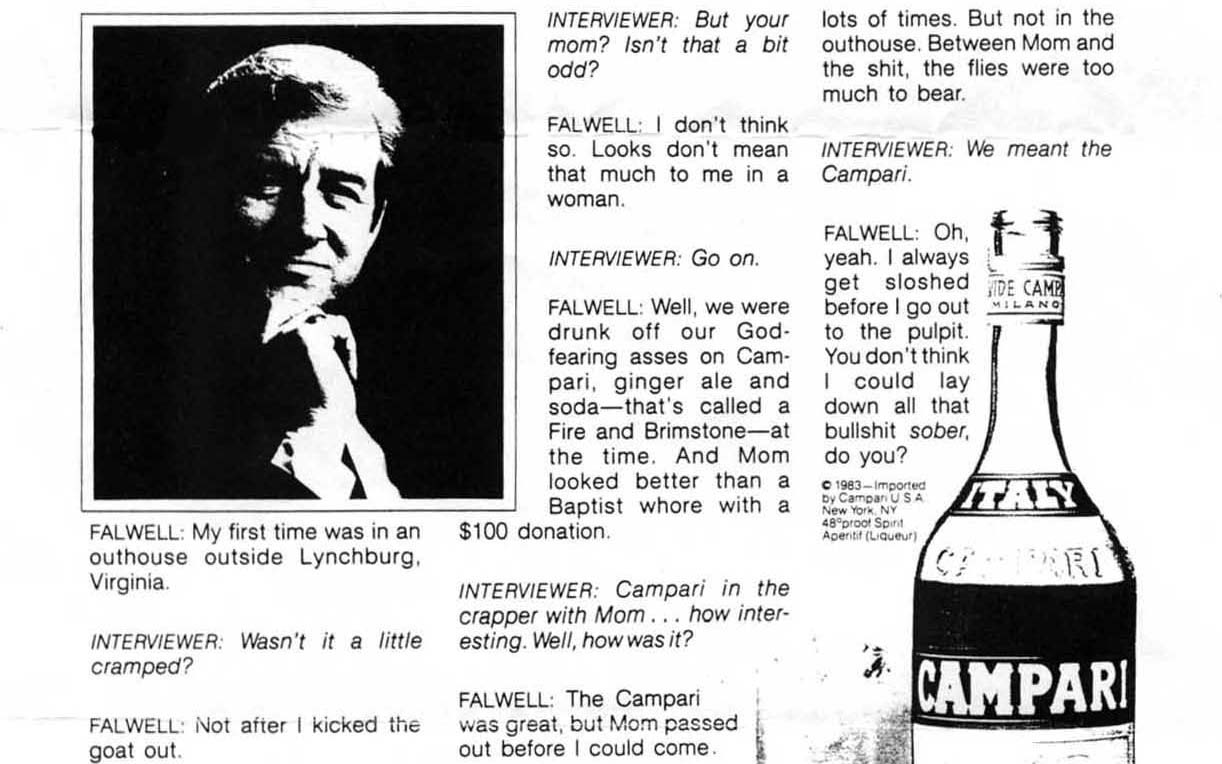
For example, Hustler magazine is incredibly tasteless, vile, and sexist. It ran an ad depicting Jerry Falwell confessing to incest with his mother, it mocks female politicians by depicting them in sexual situations, one magazine cover featured a woman in a meat grinder, and apparently it had some kind of spread depicting a pornographic version of a concentration camp. Even if you don't have a moral objection to pornography, Hustler is garbage.
However, so long as Hustler's right to free speech, however vile, is protected, more prosaic incidents of artistic nudity (and I mean legitimate art) are in significantly less danger from Moral Guardians on the right (artistic nudity is sinful and immodest, and according to the Calvinists undermines the gospel) or on the left (artistic nudity is exploitation of women). And if history is anything to go by, these groups will impose censorship if they could. This applies to both social conservatives and social liberals.
The same goes for "hate speech." As long as the speech of definitely hateful people like the Ku Klux Klan, neo-Nazis, etc. is protected, you won't have the kind of censorship of far more innocent things that "hate speech" laws in France, India, Poland, Britain, etc. have led to.
To quote A Man for All Seasons, I'd give the Devil the benefit of the law for my own safety's sake.
So I will be seeing The Interview as a matter of principle. If the movie sucks, so be it. If I'm giving money to a company that's too inept to protect its employees and customers, so be it. This is about taking a stand against appeasement and threats of violence, in defense of artistic freedom against crude coercion.
To make a long story short, Zaid said that this wasn't a free-speech issue, but Sony covering up for the incompetence of its IT department (Sony has been hacked before, on top of this recent bit of idiocy) by using the hack as part of a publicity campaign for The Interview, a movie that it feared would not do well. He did not see why he ought to give money to a company that repeatedly puts its customers at risk by failing to secure its electronics. To make a long story short, he said that Sony has been playing everybody rushing to its defense in the name of "free speech."
To be fair, he's raised some good points. If he doesn't want to see The Interview because that would be rewarding incompetence, so be it. And I could easily imagine any executive with any degree of intelligence following the dictum of never letting a good crisis go to waste. No less an authority than Forbes magazine agrees.
However, I disagree that it's not a free-speech issue:
*Most of the major American movie chains refused to screen the movie out of fear of extralegal violence, be it a threat of 9/11-esque violence (which might inspired some homegrown moron to attack a theater--I doubt there are North Korean commandos running around) or the more probable danger of hacking. The Sony hack crippled its electronic infrastructure--hacking isn't just a matter of embarrassment (racist Sony e-mails, nude pictures) but a real threat to one's business.
*For a time it seemed like Sony was going to bury the movie completely--they initially said there were "no plans" to release it on Video On Demand or DVD. Had that happened, the North Koreans would have straight-up silenced a critic well outside of their territory. It'd be like agents of the Nazi regime coming into the U.S. and waging a terror campaign to get United Artists to shelve The Great Dictator.
*An adaptation of the graphic novel Pyongyang: A Journey in North Korea
that might feature Steve Carrell had the plug pulled on it in the middle of development.*When a Texas theater chain decided to air Team America World Police
in place of The Interview to show it would not be intimidated by North Korean threats, Paramount Pictures prevented them from screening the movie.*The Associated Press theorized that the attack on Sony would deter Hollywood from making films featuring overseas villains.
These electronic attacks and threats of physical violence have unleashed a massive "chilling effect." People are being intimidated from speaking their minds, producing art, etc. by either a foreign regime, a private entity (a hacker gang trying to sound scarier than it really is), or a combination of the two (a hacker gang working for North Korea). Chuck Wendig explains it very well.
Zaid repeatedly referred to The Interview as a crappy movie. That's purely a subjective matter--I've loved movies like Skyline
that had horrible RottenTomatoes ratings and disliked movies like Get Him to the Greek that had much better ratings. RT currently gives The Interview a 48% and a kind of middling critical consensus. I could easily imagine the movie being crap--I didn't really enjoy Wedding Crashers and I disliked Get Him To The Greek so much I turned off the movie 15 minutes in and returned it.However, just because a movie is crap doesn't mean it isn't worth defending. I read parts of The Satanic Verses
and didn't really understand or enjoy it, but that doesn't mean Salman Rushdie should have been left to the tender mercies of the Ayatollah Khomeini and goons inspired by him.Furthermore, free speech is something that should be extended as broadly as possible to the most unpopular people to make sure everybody is protected.
For example, Hustler magazine is incredibly tasteless, vile, and sexist. It ran an ad depicting Jerry Falwell confessing to incest with his mother, it mocks female politicians by depicting them in sexual situations, one magazine cover featured a woman in a meat grinder, and apparently it had some kind of spread depicting a pornographic version of a concentration camp. Even if you don't have a moral objection to pornography, Hustler is garbage.
However, so long as Hustler's right to free speech, however vile, is protected, more prosaic incidents of artistic nudity (and I mean legitimate art) are in significantly less danger from Moral Guardians on the right (artistic nudity is sinful and immodest, and according to the Calvinists undermines the gospel) or on the left (artistic nudity is exploitation of women). And if history is anything to go by, these groups will impose censorship if they could. This applies to both social conservatives and social liberals.
The same goes for "hate speech." As long as the speech of definitely hateful people like the Ku Klux Klan, neo-Nazis, etc. is protected, you won't have the kind of censorship of far more innocent things that "hate speech" laws in France, India, Poland, Britain, etc. have led to.
To quote A Man for All Seasons,
I'd give the Devil the benefit of the law for my own safety's sake.So I will be seeing The Interview as a matter of principle. If the movie sucks, so be it. If I'm giving money to a company that's too inept to protect its employees and customers, so be it. This is about taking a stand against appeasement and threats of violence, in defense of artistic freedom against crude coercion.
Monday, July 14, 2014
More Thoughts on "The Strain" (SPOILERS)
Now that I've had some time to think (and sleep), here are some more ponderings about last night's premiere of The Strain.
I've only read the first 100 pages or so from the book version, but the part that was the most gripping is the story Abraham Sertrakian's elderly grandmother tells him about a giant who came to Romania. The giant--a young Polish nobleman named Josef Sardu, who suffered from gigantism--is hunting wolf with his father, who has the notion that eating this will cure his son of his sickness. The animals they seek have been displaced from their lairs by something, a something that hunts and kills the other members of the party. Josef, the sole survivor, buries them and goes into the cave to confront what he thinks is something unnatural watching him.
(You can see this part of the story in comic-book form here.)
The premiere episode of the television adaptation is great as it is, but it would have been nice to have that as a prologue just like in the book. Sardu's story could be shown in flashback form much like the comics--both the boy's flashback to his grandmother telling the story and his grandmother's flashback to the events of her childhood and what she imagined preceded them. Then the prologue could end just like the book--Sertrakian and his family are living in territory under Nazi control and have to flee those who would exterminate them just like his grandmother had to flee the monstrosity the once-kindly Josef Sardu became. It would tie in Sertrakian's back-story with the hints we've received thus far about Eichhorst as well.
However, now that I've had some time to think about it, it would be an either-or choice between that prologue and the prologue aboard the aircraft involving the flight attendants. In that respect, the flight attendant scene works better because it introduces Gabriel Bolivar and the little French girl--who will introduce the "dear ones" aspect of the story--and provides the first appearance of the villainous Master in his modern form. One major task of a writer is to "kill your darlings" and I'm sure that story can be told later--perhaps as a nightmare Sertrakian has, or a story he's telling to someone else.
I've only read the first 100 pages or so from the book version,
but the part that was the most gripping is the story Abraham Sertrakian's elderly grandmother tells him about a giant who came to Romania. The giant--a young Polish nobleman named Josef Sardu, who suffered from gigantism--is hunting wolf with his father, who has the notion that eating this will cure his son of his sickness. The animals they seek have been displaced from their lairs by something, a something that hunts and kills the other members of the party. Josef, the sole survivor, buries them and goes into the cave to confront what he thinks is something unnatural watching him.(You can see this part of the story in comic-book form here.)
The premiere episode of the television adaptation is great as it is, but it would have been nice to have that as a prologue just like in the book. Sardu's story could be shown in flashback form much like the comics--both the boy's flashback to his grandmother telling the story and his grandmother's flashback to the events of her childhood and what she imagined preceded them. Then the prologue could end just like the book--Sertrakian and his family are living in territory under Nazi control and have to flee those who would exterminate them just like his grandmother had to flee the monstrosity the once-kindly Josef Sardu became. It would tie in Sertrakian's back-story with the hints we've received thus far about Eichhorst as well.
However, now that I've had some time to think about it, it would be an either-or choice between that prologue and the prologue aboard the aircraft involving the flight attendants. In that respect, the flight attendant scene works better because it introduces Gabriel Bolivar and the little French girl--who will introduce the "dear ones" aspect of the story--and provides the first appearance of the villainous Master in his modern form. One major task of a writer is to "kill your darlings" and I'm sure that story can be told later--perhaps as a nightmare Sertrakian has, or a story he's telling to someone else.
Subscribe to:
Posts (Atom)