This io9 article written by a psychologist goes into a lot of detail about the symptoms and signs of psychopathy. Among others, psychopaths are not capable of normal emotions. They're also quite shallow emotionally. This article states they might intellectually understand the concept of sadness, but they won't feel it. The article states that Sherlock, for all his claims to be a sociopath, is not a cold, calculating machine focused only on his own gratification. Specifically, he is capable of emotional attachments, something psychopaths simply are not. This TVTropes page discusses how most fictional villains aren't actually sociopaths because real sociopaths are real-life "flat characters."
Here are some villains, both real-life and fictional, that from what I know of them don't appear to be sociopathic and are all the more complex characters for it.
Loki-The villain Loki from the Marvel Cinematic Universe has been referred to as a sociopath and in terms of bad behavior, he's done a lot--the attempted genocide of the Frost Giants, the attack on New York City that killed many thousands of people, etc. However, he has entirely too many emotional attachments. The driving force of his antics in the first movie
 is trying to please and/or show himself worthy of his adoptive father Odin. He sabotages Thor's coronation not (necessarily) because he wants the throne for himself but because he thinks Thor would be a poor king (and at this point in Thor's personal development, he'd be right). In the second film, when Odin calls him onto the carpet for his attack on Earth, he says he wanted to rule humans as a benevolent god--like Odin himself rules Asgard. The second film also shows how attached Loki is to his mother Frigga, including his total meltdown when he learns she was killed by the Dark Elves. He also throws Jane Foster out of the way when one of the Dark Elves throws a vortex grenade at her, even though she'd slapped him earlier. This shows he cares enough for Thor to save his love interest even if he doesn't care for the squishy mortal Jane (and he might--note the "I like her" comment after she slaps him). He's also too emotionally "deep" to be a sociopath--go to the TVTropes page for the first film, his character page, and the page for the second film and you'll see all sorts of explorations of his character.
Most importantly, Loki is supposed to be a tragic figure. If he was never "good" to start with, he can't fall into evil and make the audience sad.
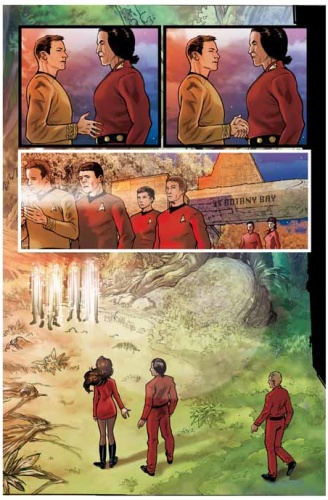
Khan Noonien Singh-The greatest Original Series villain of them all, he was a dictator on Earth who fled into space and upon being defrosted in "Space Seed," nearly took over the Enterprise and was only undone by the treachery of the Starfleet officer he'd seduced. In Star Trek II: The Wrath of Khan
 he successfully took control of a Federation ship and seriously damaged the Enterprise, killing Scotty's nephew (the relationship is made clear in a deleted scene that's included in some DVD releases) and eventually no less than Mr. Spock. A pretty bad dude? Yes. However, when Kirk exiles him he was a remarkably good sport about it rather than lashing out as some kind of psychotic man-child. He accepts the presence of Lt. McGivers among them despite her ruining his plan (and according to some sources killed other Augments to make sure she was respected) and it was her death that drove him to such vengeance against Kirk. Many of the Enterprise crew admired him as "the best of tyrants" even though they knew they had to beat him. The Wikipedia article lists a bunch of positive traits uncharacteristic of a psychopath (I'm thinking primarily the "not threatened by the success of others" and encouraging other people), with the exception of the whole "lack of regard for the rights of others" part. Obviously that's not good, but that makes him a villain, not (necessarily) a psychopath. The Wikipedia article also describes him as possessing many of the same traits as Kirk, but in much larger helpings. A "Dark Kirk" is a lot more interesting than some emotionally-shallow monstrosity any day.
Adolf Hitler-We all know just how monstrous Hitler was--not only did he start WWII (in Europe) and kill six million Jews and six million others in the Holocaust, but his intention was to turn the Slavic peoples into helots for the German Spartans at a planned cost, according to my high school history textbook, of fifty million Slavic lives. Heck, just look at Generalplan Ost, something so hellacious that many people defend Stalin's industrialization-through-forced-labor-and-famine as the most viable alternative. However, this wicked man still had some very human traits. This article here corroborates Hitler's devotion to his mother (and how normal he was as a teen--he doesn't display obvious-in-hindsight warning signs like Eric Harris here), something that extended to some degree of protection for his mother's Jewish doctor later. His mistress Eva Braun's two suicide attempts seem to be motivated by a desire to get Hitler's attention--if he weren't capable of emotional attachments, that wouldn't have worked (as it did the first time). Seriously, from a purely pragmatic perspective why bother with someone that unstable? For all his many sins he must've had some legitimate feeling for her.
Darth Vader-On the issue of emotional attachments alone, Vader cannot be a psychopath or sociopath. He was quite attached to his mother and his first major crime -- the massacre of the Sand People tribe in Episode II
 -- was in reaction to her death. One could imagine a sociopath punishing someone for harming HIS kin, but his guilty feelings in which he confesses his sins to Padme look genuine rather than some kind of act to get her sympathy. A legitimate psychopath (at least a smart one) would keep it secret or, if he figured he'd be exposed, be "honest" but downplay it. In the third film, his devotion to Padme was what Palpatine (who credibly can be described as a psychopath) played on to corrupt him. If we're going to be playing armchair shrink, some psychologists have suggested he had borderline personality disorder. However, this article has been written in rebuttal. And he feels quite a bit of guilt over Padme's death--see this image here from this comic. Psychopaths can't feel guilt, period. And before his fall into evil, he was notably loyal to his friends.
Josef Stalin-Stalin, the dictator of the Soviet Union, presided over the mass starvation of Ukraine to export grain to fund industrial projects, his control-freak attitudes toward foreign Communists contributed to the rise of Hitler, and his paranoia-fueled purges crippled Soviet espionage efforts in the United States and the Soviet military on the eve of Barbarossa. Even though the opening of the Soviet archives reduced the number of his victims, his body count ranges from three million to 20 million. However, for all his wickedness, his mother recounted that he was a sensitive child. He was totally wrecked by his first wife's death, to the point his friends feared he would commit suicide, and however odious he was to his sons he was kind to his daughter. He also semi-adopted the son of a deceased friend. He also seems to have been at least a decent poet. An exceedingly wicked man, yes, but hardly a shallow one or one incapable of emotional attachments. This article here (which is about a book) attributes Stalin's horrors to his zealous adherence to Marxism-Leninism--basically he became evil because of the politics he adopted.
Genghis Khan-Genghis Khan founded the Mongol Empire, a realm that despite uniting most of Eurasia in a zone of free trade and travel required a ludicrous degree of brutality. The Mongols killed so many people it may have affected the Earth's climate. However, as a young man his wife Borte was kidnapped by rivals, raped, and soon after her rescue gave birth to a son of questionable paternity. Many men in the pre-modern era would have committed infanticide at this point and possibly even killed the mother as well. To his credit, Temujin did neither. Furthermore, when the paternity issue came up when it came time to decide his succession, Temujin seems to love all of his sons, is upset when they're fighting, and points out how hurtful their behavior would be to Borte. Despite the atrocities inflicted both personally and on his orders, this is a man capable of forming emotional attachments, so he can't be a psychopath.
Eric von Shrakenberg-Here we're getting a bit obscure, but he's one of the major characters of S.M. Stirling's Draka series. The books follow him from his youth in the Domination's military during WWII in which he's under a cloud for helping his illegitimate daughter with a serf concubine (one he was very attached to, to a degree his landholding family found quite unhealthy) escape to the United States all the way to his becoming the Archon of the Domination. Along the way he seeks to reform the Draka slave system and consents to more extreme proposals for super-weapons, secret wars in space, etc. only to horse-trade for his reforms and for defensive purposes. Although he's the one who pulls the trigger on a nuclear war that kills 1/3 of the human race, his hand is forced by the rash actions of his niece and he orders it only because he knows if he refuses, he'll be killed and someone else will do it. He even remarks that all his life he's sought to free his people from "a way of life based on death" but in order to do this, he'll have to inflict more killing than any human who ever lived. Afterward, with the Domination victorious, he allows the Alliance for Democracy's starship to escape the solar system and grants (limited) Citizenship to the Alliance survivors in space as well as telling his niece he's going to be handing out Citizenship liberally, "as many as I can swing."
Although by any objective standard he's the worst murderer in human history, he's a very sympathetic, thoughtful character, not a heartless monster. That's what makes him all the more tragic--the man who would abolish the slave system (or at least reform it drastically) if he could is forced by circumstances and his own sense of duty to commit genocide on a scale undreamed of in order to extend this system over the overwhelming majority of humankind.
Bernie Madoff-Madoff is routinely considered a corporate psychopath (think the book Snakes in Suits)
 and given how unbelievably destructive his crimes were, it's easy to see how this account is credible. However, something that clashes with that portrayal was his taking all of the blame for the Ponzi scheme on himself. Psychopaths routinely blame others for their problems and refuse to take responsibility. He was pretty obviously trying to shield his family and associates from the blame--not surprising considering how other people were part of the plan--but the fact he was willing to protect others rather than sell them out to save himself is fairly telling. He was greedy, selfish, dishonest, and generally slimy--but his taking responsibility for his actions undermines the idea that he is a psychopath.
Magneto-This gets tricky due to all the retcons and the abominably out-of-character moment in the the second X-Men film
 when he decides to kill all ordinary humans. However, in the comics, between his escape from the concentration camp and his daughter being killed by an angry mob frightened by his mutant powers (something I remember very vividly in a flashback scene in a comic I read a child), he lived a fairly normal, loving family life. No abuse, no affairs, no secret serial killing while maintaining an upstanding facade, none of that. This biography here describes how his creators never intended for him to be a "bad guy" per se and he's described as "charismatic, noble, and wise." When he thinks he nearly killed the young Kitty Pryde, it horrifies him so much he renounces his terrorist ways for a time and later even becomes a teacher at Xavier's school, returning to villainy only after a series of murders of mutants. There's a line I remember from one of the comics in which Xavier points out Magneto refraining from some particularly large act of villainy and says that Magneto knew that going through with this would make him a Hitler, something a Holocaust survivor would not want to be.
This is not to say that there aren't psychopathic villains, both fictional or historical. However much I object to using "psychopath" as some kind of post-Christian attempt to pathologize moral failings or even political disagreements, I'm not such a fool to ignore the obvious physical evidence for it. Prominent Nazi Reinhard Heydrich seemed like a totally amoral killing machine, with the only "complicated" aspect to him being his self-loathing over possible Jewish ancestry. Palpatine and Columbine mastermind Eric Harris I've already mentioned. The sadistic degenerate Ariel Castro seems to fit as well.
However, if I were writing a villain, I wouldn't use them for models and neither should you. The ones I listed above are much better examples. They're deeper, more complicated character rather than two-dimensional monsters. And if you can write them well enough that at least some readers will take their side over the protagonist, Internet fan controversies raise awareness and thus sell more books. :)
 last night. The movie absolutely rocked. Here's my review telling you why:
 last night, in 3D no less. Here's my review...